
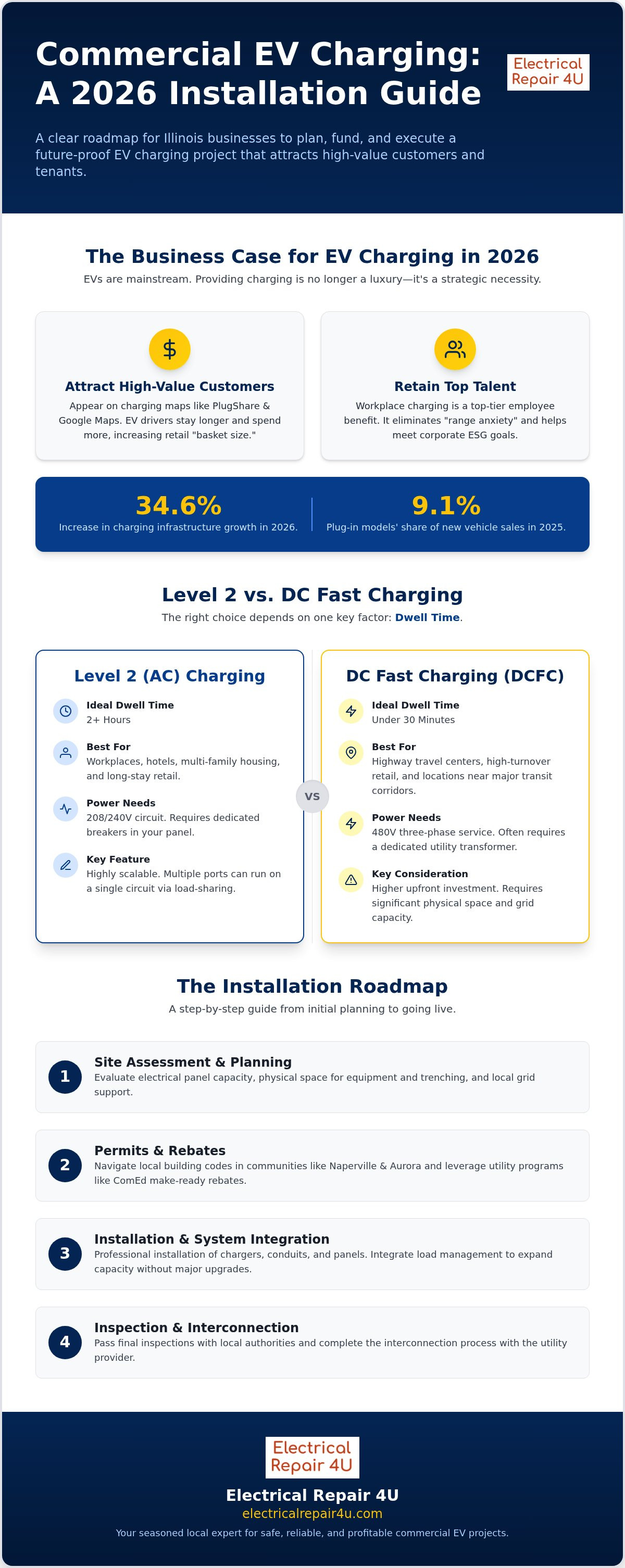
For the first time since the electric revolution began, the growth of charging infrastructure has finally kept pace with vehicle sales, marking a 34.6% increase in 2026. This shift means your customers and tenants no longer just hope for a place to plug in; they expect it. We know that planning a commercial EV charging station installation feels like a complex, high-stakes project. You might worry about high upfront costs, confusing building codes, or the risk of overloading your building's electrical system.
You want to future-proof your Illinois business without compromising safety or your budget. This guide provides a clear roadmap to help you plan, fund, and execute a project that attracts high-value visitors. We'll explore the critical differences between Level 2 and DC Fast Charging, how to navigate local permits in Naperville and Warrenville, and how to leverage ComEd make-ready rebates. You'll learn how to use modern load management to expand your capacity while maintaining the rock-solid reliability your property depends on.
Key Takeaways
- Discover how workplace and retail charging solutions attract high-value tenants and boost employee retention in 2026.
- Identify whether Level 2 or DC Fast Charging fits your property's specific needs, from multi-family housing to high-turnover retail sites.
- Learn how to navigate a commercial EV charging station installation by accounting for hidden variables like trenching and electrical panel capacity.
- Master the roadmap for securing local permits and passing inspections in Illinois communities like Aurora, Elgin, and Bolingbrook.
- Understand the security of hiring a seasoned local expert to prevent electrical system failures and ensure long-term equipment reliability.
The Business Case for Commercial EV Charging Station Installation in 2026
By 2026, electric vehicles have moved from the early-adopter phase into the mainstream. In 2025 alone, plug-in models accounted for 9.1% of all new passenger vehicle sales in the U.S., proving that the demand for reliable power is surging. Providing access to electric vehicle supply equipment (EVSE) is no longer a luxury; it's a strategic necessity for any property owner. A professional commercial EV charging station installation does more than just fill a battery. It signals to your community that your business is forward-thinking and ready for the future of transportation.
Attracting the Modern EV-Driving Consumer
Charging stations act as powerful digital magnets for your property. When drivers search for their next stop on apps like PlugShare or Google Maps, your business appears as a verified destination. This visibility is especially crucial in high-traffic areas like the Naperville and Oak Brook commercial corridors. Data shows a strong correlation between charging availability and increased retail "basket size." Customers tend to stay longer and spend more while their vehicle recovers range. By offering a reliable place to power up, you turn a quick stop into a loyal relationship.
Workplace Charging: A Modern Employee Benefit
Providing workplace charging has become a top-tier benefit for attracting and retaining talent. For most commuters, Level 2 charging is the gold standard because it aligns perfectly with an eight-hour office shift. It effectively eliminates "range anxiety" for employees who can't charge at home. Beyond the practical benefits, these installations help your company meet corporate ESG goals and demonstrate a commitment to sustainability. We recommend implementing clear fair-use policies, such as time limits or small fees, to ensure every team member has access when they need it.
Investing in this infrastructure protects your property's long-term value. Illinois is moving toward stricter building mandates, and getting ahead of these requirements now prevents costly retrofits later. Beyond compliance, you create a new stream of ancillary revenue. Whether you choose to offer paid charging sessions or simply benefit from the increased dwell time at your storefront, the return on investment is clear. Planning your commercial EV charging station installation now ensures you stay ahead of competitors. Our team has spent 40 years helping local businesses navigate technical shifts. We're here to ensure your transition to electric is safe, efficient, and profitable.
Level 2 vs. DC Fast Charging: Choosing the Right Infrastructure
Selecting the right equipment for your commercial EV charging station installation depends on one primary factor: dwell time. This refers to how long a typical customer or employee stays parked at your property. If you rush into buying the fastest charger available without analyzing your site's electrical capacity, you might end up with a system that's over-powered for your needs and over-budget for your bottom line. We've seen many Naperville businesses find the perfect balance by matching charger speed to their specific service model.
Level 2 Charging for Long-Dwell Locations
Level 2 (AC) charging is the most versatile solution for offices, hotels, and multi-family housing. These units operate on 208/240V circuits and require dedicated breakers in your electrical panel. For most Warrenville small businesses, we recommend Level 2 because it provides a steady, reliable charge for drivers staying two or more hours. It's also highly scalable. By using load-sharing technology, you can often install multiple charging ports on a single circuit. This allows your infrastructure to grow without immediately triggering a massive electrical service upgrade. If you're unsure about your current capacity, a professional breaker box maintenance assessment can clarify what your building can handle today.
DC Fast Charging for High-Turnover Sites
DC Fast Charging (DCFC), often called Level 3, is essential for highway travel centers and high-turnover retail locations where customers stop for 30 minutes or less. The power demands are significant, typically requiring 480V three-phase service and often a dedicated utility transformer. Before moving forward with DCFC, you must evaluate if your parking lot has the physical space for heavy-duty cabinets and if your local grid can support the draw. While the investment is higher, it's often justified for businesses located near major Illinois transit corridors where speed is the primary driver of customer traffic.
Future-proofing is the smartest way to protect your investment. Even if you start with a modest setup, we suggest installing 11kW-capable wiring during the initial phase. Tapping into the Public EV Charging Infrastructure Playbook can help you align your site plan with federal and state standards. Running higher-gauge wire and larger conduit now prevents you from having to dig up your parking lot again when you need to add more stations in three years. It's about doing the job right the first time so your business stays powered for the long haul.
Navigating Installation Variables and ROI for Illinois Businesses
Success in 2026 depends on looking beyond the charging unit itself. While hardware is a visible part of the project, the real budget drivers for a commercial EV charging station installation are often hidden underground or inside your electrical room. Many national providers focus on the "hosting" model, where they own the chargers and take the revenue. We believe in the "ownership" model. When you own the infrastructure, you control the pricing and keep the profits, but you must plan carefully for the make-ready costs that precede the first plug-in.
Hidden Factors in Installation Costs
Your current electrical capacity is the foundation of your project. Before adding heavy EV loads, a comprehensive review of your breaker box maintenance needs is essential. An outdated panel or a lack of open breaker space can lead to system failures if not addressed early. The physical distance between your breaker box and the parking stalls also dictates a large portion of the labor. Trenching through existing asphalt is significantly more intensive than running conduit through a green space or along a wall.
Compliance adds another layer of complexity. Illinois building codes and the Americans with Disabilities Act (ADA) require specific stall widths and accessible paths of travel to the chargers. Utilizing professional commercial electrical services ensures that your site plan meets these legal requirements from day one. This proactive approach prevents costly code violations and ensures your facility is safe for every visitor.
Incentives and the 2026 Regulatory Landscape
The financial landscape for EV infrastructure changed mid-year. The federal 30C tax credit expired for properties placed in service on or after July 1, 2026. This shift makes local and utility-level support more critical than ever. Fortunately, businesses in the ComEd service territory have access to robust make-ready rebates. For Level 2 installations, you may qualify for up to $5,333 per port. In designated low-income or environmental justice communities, that rebate can increase to $8,000 per port.
DC Fast Charging projects also see significant support, with rebates reaching up to $667 per kW. These programs are designed to offset the costs of electrical upgrades and trenching, which are the most expensive parts of the job. By documenting your installation correctly and working with a local expert who understands these filings, you can maximize your ROI through a combination of direct charging fees, carbon offsets, and significantly reduced upfront expenses.
The Installation Roadmap: From Site Assessment to Interconnection
Transforming your property for the electric age requires a disciplined, step-by-step approach. It's not just about bolting a box to a wall. It's about ensuring your infrastructure can handle the new demand without a single flicker of trouble. We've spent 40 years mastering the local electrical landscape, so we know that a successful commercial EV charging station installation depends on getting the technical details right before the first shovel hits the dirt. This roadmap ensures your project moves from a concept to a fully operational asset without unnecessary delays or safety risks.
Site Assessment and Electrical Load Calculations
Every project begins with a rigorous load calculation to protect your building's electrical integrity. We examine your current peak demand to determine if your service can support an additional 40A to 80A per charging port. If your building is older or your current capacity is near its limit, you might require a 200 amp panel upgrade or a larger commercial service entrance. During this phase, we also identify the most cost-effective path for electrical conduits. By finding creative ways to route power, we often minimize expensive asphalt cutting and trenching, keeping your costs manageable and your site clean.
Permitting and Local Code Compliance
Navigating the red tape in municipalities like Aurora, Elgin, or Bolingbrook is often the most complex part of the journey. Each city has unique electrical permit requirements and inspection timelines that must be managed. We take the lead on ensuring your site meets all National Electrical Code (NEC) standards for outdoor installations. This includes critical ground-fault protection and specific disconnect locations for emergency safety. We also look at the bigger picture. We make sure your security lighting installation provides enough visibility for nighttime users. This creates a safe, welcoming environment that protects both your customers and your investment around the clock.
Once the paperwork is settled, the physical installation moves quickly. This phase involves trenching, mounting the charging pedestals, and making the final high-voltage terminations. We coordinate directly with local utilities if your project requires a new meter or a transformer upgrade to handle the load. The final step is commissioning. We test the hardware and software integration to ensure your payment systems and load management tools work exactly as intended. This thorough testing phase eliminates the anxiety of technical failures and ensures a smooth experience for your drivers. Ready to start your site assessment? Contact our team of licensed professionals to ensure your commercial EV charging station installation is code-compliant and built to last.
Why Local Expertise Matters for Your Commercial EV Project
Choosing the right partner for your commercial EV charging station installation is just as important as selecting the hardware itself. While some national networks promise a one-size-fits-all solution, they often lack the boots-on-the-ground knowledge required to navigate the specific grid quirks of DuPage and Kane Counties. High-capacity charging puts a unique strain on your building's infrastructure. Treating it like a standard appliance installation is a recipe for technical failure. You need a team that understands the high stakes of commercial power and treats your property like a part of their own community.
Safety and Long-Term Reliability
Thermal issues and frequent breaker trips are common symptoms of an undersized or poorly executed installation. When multiple vehicles draw maximum current simultaneously, even small errors in wire sizing or termination can lead to significant equipment damage. By hiring a licensed and insured team, you protect your business from the liability risks associated with electrical fires or system-wide outages. Utilizing UL-listed equipment is a non-negotiable standard for commercial settings in 2026 to ensure that every component has been rigorously tested for high-voltage safety and fire prevention. We don't just finish the job and leave; we integrate your new stations into a broader preventative electrical maintenance plan to ensure your investment stays operational for decades.
Partnering with Electrical Repair 4U
Our approach is built on a foundation of neighborly reliability and 40 years of local history. We aren't a faceless corporation; we're the veterans who have kept Warrenville and Naperville businesses running since the 1980s. This long-standing tenure means we know exactly how to coordinate with local inspectors and utility providers to move your project forward without hitches. We understand that your business needs to stay open during construction, so we plan our work to minimize disruption to your staff and customers.
If a charging port goes down, a national network might take weeks to dispatch a technician from across the state. Because we're based right here in the community, we provide the rapid response you need to keep your tenants and shoppers happy. We take pride in our craft and stand behind every connection we make. Security comes from knowing that your infrastructure was built by experts who value safety and honesty above all else. Schedule a commercial site assessment with our master electricians today.
Powering Your Business for the Road Ahead
By 2026, providing a place to plug in has become a cornerstone of modern property management. You now understand that a successful commercial EV charging station installation is about more than just hardware. It's about matching charger speeds to your visitors' dwell times and securing the right utility rebates to protect your bottom line. Whether you're installing Level 2 ports for employees or high-speed DC units for retail shoppers, the right infrastructure future-proofs your Illinois business against evolving mandates and shifting consumer expectations.
You don't have to navigate these complex electrical upgrades alone. Our team of licensed and insured master electricians brings over 40 years of local service to every project. We've spent decades supporting the Warrenville, Naperville, and Greater Chicago area, ensuring that every connection is safe, code-compliant, and built for longevity. We're ready to help you remove the anxiety of technical failure and replace it with the confidence of a job done right. Get a Professional Quote for Your Commercial EV Installation today and let's build a more sustainable future together.
Frequently Asked Questions
How much power does a commercial EV charging station require?
A standard Level 2 commercial EV charging station installation typically requires a 208/240V circuit with 40 to 80 amps of dedicated capacity per port. DC Fast Chargers are much more demanding, requiring 480V three-phase service. We often use load management strategies under NEC 625.42 to help Aurora businesses add ports without needing massive infrastructure overhauls. This ensures your building stays within safe electrical limits while meeting driver demands.
Can I charge customers for using my EV charging stations?
Yes, you can absolutely generate revenue by charging customers for their sessions. Networked chargers allow you to set pricing based on energy consumed, time spent at the stall, or a flat fee. Many Naperville retail centers use this to offset their utility costs or even turn the station into a profit center. We'll help you select the right software to manage these payments securely and transparently for your visitors.
How long does the installation process typically take for a business?
The timeline for a commercial EV charging station installation usually spans several weeks from the initial assessment to the final commissioning. While the physical mounting and wiring might only take a few days, securing local permits in municipalities like Bolingbrook or Elgin and coordinating with ComEd for service upgrades can add time. We manage the scheduling tightly to minimize disruption to your daily business operations.
What is the difference between networked and non-networked chargers?
Networked chargers are connected to the internet, allowing you to monitor usage, collect payments, and manage electrical loads remotely. Non-networked chargers are simpler "plug and play" devices without data tracking or billing capabilities. For most commercial sites in Oak Brook, we recommend networked units. They provide the analytics you need to prove ROI and ensure that your charging infrastructure is being used efficiently by authorized users.
Do I need to upgrade my electrical panel for a Level 2 charger?
It depends on your current peak demand and the age of your infrastructure. Many older buildings in Warrenville require a panel upgrade to safely handle the continuous high-amperage draw of an EV charger. As specialists in breaker box maintenance, we'll perform a detailed load calculation first. If your panel is at capacity, we'll guide you through the upgrade process to ensure your entire system remains stable and code-compliant.
Are there Illinois state grants available for EV charging in 2026?
While the federal 30C tax credit expired for properties placed in service after July 1, 2026, significant local support remains. ComEd offers robust make-ready rebates that can cover a large portion of your infrastructure costs. These rebates often range from $5,333 to $8,000 per port for Level 2 stations, depending on your location's equity status. We stay current on these Illinois programs to help you maximize every available incentive.
What maintenance is required for commercial EVSE?
Commercial EVSE requires periodic physical inspections and software updates to maintain peak performance. You should regularly check cables for wear, ensure connectors are clean, and verify that the cooling fans in high-power units are functioning. We recommend including your chargers in a preventative electrical maintenance plan. This proactive approach prevents unexpected downtime and ensures that your customers always find a reliable, safe place to power up when they arrive.
Is my parking lot suitable for a DC Fast Charger?
Suitability for a DC Fast Charger depends on your proximity to a utility transformer and the availability of 480V three-phase power. These units are best for high-turnover locations near major transit corridors. If your parking lot requires extensive trenching or lacks the necessary space for heavy-duty electrical cabinets, we might suggest a high-output Level 2 array instead. A professional site assessment will clarify the most cost-effective path for your property.


