
Did you know that 78% of fire safety non-compliance fines in North America this year were tied directly to insufficient emergency lighting brightness? It's a staggering number that highlights how easily critical safety systems can slip through the cracks. When the power fails, your occupants rely on those glowing signs and path lights to lead them to safety. If your system falters, the anxiety of potential fines is nothing compared to the worry over actual occupant safety. That's why prioritizing emergency lighting repair isn't just a legal chore; it's a vital part of being a responsible, reliable property owner in our community.
We understand that navigating the complex web of NFPA 101 and OSHA regulations can feel overwhelming. You want your building to be a safe haven, not a source of constant stress during inspection season. This guide will help you master the essentials of emergency lighting repair, from identifying common battery failures to performing the 90-minute discharge tests required in 2026. We will walk through troubleshooting steps and explain when it's time to collaborate with a professional electrical partner. By the end, you will have a clear roadmap to achieving fully functional illumination and passing your next safety inspection with total confidence.
Key Takeaways
- Identify the common warning signs of failing NiCad and Lead-Acid batteries to prevent sudden system failures during a power outage.
- Master the 2026 NFPA 101 standards, including the critical difference between monthly 30-second checks and annual 90-minute discharge tests.
- Learn when to invest in emergency lighting repair and when a modern LED upgrade offers better long-term savings and reliability for your property.
- Use simple diagnostic techniques like the "Push-to-Test" method and breaker panel checks to resolve minor issues before they become major safety liabilities.
- Discover how a seasoned, local electrical partner with over 40 years of experience can simplify your compliance journey and ensure your building stays bright.
Common Causes of Emergency Lighting Failure
When the power drops, your backup systems must activate within 10 seconds. It's a high-stakes moment for any property owner. Emergency lighting systems often sit idle for months, which can lead to a false sense of security. Most issues we encounter during an emergency lighting repair call aren't sudden catastrophes. Instead, they're the result of slow degradation in components that haven't been exercised or maintained properly. Our team has seen how easily a small oversight can turn into a major compliance headache.
Battery Depletion and Charging Circuit Issues
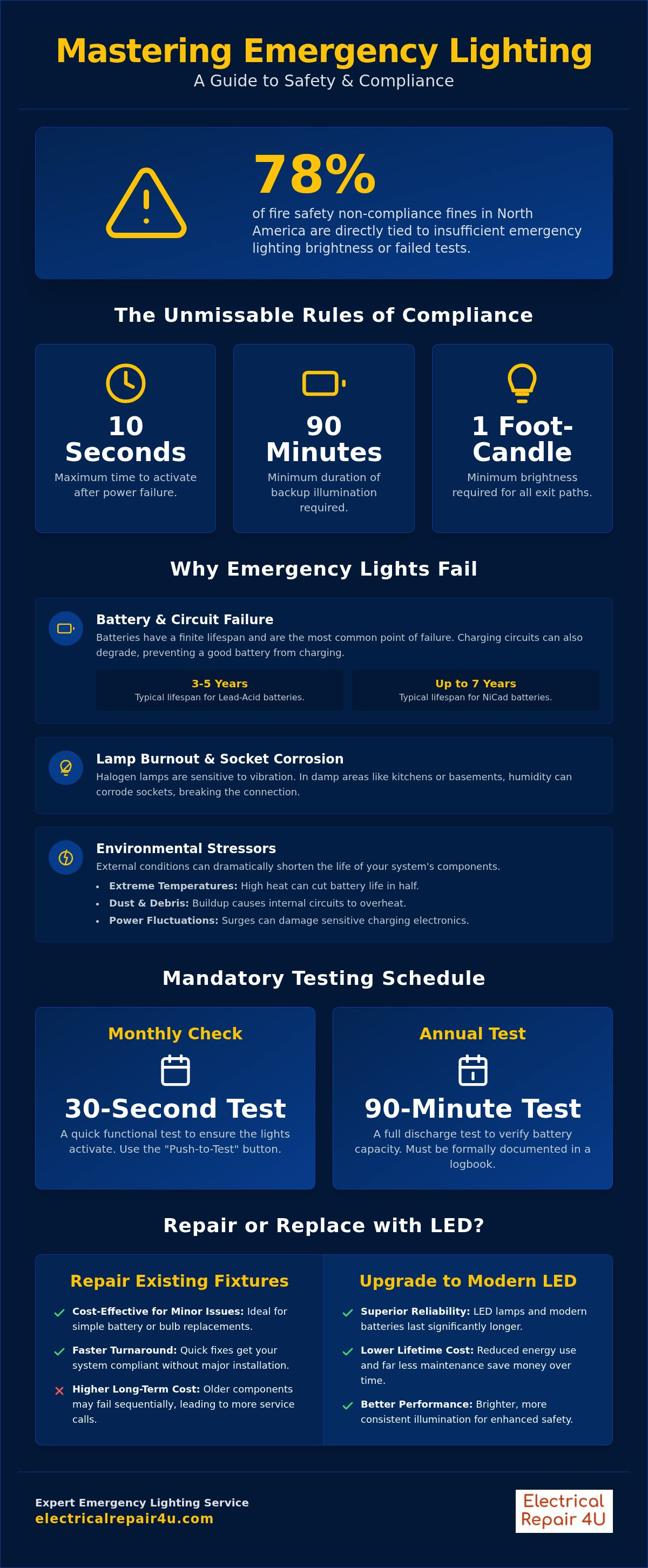
Batteries are the heart of these units, but they have a finite lifespan. Lead-acid batteries typically last three to five years, while NiCad (nickel-cadmium) versions might reach seven. However, older NiCad units often suffer from "memory effect." If they aren't fully discharged occasionally, they "forget" their total capacity and fail early. Even if the power never goes out, the constant trickle charge can eventually cook the battery or wear out the charging circuit board. A faulty board won't just stop charging; it might even drain a perfectly good battery cell, leaving you in the dark when it matters most.
Lamp Burnouts and Socket Corrosion
Not every dark fixture is a battery problem. Traditional halogen lamps are sensitive to the vibrations common in commercial warehouses or industrial plants. These constant micro-shocks can loosen bulbs or snap fragile filaments. In places like commercial kitchens or damp basements, humidity is the enemy. It leads to socket corrosion, which breaks the electrical connection even if the bulb is brand new. Distinguishing between a simple dead bulb and a deeper wiring fault is a critical part of professional emergency lighting repair.
Environmental factors play a huge role in fixture longevity. We've found that the following conditions are the most frequent culprits for system failure:
- Extreme Temperatures: In unconditioned spaces, high heat can cut battery life in half.
- Dust and Debris: Heavy buildup acts as an insulator, causing internal circuits to overheat and fail prematurely.
- Power Fluctuations: Surges or brownouts can spike the sensitive electronics on the main control board, damaging the charging logic.
Identifying these culprits early keeps your building safe and avoids the stress of a failed inspection. We take pride in helping local business owners catch these small problems before they lead to heavy fines or safety risks. Whether it's a simple lamp replacement or a complex circuit fix, staying proactive is the key to long-term reliability.
Understanding Compliance: NFPA 101 and OSHA Standards
Staying compliant isn't just about avoiding an inspector's frown; it's about the security of your staff and the stability of your business. The NFPA 101 Life Safety Code sets a high bar for 2026. Every fixture must activate within 10 seconds of a power failure and provide at least 90 minutes of backup illumination. If your lights flicker out at minute 45, you need immediate emergency lighting repair. This isn't a suggestion; it's a legal mandate that protects your property from high-stakes liability.
The 90-Minute Discharge Test Requirement
This annual test is the ultimate stress test for your backup batteries. You can't just glance at the unit and assume it works. You must physically disconnect the primary power or use the test switch to ensure the unit lasts the full hour and a half. Faking these records is a dangerous gamble. Inspectors in 2026 are increasingly diligent. A recent survey revealed that 78% of fire safety fines in North America stemmed from insufficient brightness or failed discharge tests. Our team helps you document these results in a formal logbook, providing the paper trail you need for insurance and legal peace of mind.
OSHA Workplace Safety Regulations
OSHA is equally strict about your exit paths. According to OSHA Standards, every exit route must be lit to at least 1 foot-candle. This ensures that even in a smoky or dark environment, your team can see the floor clearly. High-hazard industrial zones often require even more robust coverage to prevent accidents during a blackout. Managing these requirements is easier when you integrate them into your broader Professional Commercial Electrical Services. A regular inspection schedule keeps you ahead of the curve and ensures your emergency lighting repair needs are caught before an inspector arrives.
Failing to meet these marks leads to more than just a fine. It can void your insurance coverage or lead to devastating lawsuits if an injury occurs during an outage. We believe in being a collaborative partner for our local neighbors. If you're unsure if your system meets the 2026 codes, connecting with a reliable maintenance partner can remove that anxiety instantly. Proper record-keeping and regular testing are the pillars of a safe, functional workspace.
Repair vs. Replace: Is it Time for an LED Upgrade?
Choosing between a quick fix and a total overhaul is a common crossroad for property managers. When you face an emergency lighting repair, you have to weigh the immediate cost against future reliability. Legacy halogen systems were the standard for years, but their high energy draw and heat output make them increasingly expensive to maintain in 2026. We've seen many businesses struggle with the cycle of replacing expensive bulbs and batteries in units that are simply past their prime.
Switching to LED isn't just about being modern; it's about performance and peace of mind. LEDs use significantly less power, which means your backup batteries can provide longer, more stable runtimes during an outage. In fact, LED technology is expected to hold a 78.6% share of the market this year because it's simply more efficient. Modern "self-testing" units are a game-changer for busy owners. These fixtures perform their own monthly 30-second checks and alert you if a component fails. This ensures you stay aligned with OSHA Standard 1910.37 without the constant manual labor of a traditional testing schedule.
The Benefits of LED Emergency Lighting
Lower power draw is the headline, but the reduced heat output is the secret to longevity. Halogen bulbs get hot, which can degrade the sensitive charging circuits and battery casings over time. By upgrading, you're investing in a system that stays cool and lasts longer. Our team at Warrenville Lighting Solutions can help you modernize your property with fixtures that look great and perform even better. These upgrades often pay for themselves through reduced maintenance and lower replacement part costs.
When Repair is the Right Choice
Replacement isn't always the answer. If you have high-quality architectural fixtures that match your building's aesthetic, a professional emergency lighting repair can often save you money. Simple battery or bulb swaps are cost-effective ways to extend the life of a sturdy unit for several more years. Before you commit to an upgrade, we always recommend evaluating the condition of your electrical system. Ensuring you stay on top of breaker box maintenance is vital. If the underlying circuit is faulty, even a brand-new LED fixture won't solve your problem. We look at the structural integrity of the existing housing to ensure it's worth the investment in new parts before we begin any work.
Safe Troubleshooting Guide for Property Managers
Managing a facility comes with a long list of responsibilities. Keeping the lights on during a crisis is at the top of that list. While complex emergency lighting repair requires a licensed professional, there are several safe steps you can take to diagnose issues early. Spotting a problem before the fire marshal arrives removes the anxiety of potential fines and ensures your team stays safe. It's about being proactive rather than reactive.
Your first step is the "Push-to-Test" button located on the side or front of the fixture. This button bypasses the main power to simulate a localized outage. Hold it for at least 30 seconds. If the lamps fail to light or begin to dim significantly, your battery isn't holding a sufficient charge. Next, verify the power source at the source. Check your breaker panel for any tripped circuits dedicated to emergency lighting. If the unit isn't receiving AC power, it can't maintain its backup supply, leaving you vulnerable during a real emergency.
Testing the Charging Circuit
Modern units feature LED status indicators that tell a story about the internal health of the fixture. A solid green light typically indicates the system is healthy and receiving steady power. However, a blinking red light often signals a battery disconnect or a failure in the charging board. If you're comfortable using a multimeter, you can safely check for incoming voltage at the input leads. A trickle charge is a constant, low-level electrical current designed to keep a battery at its peak capacity while preventing damage from overcharging. If this current is missing, your battery will eventually deplete and fail even if the bulbs are brand new.
Inspecting Wiring and Connections
Sometimes the issue isn't the fixture itself but bad electrical wiring leading to the unit. Look for flickering lights, which often point to a loose neutral wire or a ground fault within the junction box. In commercial ceiling voids or warehouse attics, we frequently find wires that have been chewed by rodents. These damaged sections create high-resistance points that can lead to heat buildup or total circuit failure. Identifying these physical signs of wear can help you describe the problem more accurately when you call for service.
Safety is our priority. If you encounter exposed wires, see signs of smoke, or smell a distinct "ozone" burning scent, stop immediately. Electrical work involves high-stakes risks that require a steady, expert hand. If your troubleshooting reveals a deeper issue that requires specialized tools, reach out to a professional electrical partner to restore your system to full compliance and protect your property.
Expert Emergency Lighting Repair in Warrenville & Naperville
When life safety is on the line, you don't need a faceless national corporation. You need a neighbor who knows your building and your community. Electrical Repair 4U has stood as a stable pillar in DuPage County for over 40 years. We've seen every type of equipment failure and navigated every code update since the early 1980s. This deep history allows us to provide emergency lighting repair that isn't just a mechanical fix; it's a long-term commitment to your property's safety. We treat every local business owner as a collaborative partner. This means we focus on your specific needs rather than a one-size-fits-all checklist.
Tailored Solutions for Local Businesses
Every facility has unique demands. A high-ceiling warehouse in Elgin requires a different approach than a busy retail storefront in Lombard or a professional office in Naperville. We bring specialized experience to every job, whether we're serving clients in Aurora, Elmhurst, or Bolingbrook. Our licensed master electricians understand the high-stakes nature of code compliance in 2026. We prioritize fast response times because we know a failed inspection can halt your operations and hurt your bottom line. You can expect fair pricing and high-caliber results that reflect our four decades of local dedication. We take pride in our craft and the communities we protect.
Emotional Reassurance through Professional Service
Technical failures and complex legal codes create unnecessary stress for property managers. Our goal is to remove that anxiety entirely. We don't just fix the hardware; we provide the emotional reassurance that your building is a safe haven for every occupant. By the time we finish your emergency lighting repair, your system will be fully functional and your logbooks will be perfectly documented. This level of diligence distinguishes a seasoned veteran from a standard contractor. You'll have the confidence to face any fire marshal or insurance auditor without hesitation.
Don't leave your compliance to chance. A proactive safety audit can identify hidden risks like faulty charging circuits or degraded batteries before they become expensive liabilities. Let our team handle the technical heavy lifting so you can focus on running your business. Secure your building with Electrical Repair 4U today and experience the peace of mind that comes with 40 years of proven local expertise. We are ready to help you restore safety today.
Brighten Your Path to Compliance
Ensuring your building is ready for a power outage is a significant responsibility, but it doesn't have to be a source of stress. By mastering the 2026 testing requirements and recognizing when to upgrade to efficient LED technology, you protect both your occupants and your bottom line. Proactive emergency lighting repair is the most effective way to stay ahead of inspectors and avoid the anxiety of heavy non-compliance fines. We've seen how a well-maintained system provides immediate emotional reassurance during high-stakes situations.
At Electrical Repair 4U, we pride ourselves on being more than just contractors; we're your dedicated safety partners. With over 40 years of local experience in Warrenville, Naperville, and the greater DuPage area, our licensed and insured master electricians have the expertise to keep your facility fully illuminated. We handle the technical complexities so you can focus on your business with total peace of mind. Don't wait for a failed inspection to take action. Schedule Your Emergency Lighting Repair with a Local Expert today. Your property's safety is our highest priority, and we're ready to help you light the way forward.
Frequently Asked Questions
How often do emergency lights need to be tested for compliance?
Compliance requires two distinct testing intervals. You must perform a 30-second functional test every month to ensure the lamps activate. Once a year, a full 90-minute discharge test is mandatory to verify battery capacity. Keeping a written log of these results is essential for your next fire safety inspection in Warrenville. Regular testing prevents the anxiety of a sudden failure when the power actually goes out.
Can I replace the batteries in my exit signs myself?
While you can physically swap a battery, it's often safer to have a professional handle it. Using the wrong battery type can damage the charging circuit or lead to shorter runtimes. Our team in Naperville ensures every emergency lighting repair includes the correct voltage and capacity specs. We also provide the formal documentation an inspector needs to see, which removes the legal risk of self-performed maintenance.
Why is the red light on my emergency fixture blinking?
A blinking red light is a diagnostic signal that your fixture has detected a fault. This usually means the battery is disconnected or the internal charging board has failed. It could also indicate that the battery no longer holds enough power to pass its self-test. If you see this in your Aurora facility, it's a clear sign that the system is compromised and needs immediate technical attention to restore safety.
What is the difference between an emergency light and an exit sign?
These two fixtures serve different but complementary roles in your life safety plan. Emergency lights, often called bug eyes, provide at least 1 foot-candle of illumination along your floor paths. Exit signs specifically mark the doorways and direction of travel out of the building. Both are required by OSHA and NFPA 101 to ensure your staff in Bolingbrook can navigate safely during a total blackout or smoky fire.
How long must emergency lights stay on during a power outage?
Your system must provide backup power for a minimum of 90 minutes. This duration is a hard requirement set by the NFPA 101 Life Safety Code. It gives occupants enough time to evacuate and allows emergency responders in Sugar Grove to enter the building safely. If your lights dim or flicker out before the 90-minute mark, your batteries have reached the end of their lifecycle and require professional replacement to stay compliant.
Does my small business really need emergency lighting if we have windows?
Yes, your business must have functional emergency lighting regardless of natural light. Windows are useless during nighttime outages or if thick smoke fills the room during a fire. Regulations require a reliable, internal power source that activates within 10 seconds of a failure. For small business owners in Elmhurst, staying compliant protects you from significant liability and ensures your team feels secure in every area of the property.
What should I do if my emergency lighting fails an inspection?
If you fail an inspection, you must address the violations immediately. Most fines in 2026 are tied to insufficient brightness or failed discharge tests. We recommend contacting a licensed electrician to perform a comprehensive emergency lighting repair and safety audit. We'll fix the underlying issues and help you document the repairs properly. This collaborative approach ensures you pass your re-inspection in Lombard or Elgin without further stress.
Is it worth upgrading my old emergency lights to LED?
Upgrading is definitely worth the investment. Modern LED fixtures use significantly less power and generate less heat, which extends the life of your backup batteries. Many newer units also feature self-testing technology that reduces the manual labor of monthly checks. For property owners in Oak Brook, the long-term savings on replacement parts and labor costs make LED upgrades the smartest choice for both safety and budget stability.


