

Did you know that roughly 24,200 residential electrical fires happen every year in the United States? While a blinking bulb might seem like a minor annoyance, it’s often your home's early warning system signaling a deeper infrastructure issue. When you start troubleshooting flickering lights, you aren't just fixing a nuisance; you're actively protecting your family from hidden hazards like loose wiring or overloaded circuits.
It’s completely normal to feel a sense of dread when the kitchen lights dim every time the refrigerator kicks on. You deserve a home that feels stable and secure, not one that leaves you worrying about the potential cost of hidden repairs. This guide will help you identify the root cause of the problem so you can finally enjoy a flicker-free environment. We'll explain when a simple bulb swap is enough and when modern safety standards require a professional electrician. From smart home compatibility to the latest 2026 electrical code updates, you'll gain the clarity needed to decide between a quick DIY fix and calling in a seasoned expert who has seen it all before.
Key Takeaways
- Learn to distinguish between nuisance flickering in a single fixture and systemic issues that affect multiple rooms in your home.
- Master the basics of troubleshooting flickering lights by checking for loose bulbs or incompatible dimmer switches before assuming the worst.
- Understand how inrush current from heavy appliances can cause momentary dimming and when it indicates a need for circuit maintenance.
- Identify the critical warning signs of corroded connections and faulty wiring that pose a serious fire hazard to your property.
- Discover why complex repairs require a licensed professional with specialized tools and decades of local experience to ensure long-term safety.
Is It Dangerous? Categorizing Your Flickering Lights
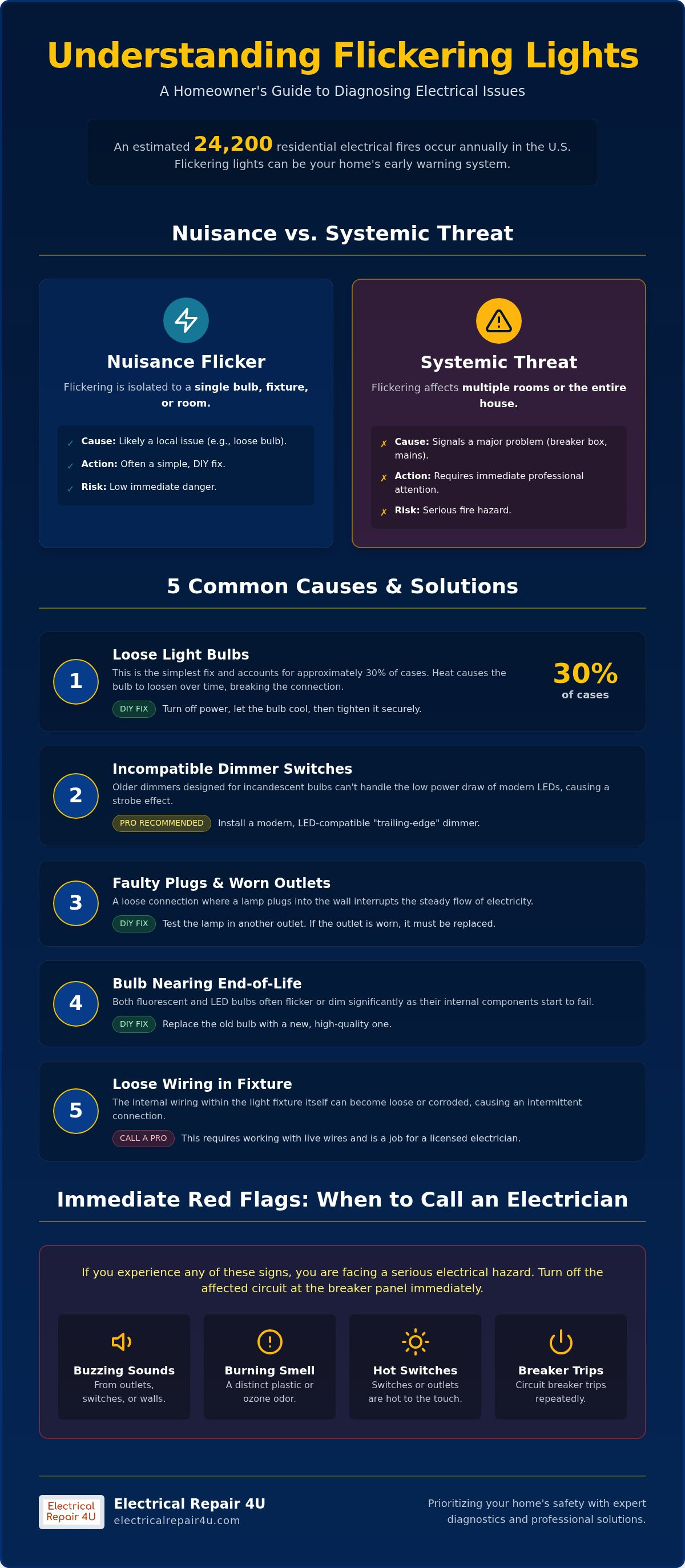
Flickering is technically defined as an irregular fluctuation in light output. For most homeowners, it starts as a minor distraction while reading or cooking. Think of it as your home's way of communicating with you. When you begin troubleshooting flickering lights, the first step is determining the scale of the problem. Is it a nuisance issue or a systemic threat? Your safety depends on knowing the difference.
A nuisance flicker usually involves a single bulb or fixture. It’s often caused by a loose connection in the socket or a bulb nearing the end of its life. Systemic flickering is far more serious. This occurs when lights across multiple rooms or different circuits start to blink simultaneously. Ignoring these signs can lead to electrical arcing, which is a primary cause of house fires. According to the National Fire Protection Association, 13% of home fires are tied to faulty wiring or lighting equipment. If you notice burning smells, hear buzzing sounds from the walls, or feel switches that are hot to the touch, you are facing an immediate red flag.
The "Single Source" vs. "Whole House" Test
You can narrow down the cause by performing a simple isolation test. Turn on lights in various parts of your home. If the flickering is limited to one room, the issue likely resides in that specific circuit's wiring or the fixtures themselves. On the other hand, if you see the lights dim in the kitchen while the bedroom lamps also flicker, you might have a problem with your main service drop or the breaker box. This distinction is vital. Localized issues often require simple repairs; however, whole-house fluctuations suggest a high-stakes failure in your home's electrical foundation. While troubleshooting flickering lights, always look for patterns that cross multiple rooms.
When to Shut Off the Power Immediately
Safety isn't just a goal; it's our standard. If you detect heat or a distinct ozone smell near your panel or switches, take action now. Go to your breaker box and flip the switch for the affected circuit to the "OFF" position. If a breaker trips on its own during a flickering event, don't attempt to reset it. A tripped breaker is a safety feature doing its job to prevent a fire. Our team specializes in residential electrical repair in Warrenville, ensuring that these complex diagnostics are handled with the precision that 40 years of local experience provides. We treat your home like our own, removing the anxiety of technical failures by delivering stable, proven results.
5 Common Causes of Flickering Lights and How to Fix Them
When you begin troubleshooting flickering lights, you'll find that many issues have straightforward resolutions. In fact, a loose light bulb is the simplest fix and accounts for approximately 30% of cases we see in the field. Heat causes the socket and bulb threads to expand and contract over time, which eventually works the bulb loose and breaks the electrical connection. While you might ask Is It Dangerous?, often the answer is just a simple maintenance task that you can handle in seconds.
Beyond loose bulbs, several other common culprits often disrupt your home's peace:
- Incompatible Dimmer Switches: Older dimmers were designed for high-wattage incandescent bulbs. When you install modern LEDs, the low power draw often confuses the switch, leading to a strobe effect.
- Faulty or Loose Plugs: If a lamp flickers, check the wall outlet. A loose plug or a worn-out outlet won't maintain a steady flow of electricity.
- End of Bulb Life: Both fluorescent tubes and LEDs don't always just "burn out." They often flicker or dim significantly as their internal components fail.
- Loose Light Fixtures: Sometimes the problem is deeper than the bulb. Worn-out sockets or loose internal wiring within the fixture can cause intermittent power loss.
If your lights continue to dance after a basic bulb swap, our team at Electrical Repair 4U is here to help you restore stability to your home's lighting.
Solving the LED and Dimmer Conflict
Many homeowners face a technology mismatch when upgrading to energy-efficient lighting. Most older "leading-edge" dimmers cut the voltage in a way that modern LED drivers simply can't process, especially at low dimming levels. You'll notice this as a rapid, rhythmic pulse rather than a random flicker. Dimmer compatibility is the synchronization between switch voltage and bulb requirements. To fix this, you typically need to install a digital "trailing-edge" dimmer designed specifically for LED technology.
The DIY Troubleshooting Checklist
You can solve many lighting issues yourself by following a logical process. Safety is always the priority, so turn off the switch before you touch any bulb or fixture to avoid a shock. Start by testing the fixture with a known "good" bulb from a different room. This simple step helps you rule out whether the problem is the bulb itself or the fixture's internal socket. If the flicker persists across multiple fixtures or occurs when you aren't touching anything, it's time to stop DIY efforts. Complex issues often require professional breaker box maintenance to ensure your home's main electrical hub is functioning safely and efficiently.
Voltage Fluctuations and Appliance Interference
If you notice your kitchen lights dim for a split second when the refrigerator kicks on, you are witnessing a phenomenon known as inrush current. This occurs because large motorized appliances require a massive surge of power, often three to five times their normal running wattage, just to start up. This sudden demand pulls energy away from the rest of the circuit, causing a momentary voltage drop that manifests as a brief flicker. When troubleshooting flickering lights, it's vital to distinguish between these split-second dips and persistent fluctuations that last throughout the appliance's operation.
Many older homes in areas like Aurora and Naperville were built with 100-amp electrical service, which was standard decades ago. Today, our homes are packed with high-demand electronics and smart appliances that the original builders never anticipated. This limited capacity makes these older systems much more susceptible to interference. While a momentary dip is often a normal characteristic of a heavily loaded system, constant flickering suggests that your electrical panel is struggling to keep up with your family's daily power needs.
Is Your HVAC System Overloading Your Circuit?
During intense Illinois summer heatwaves, your air conditioner works overtime. If every AC cycle triggers a strobe effect in your living room, your HVAC system might be sharing a circuit with your lighting, which is a common but outdated wiring practice. Ideally, heavy appliances should reside on separate, dedicated circuits to prevent this interference. If the flicker is accompanied by a loud clicking or grinding noise from the outdoor unit, you might be dealing with a struggling capacitor rather than a general wiring issue. Identifying these patterns early prevents unnecessary wear on your expensive cooling equipment and keeps your home's power stable.
Upgrading for Modern Power Demands
The most effective way to eliminate interference is to provide your home with a more robust foundation. Upgrading to 200-amp service provides the "headroom" necessary to run multiple high-draw appliances without affecting your lighting quality. This stability is especially important as we move toward a more electrified future. For example, a proper EV charger installation in Warrenville requires precise load calculations to ensure that charging your vehicle doesn't cause your lights to dance every evening. By installing dedicated circuits for kitchens, laundry rooms, and vehicle chargers, we ensure that each high-demand device has the dedicated "lane" it needs to operate safely without disrupting your peace of mind. We take pride in helping our neighbors transition to these modern standards with the steady hand that comes from 40 years of local service.
Hidden Dangers: Faulty Wiring and Loose Mains
While appliance surges are common, persistent flickering often points to structural failures within your home's electrical skeleton. Loose wiring at a fixture or switch is a leading cause of residential fires because it creates "arcing." Arcing occurs when electricity jumps across a gap in a connection, generating intense heat that can ignite nearby insulation or wood. When you are troubleshooting flickering lights, look for fixtures that only blink when the wall is bumped or a door is slammed nearby. These physical triggers are classic signs of a connection that has worked itself loose over time.
One of the most hazardous scenarios is a "loose neutral" wire. This specific fault causes some lights to get brighter while others dim randomly across the entire house. It’s a high-stakes situation that can destroy sensitive electronics and poses a severe fire risk. This often happens in the main service panel due to outdated breakers or bus bar corrosion. If your home's lighting seems to have a mind of its own across multiple circuits, you need an expert to check your panel's integrity immediately. We take pride in providing the emotional reassurance that comes with a stable, proven electrical system.
Signs of Frayed or Animal-Damaged Wiring
Rodents in suburban attics are a frequent culprit for flickering in older local homes. These animals often chew through wire insulation, leaving bare copper exposed. You might notice visual cues like scorching on outlets or discolored switch plates. These aren't just cosmetic issues; they are evidence of heat buildup. Arcing is often called the invisible killer because it can happen behind your drywall for months before a fire starts. Our diligent team is trained to spot these hidden hazards during every service call.
The Main Service Connection
Local Illinois weather plays a significant role in electrical stability. Our extreme humidity and dramatic temperature swings cause metal components to expand and contract, leading to corroded connections. If your lights flicker primarily during windy days or heavy storms, the problem likely sits at the weatherhead where the utility lines meet your house. While the utility company is responsible for the lines in the street, the connection at your mast is the homeowner's responsibility. A professional electrical safety inspection can identify these hidden faults before they become emergencies. If you suspect your wiring is compromised, contact us for a professional electrical repair to secure your home and restore your peace of mind.
Professional Troubleshooting for Warrenville Homeowners
Professional intervention is about more than just finding a fault; it's about providing the total emotional reassurance that your home is safe. When you've reached the limit of DIY troubleshooting flickering lights, a licensed expert brings a level of precision that visual inspections simply can't match. We use specialized infrastructure tools like a megohmmeter to measure insulation resistance and identify hidden shorts that are buried deep within your walls. With over 40 years of history in the Warrenville community, we've developed a deep understanding of neighborhood-specific grid issues and the unique wiring quirks of local homes.
During a professional troubleshooting appointment, you can expect a proactive and diligent approach. We don't just fix the immediate blink; we look at the system as a whole to ensure long-term stability. This thoroughness is what distinguishes a seasoned veteran from a standard contractor. We view ourselves as your collaborative partners in home safety. Our goal is to remove the anxiety of technical failures and replace it with a sense of security.
Our Diagnostic Process
Our team follows a logical and steady rhythm to move from the problem to the resolution. We start with comprehensive circuit mapping to identify which lines are carrying too much load and causing fluctuations. Using advanced thermal imaging technology, we detect "hot spots" behind your drywall without the need for invasive demolition. This allows us to find arcing wires or failing connections with pinpoint accuracy. Finally, we perform essential maintenance within your main service panel by tightening lugs and cleaning connections to ensure a high-caliber result that lasts for years.
Protecting Your Home Long-Term
Stability is the foundation of a happy home. Once we've resolved the immediate issue, we focus on proactive measures to prevent future failures. A whole house surge protector installation acts as a primary defense for your sensitive electronics and smart lighting drivers. This modern upgrade shields your entire infrastructure from external grid spikes and internal appliance surges alike. It’s a strategic investment in the longevity of your home's electrical system.
We also recommend annual maintenance plans to catch loose wires or corroded terminals before they evolve into high-stakes fire hazards. By staying ahead of the curve, you remove the stress typically associated with complex installations. We’re your neighbors, here to keep your lights on and your family safe. Trust our licensed professionals to deliver the dependable results you deserve through every season.
Secure Your Home and Restore Your Peace of Mind
A flicker in your lighting is more than a minor distraction; it's a vital signal that your home's electrical foundation needs attention. Whether the issue is a simple technology mismatch or a high-stakes failure like a loose neutral wire, taking action now prevents costly emergencies later. Effective troubleshooting flickering lights requires a balance of DIY awareness and knowing when to lean on a seasoned veteran. You deserve the security of a stable, flicker-free environment for your family.
Our team brings over 40 years of local electrical expertise to every doorstep. We are licensed, insured, and safety-focused professionals trusted by homeowners across Naperville, Aurora, and Warrenville. Don't let electrical anxiety linger in your home. Schedule your professional electrical troubleshooting in Warrenville today! We are your collaborative partners in building a safer, more dependable living space. We take pride in our craft and look forward to keeping your lights on and your family secure.
Frequently Asked Questions
Why do my lights flicker when the air conditioner turns on?
It's usually due to inrush current. Large motors in HVAC units require a massive surge of power to start. This demand can momentarily drop the voltage in the rest of your home. In older Naperville and Aurora homes with 100-amp service, this is very common. If it persists for more than a second, it indicates your circuit is overloaded or the panel needs maintenance to handle the modern load.
Can a flickering light bulb cause an electrical fire?
Yes, flickering can be a symptom of a fire hazard. While a loose bulb is usually harmless, flickering caused by arcing wires or loose connections generates extreme heat. This heat can ignite surrounding materials like insulation or wood framing. If you detect a burning smell or hear buzzing along with the flickering, you should contact a licensed professional to inspect your home's wiring repairs immediately to ensure safety.
Why are my LED lights flickering even when they are turned off?
This is often caused by ghost voltages or residual energy in the circuit. Some smart switches or dimmers allow a tiny amount of current to flow even when off to power their internal sensors. Since LEDs are incredibly efficient, they can light up or strobe with even this small amount of power. Installing a bypass or switching to high-quality, compatible drivers typically resolves this nuisance and restores stability to your lighting.
Is it normal for lights to flicker during a storm in Illinois?
Brief flickering during severe Illinois storms is common when wind or debris hits utility lines. However, if your lights flicker every time the wind blows, you might have a loose connection at your home's weatherhead or service mast. This is the homeowner's responsibility to repair. Persistent flickering after a storm suggests damage to your main service line that requires a professional safety inspection to prevent long-term instability in your electrical system.
How much does it cost to fix flickering lights in a house?
The cost varies significantly based on the root cause. A simple bulb replacement is inexpensive, while repairing complex wiring issues or performing troubleshooting flickering lights across multiple circuits requires professional labor. Factors include the age of your home and the specific components involved, such as outlets or breaker boxes. We recommend checking with a local licensed electrician for a project-specific estimate tailored to your home's unique needs and safety requirements.
Should I replace my dimmer switch if my lights are flickering?
You should replace it if you are using modern LED bulbs with an older incandescent dimmer. These older leading-edge switches are often incompatible with LED drivers, leading to a rapid pulse or strobe effect. Upgrading to a trailing-edge dimmer designed for LED technology ensures smooth voltage control. If the flicker continues after the upgrade, the problem likely resides in the fixture's internal socket or the circuit's main wiring which needs professional attention.
What is a loose neutral and why is it dangerous?
A loose neutral is a broken or unstable return path for electricity in your home's system. It is dangerous because it causes voltage imbalances; some lights may dim while others become dangerously bright. This imbalance can fry sensitive electronics and creates a high risk of electrical fires. If you notice random brightness changes across different rooms, it's a high-stakes emergency that requires immediate attention from our seasoned team of licensed professionals to protect your home.
Can a bad circuit breaker cause lights to flicker?
Yes, a failing or corroded circuit breaker can cause intermittent power delivery. If the breaker doesn't sit tightly on the bus bar or if the internal contacts are worn, the connection will be unstable. When troubleshooting flickering lights, we often find that an outdated panel is the culprit. Replacing a faulty breaker or performing comprehensive breaker box maintenance restores the steady flow of power your modern appliances and lighting solutions require for safe operation.


