
You're finishing dinner in your kitchen when a sudden "pop" leaves your appliances silent and your lights dark. It's a frustrating moment that immediately triggers worries about hidden fire hazards and the potential cost of repairs. When you need to find an electrical short in house Naperville systems, the uncertainty can feel just as heavy as the darkness. We know you value the safety of your family above all else. After serving DuPage County for over 40 years, we've seen how a little bit of expert guidance can replace that anxiety with a sense of security. This guide will empower you to safely identify and isolate the source of an electrical short before you decide to call in a professional. We'll walk you through a logical process of elimination, from checking your breaker box to inspecting individual outlets. By the end, you'll know exactly how to restore your power and when it's time to bring in a licensed master electrician to ensure your home's long-term stability.
Key Takeaways
- Learn the critical difference between short circuits and ground faults to better understand your home's immediate safety risks.
- Identify early warning signs like persistent breaker trips or scorched outlets to stop potential electrical fires before they start.
- Follow a safe, systematic process to find an electrical short in house Naperville systems by isolating individual circuits and inspecting fixtures.
- Understand how Naperville's local housing history, from historic knob-and-tube wiring to modern builder-grade components, impacts your troubleshooting approach.
- Recognize exactly when a "hidden" short requires the expertise of a licensed master electrician to protect your property's long-term stability.
What is an Electrical Short and Why is it Dangerous?
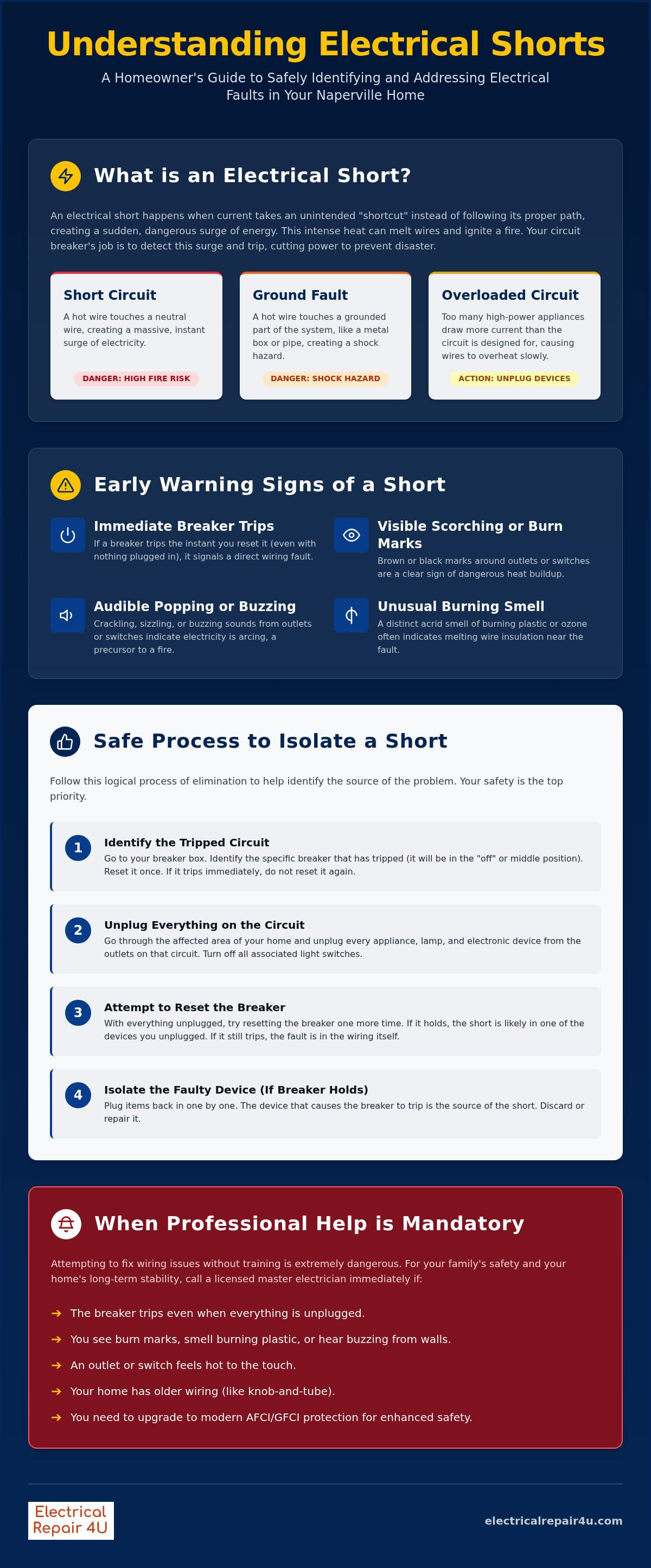
Electricity always looks for the path of least resistance. In a healthy system, that path stays within the insulated wires designed to carry it. A short circuit happens when that current "jumps the track" and takes a shortcut. Specifically, What is a short circuit? It occurs when a hot wire carrying the current accidentally touches a neutral wire or a grounding wire. This creates a sudden, massive surge of electricity that bypasses your home's appliances and devices.
When you attempt to find an electrical short in house Naperville systems, you're looking for a specific type of failure. While a short circuit involves hot and neutral wires, a ground fault is slightly different. That's when the hot wire touches a grounded part of the system, like a metal junction box or a copper pipe. Both are dangerous because they generate intense heat. This heat can melt plastic insulation, scorch wood framing, and start a fire in seconds. Your circuit breaker is your home's primary gatekeeper. It's designed to sense this surge and "trip" immediately, cutting off the power before the heat leads to a disaster.
Short Circuit vs. Overloaded Circuit
Many homeowners confuse a short with a simple overload. An overloaded circuit happens when you plug too many high-wattage items, like a space heater and a hair dryer, into the same outlet. The wires get warm, and the breaker trips to protect them. You can usually fix this by unplugging a few things. A short circuit is different. It's a physical fault in the wiring itself. If your breaker trips the moment you flip it back on, even when everything is unplugged, you're likely dealing with a short. Don't keep resetting the breaker. Forcing it to stay on can cause permanent damage to your panel or even lead to an electrical fire.
The Role of AFCI and GFCI Breakers
Modern safety standards have evolved to catch these problems faster than ever. Arc Fault Circuit Interrupters (AFCI) are specialized breakers that detect the unique "signature" of a spark or arc before it generates enough heat to start a fire. Since the City of Naperville follows the 2023 National Electrical Code, these are now required in most living areas. Learning how to find an electrical short in house Naperville properties starts with understanding your breaker's behavior. If you live in an older home near the Historic District, your panel might still rely on older technology. Upgrading to AFCI and GFCI protection provides emotional reassurance that your family is protected by the latest safety innovations.
Common Signs of an Electrical Short in Your Naperville Home
You might notice something is off before you ever see a spark. Identifying these red flags early is the best way to prevent a minor nuisance from turning into a major hazard. When you're trying to find an electrical short in house Naperville properties, your senses are your best tools. Most shorts present themselves through a combination of physical evidence and unusual performance from your breaker box. Following proper electrical safety procedures is vital when you suspect a fault, as even a small short can deliver a dangerous shock.
- Immediate Breaker Trips: If your circuit breaker flips back to the "off" or "tripped" position the moment you try to reset it, you have a direct wiring fault.
- Visible Scorching: Brown or black burn marks around outlet faceplates or switches indicate that heat has reached a dangerous level.
- Auditory Warnings: Popping, buzzing, or crackling sounds when you flip a switch mean electricity is struggling to stay on its path.
- Heat Build-up: An outlet or switch that feels hot to the touch, even when nothing is plugged in, is a classic sign of an internal short.
Visual and Auditory Warning Signs
Discoloration on your outlet faceplates isn't just an aesthetic issue. It means the plastic is literally melting from the inside out due to high-resistance heat. Sizzling sounds are even more urgent. They indicate that electricity is actively jumping through the air to reach a ground source. Arcing is a dangerous precursor to a short circuit where current leaps across a gap between loose or damaged connections. If you hear these sounds, you should stop using that circuit immediately to prevent a fire. If you're unsure about what you're seeing, our team is always ready to provide a professional electrical repair assessment.
The 'Burning Smell' Diagnostic
A short circuit often produces a distinct, acrid odor similar to burning plastic or ozone. This scent usually lingers near the source of the fault. You can safely track the scent by moving from room to room, but you must never touch the wiring or open a junction box yourself. If the smell is strongest near a specific wall, the short might be hidden deep within your home's infrastructure. If you notice these symptoms along with flickering lights, you should check our guide on signs of bad electrical wiring for a deeper look at your system's health. Identifying these smells early allows you to act before the situation escalates into a full-scale emergency.
Steps to Safely Locate an Electrical Short
Taking the first steps to find an electrical short in house Naperville systems doesn't have to be a high-stress ordeal. It's a logical process that starts with your own safety. Always wear rubber-soled shoes to provide a layer of insulation between you and the ground. Never touch electrical wires with your bare hands. Use insulated tools if you must move a cord. If you detect the sharp scent of ozone or see active sparks, stop immediately. Your safest move is to shut off the main power switch at the panel to kill all current to the home.
A short circuit is essentially a "leak" of electricity. We want to find where that leak is happening without putting you in harm's way. By following a systematic approach, you can often determine if the problem is a simple broken toaster or a more serious issue within your walls. This clarity helps you provide better information when you call for professional assistance, saving time and reducing your repair anxiety.
The Process of Elimination Method
We often find that the short isn't in the home's permanent wiring at all. It's frequently a failed power strip or a frayed appliance cord. To test this, follow these three simple steps:
- Step 1: Identify the tripped breaker. Look for the switch in the panel that isn't fully "on" or "off" but stuck in the middle.
- Step 2: Unplug everything. Go through every room served by that circuit and disconnect every lamp, charger, and appliance. Don't just turn them off; pull the plugs from the walls.
- Step 3: Reset the breaker. Flip it to "off" then back to "on". If the breaker stays on, you've confirmed the house wiring is safe. You can now plug devices back in one at a time. When the breaker trips again, you've found your faulty device.
Isolating the Faulty Outlet or Switch
If the breaker trips even when every single device is unplugged, the fault lies within your switches, outlets, or the wires behind your drywall. You can narrow this down by keeping all devices unplugged and turning every wall switch on that circuit to the "off" position. Reset the breaker. If it stays on, flip the switches on one by one. If a specific switch causes an immediate trip, you've isolated a short in that light fixture or switch box.
Dealing with internal wiring is where DIY efforts should end. A short inside a junction box is a serious fire risk that requires a licensed expert to resolve safely. If your troubleshooting points toward a problem in the panel itself or the permanent wiring, it's time to call for professional breaker box maintenance. Our team has spent over 40 years helping neighbors stay safe by resolving these complex issues with precision and care.
Why Naperville Residents Face Unique Electrical Challenges
Naperville isn't a "one size fits all" community. From the Victorian charm near North Central College to the sprawling subdivisions in the south, every neighborhood has its own electrical quirks. These differences mean that the reason you need to find an electrical short in house Naperville systems depends heavily on when your home was built. We've spent over 40 years navigating these local nuances. We understand that a home in the Historic District faces very different risks than a newer build near 95th Street.
Local wildlife also plays a surprisingly large role in our electrical health. Squirrels and mice in DuPage County attics often seek warmth near junction boxes. They have a destructive habit of chewing through plastic wire insulation. This creates "hidden" shorts that are difficult to locate without specialized diagnostic tools. When insulation is stripped away, the bare copper is left exposed to wood framing. This creates a silent fire hazard that remains invisible until a breaker finally trips.
Historic Homes and Outdated Wiring
If you live in one of our city's older neighborhoods, you may be dealing with vintage infrastructure. Mixing modern high-wattage loads with vintage systems is a recipe for trouble. Cloth-insulated wires are particularly problematic. Over many decades, this material becomes brittle and simply flakes away if the wire is moved or overheated. Knob-and-tube wiring is considered a high-priority safety risk in Naperville because it lacks a modern grounding wire and cannot safely dissipate surges. If your home still relies on these systems, attempting a DIY fix can often cause more harm than good by disturbing fragile connections.
Environmental Factors in DuPage County
Our local climate puts constant stress on your home's wiring. The high humidity of Illinois summers often leads to condensation in damp basements or crawlspaces. When moisture accumulates in unsealed junction boxes, it creates a path for current to leak, leading to mysterious ground faults. During our freezing winters, outdoor security lighting and holiday displays are prone to shorts. Plastic housings contract and crack in the cold, allowing melting snow to seep into the circuitry. Always ensure your exterior outlets use professional weather-rated boxes to prevent these seasonal failures. If your older home is struggling to keep up with modern demands, our team is ready to provide a comprehensive electrical repair to restore your peace of mind.
When Professional Troubleshooting is Mandatory
While the initial steps to find an electrical short in house Naperville systems can be handled by a diligent homeowner, there's a clear line where DIY safety ends and professional expertise must take over. If you've unplugged every device and the breaker still refuses to stay engaged, the fault is buried within your home's infrastructure. This isn't just a matter of convenience. It's a matter of preventing a fire that could start behind your drywall where you can't see it. Our goal is to provide the emotional reassurance that your home is a safe haven, not a source of hidden hazards.
Professional intervention is mandatory when the short is "hidden" within a wall or ceiling cavity. These faults often stem from wires that have rubbed against metal studs or were accidentally pierced by a nail during a past renovation. We also see many cases in DuPage County where local wildlife, such as squirrels or mice, have left behind chewed insulation in an attic. This makes a professional inspection non-negotiable. We use specialized diagnostic tools, such as megohmmeters, to test the integrity of wire insulation. These devices allow us to pinpoint the exact section of wiring that needs replacement without unnecessarily tearing into your home's structure.
The Limits of DIY Electrical Work
Opening your main service panel is where the stakes become incredibly high. Non-professionals should never attempt to tighten lugs or move wires inside the breaker box. The risk of a fatal arc flash or a severe shock is far too great for anyone without master-level training. Beyond the immediate physical danger, "blind" repairs often miss secondary damage. A short circuit generates intense heat that can compromise other nearby wires in a bundle. Our team at Electrical Repair 4U relies on over 40 years of local experience to identify these hidden risks. We don't just fix the symptom; we ensure the entire circuit is stable and safe for your family.
Electrical Repair 4U: Your Naperville Safety Partners
Our approach is rooted in neighborly reliability and technical precision. We don't just swap out parts. We perform comprehensive troubleshooting to ensure your home meets the latest safety codes. Once we've resolved your immediate short, we can help you prevent future electrical stress by installing whole house surge protection. This proactive step shields your sensitive electronics from the power fluctuations common in our area. Don't guess with your family's safety. Contact Electrical Repair 4U for professional diagnostics and let our master electricians restore your home's security and stability.
Protect Your Peace of Mind and Home Stability
You now have the knowledge to identify the warning signs of a short circuit, from acrid smells to immediate breaker trips. While a systematic process of elimination helps you rule out faulty appliances, internal wiring issues are best left to those with technical credentials. When you need to find an electrical short in house Naperville systems, taking a proactive approach ensures your property remains a safe haven for your family.
Electrical Repair 4U has served Naperville and DuPage County for over 40 years. As a stable pillar of the community, we offer licensed, insured, and master-level expertise to resolve even the most complex troubleshooting challenges. Our A+ rated local service focuses on delivering high-caliber results that remove the anxiety of technical failures. We take pride in our craft and remain dedicated to your home's long-term safety and stability.
Don't let a hidden fault put your property at risk. Schedule a Safety Inspection with Electrical Repair 4U Today. We're ready to partner with you to keep your home's electrical system reliable and secure for years to come.
Frequently Asked Questions
Is it safe to keep resetting a breaker that keeps tripping?
No, you should never repeatedly reset a circuit breaker that keeps tripping because it creates a serious fire hazard. Each time you force the breaker back on, you allow an intense surge of electricity to generate heat along the fault. This heat can melt insulation and ignite nearby building materials. If a breaker won't stay engaged, it has done its job as a safety gatekeeper. You need to identify the root cause before attempting to restore power.
How can I tell if the short is in my appliance or my wall wiring?
You can determine the source by unplugging every device on the affected circuit and resetting the breaker. If the breaker stays on while the outlets are empty, the short is likely inside one of your lamps or electronics. However, if the breaker trips even when nothing is plugged in, the fault is located within your home's permanent wiring. This is a clear sign that you need a professional to find an electrical short in house Naperville systems.
What should I do if I see sparks coming from an outlet in Naperville?
If you see sparks from an outlet, your first priority is to shut off the main power at your breaker panel immediately. Do not attempt to touch the outlet or anything plugged into it. Sparks indicate an active arc fault which can lead to a fire in seconds. Once the power is disconnected, stay away from the area and contact a licensed master electrician to inspect the damage and perform necessary wiring repairs.
Can a bad lightbulb cause a short circuit?
Yes, a bad lightbulb can occasionally cause a short circuit if the internal filament breaks and creates a path between the hot and neutral connections. This sometimes happens when a bulb blows with a loud pop and trips the breaker. To test this, unscrew the bulb and reset the breaker. If the power stays on without the bulb, you've found the issue. Replacing the bulb or the entire fixture will usually resolve the problem.
How much does it typically cost to find and fix an electrical short?
The cost to find and fix an electrical short varies depending on the location of the fault and the complexity of your home's wiring. A simple fix for a loose connection in an outlet box will be less involved than replacing a damaged wire hidden deep behind a wall. While we don't provide fixed diagnostic fees, we focus on providing honest assessments and high-caliber results based on our 40 years of local experience in DuPage County.
Why does my breaker trip only when it rains?
Rain-related trips usually indicate that moisture is entering an outdoor fixture, a weather-rated outlet box, or an underground service line. Since 95% of Naperville's electrical cables are underground, moisture can sometimes seep into aging insulation or cracked conduit during heavy Illinois storms. This creates a ground fault that trips your breaker to prevent a shock hazard. A professional inspection can identify which exterior component has lost its watertight seal.
Does insurance cover the cost of repairing an electrical short?
Homeowners insurance policies typically cover the damage caused by an electrical short, such as fire or smoke damage, but they often exclude the cost of repairing the faulty wire itself. Most insurers view wiring maintenance as a homeowner responsibility. It is best to review your specific policy or speak with your agent to understand your coverage limits. Investing in whole house surge protection can also help mitigate risks that lead to insurance claims.
What is the difference between a short circuit and a ground fault?
A short circuit occurs when a hot wire touches a neutral wire, while a ground fault happens when a hot wire touches a grounded component like a metal box or copper pipe. Both faults create a path of least resistance for electricity to surge, which triggers your breaker. While they have different technical definitions, both require immediate attention to prevent electrical shocks or fires. Understanding these differences helps us provide more accurate troubleshooting for your Naperville home.


