By 2030, an estimated 92% of all electric vehicle charging will happen right in our own driveways and garages. As we move through 2026, the shift toward electric driving is undeniable, but the transition often brings up valid concerns about slow charging speeds and the safety of your home's electrical system. A professional level 2 charger installation is no longer just a luxury; it's a vital infrastructure upgrade that ensures your vehicle is ready to go whenever you are.
It's natural to feel a bit overwhelmed by technical jargon or the fear of improper wiring causing a hazard. You want the peace of mind that comes with waking up to a 100% battery every morning without worrying about your breaker box. This guide will help you master the latest 2026 technical requirements, understand the real-world costs, and navigate the newest safety standards. We'll break down the difference between 40-amp and 50-amp requirements and explain how the latest National Electrical Code updates affect your project. By the end, you'll have a clear path to a fast, code-compliant home charging station that protects both your car and your family.
Key Takeaways
- Eliminate range anxiety by understanding how 240V power delivers up to 80 miles of range per hour compared to standard wall outlets.
- Master the "80% Rule" to ensure your home's electrical panel is safely configured for a continuous high-capacity charging load.
- Compare the flexibility of NEMA 14-50 plug-in units against the high-speed performance of a hardwired level 2 charger installation.
- Learn why professional oversight and proper permitting in counties like DuPage and Cook are vital for long-term safety and insurance compliance.
- Discover the step-by-step path from your initial consultation to a fully powered home refueling station that's built to last.
What is Level 2 Charger Installation and Why Does It Matter?
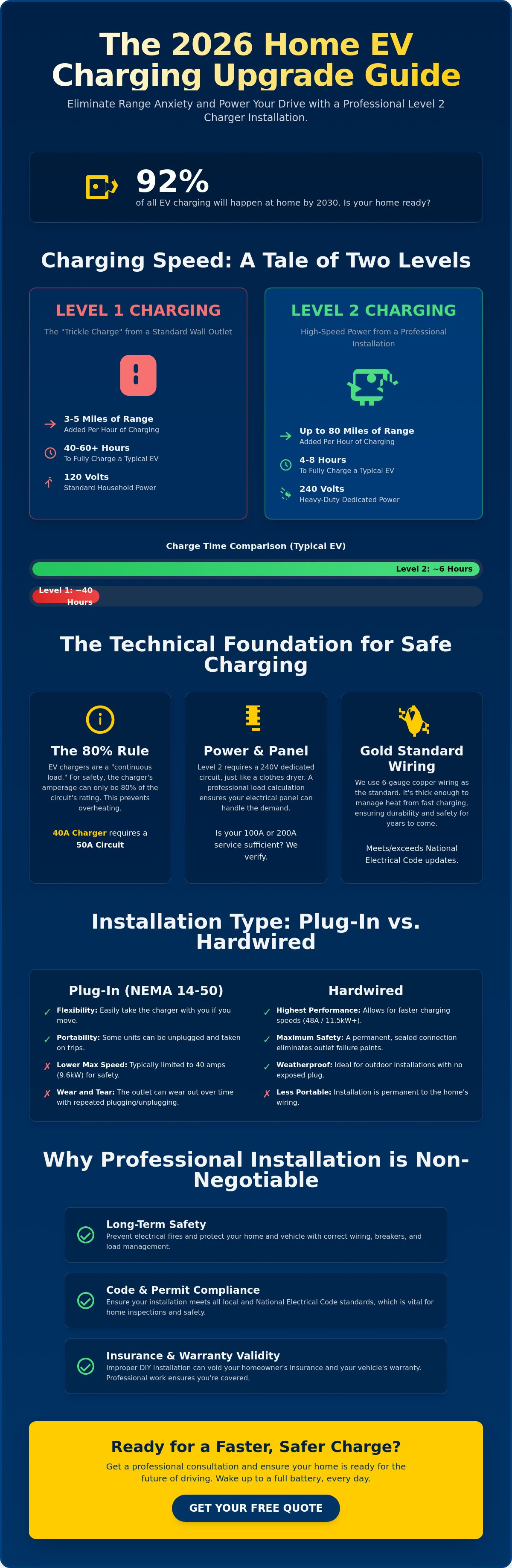
Standard 120V wall outlets were designed for lamps, toasters, and hair dryers. They weren't built to fuel a 4,000 pound vehicle. When you rely on a standard outlet, you're dealing with the "trickle charge" problem. It's a slow, agonizing process that often leaves you with a half-empty battery when you need to leave for work. A professional level 2 charger installation changes that dynamic entirely by upgrading your home's electrical heart to handle high-speed refueling.
At its core, a Level 2 setup utilizes 240V AC power, which is the same heavy-duty voltage used by your clothes dryer or electric oven. This system consists of three main parts: the Electric Vehicle Supply Equipment (EVSE) unit, a dedicated circuit, and specialized safety breakers. By tapping into this higher voltage, AC Level 2 charging provides between 12 and 80 miles of range for every hour it's plugged in. Beyond just speed, it allows you to pre-condition your car's cabin in the dead of a Chicago winter without draining your battery. It also gives you the power to schedule charging for the middle of the night when utility rates are at their lowest.
Level 1 vs. Level 2: A Speed Comparison
The difference in performance is staggering. If you're driving a Tesla Model Y, a standard Level 1 outlet might take over 40 hours to reach a full charge. For a massive battery like the one in a Ford F-150 Lightning, that time can stretch toward 50 or 60 hours. That simply doesn't work for daily commuters. Level 2 charging slashes those times down to a manageable 4 to 8 hours. Instead of thinking in days, you start thinking in "miles per hour." Most homeowners find that a few hours of charging each evening is more than enough to recover their daily commute, ensuring the car is always at 100% by morning.
Why 2026 is the Year to Upgrade Your Home Charging
As we move through 2026, the average real-world range for new EVs has climbed to 325 miles. These larger batteries make Level 1 charging effectively obsolete for anyone who drives more than a few miles a day. Timing is also critical for your wallet. The federal 30C tax credit, which covers 30% of the cost of your unit and installation up to $1,000, is currently set to expire on June 30, 2026. Acting now allows you to secure these savings while also boosting your property value. Modern buyers are increasingly looking for homes that are already equipped with dedicated EV infrastructure, viewing a level 2 charger installation as a premium, future-proof asset.
The Technical Requirements: Amps, Volts, and Your Electrical Panel
A successful level 2 charger installation depends on more than just the unit you buy. It requires a robust electrical foundation that can handle high-intensity power for hours at a time. Unlike a toaster that runs for two minutes, an EV charger is a continuous load. This is why we follow the 80% rule. To safely deliver a 40-amp charge, your circuit must be rated for 50 amps. This 20% safety margin prevents your breakers from overheating and ensures your home remains secure while you sleep.
The jump from Level 1 to Level 2 is essentially a jump in voltage. We're moving your charging setup from standard 120V household power to the 240V "heavy-duty" power typically reserved for electric dryers or water heaters. This transition requires a dedicated circuit breaker. Without it, you risk nuisance tripping or, worse, electrical fires caused by overloaded wires. We use 6-gauge copper wiring as the gold standard for these installations. It's thick enough to manage the heat generated by fast charging without degrading over time. These practices aren't just our preference; they align with the Federal EV Installation Standards which prioritize the stability of our national charging infrastructure.
Is Your Electrical Panel Ready for the Load?
In local neighborhoods like Elmhurst and Oak Park, many beautiful older homes still operate on 100-amp electrical service. Just because you see an empty slot in your breaker box doesn't mean your system can handle the added demand. We perform a detailed load calculation to determine if your existing service can support a car, an air conditioner, and an electric range simultaneously. Staying proactive with breaker box maintenance helps us identify these capacity issues before they lead to a failure. If you're unsure about your current capacity, a quick professional electrical assessment can provide the clarity you need.
When a 200-Amp Panel Upgrade is Necessary
If your lights dim when the refrigerator kicks on or your panel feels warm to the touch, you've likely reached your electrical limit. Adding a high-speed charger to an overtaxed system is a recipe for trouble. Upgrading to a 200-amp panel provides the breathing room necessary for modern life. It doesn't just power your car; it prepares your home for future smart technology and electric appliances. A 200-amp panel is the foundation of a modern, electric-forward home.
Hardwired vs. Plug-In: Choosing the Right Level 2 Setup
Once you've confirmed your electrical panel can handle the load, you face a critical decision. Should you install a NEMA 14-50 outlet for a plug-in unit, or should you opt for a hardwired level 2 charger installation? This choice affects your charging speed, your long-term maintenance costs, and even how your garage looks. While both options provide the 240V power you need, the way that power reaches your vehicle makes a significant difference in daily reliability.
A plug-in setup offers flexibility. If you move frequently or want the ability to take your charger with you, a NEMA 14-50 outlet is a practical choice. However, hardwired installations are increasingly becoming the professional standard for high-performance home charging. Hardwiring allows for higher amperage, often reaching 48 to 80 amps, which slashes charging times even further compared to the 40-amp limit of most plug-in units. It also provides a cleaner aesthetic by removing the bulky plug and thick cord from your wall, leaving only the sleek charging unit visible.
The Pros and Cons of NEMA 14-50 Plugs
The primary appeal of a plug-in unit is ease of replacement. If your charging hardware fails, you simply unplug it and swap in a new one without calling for service. But this convenience comes with specific safety requirements. Under the latest electrical codes, outlets used for EV charging often require a Ground-Fault Circuit Interrupter (GFCI) breaker. These breakers are more expensive and can sometimes lead to "nuisance tripping," where your car stops charging unexpectedly in the middle of the night. We always insist on industrial-grade outlets. Cheap, big-box store outlets designed for clothes dryers aren't built for the constant, high-heat stress of EV charging and can literally melt under the load.
Why Hardwiring is the Professional Standard
Hardwiring eliminates the plug-and-socket connection, which is a common point of failure. By creating a direct link between your breaker and the charger, we reduce heat buildup and increase the lifespan of your equipment. This setup is essential for outdoor installations. Illinois winters are brutal, and a hardwired connection offers superior weather resistance against snow, ice, and fluctuating temperatures. According to the DOE Installation Planning Guide, choosing the right connection type is a foundational step in building a resilient home refueling station. A hardwired level 2 charger installation often removes the need for a GFCI breaker in many jurisdictions, which means more reliable charging sessions and fewer morning surprises.
The Step-by-Step Installation Process: From Permits to Power-On
Transforming your home into a high-speed refueling station starts with a clear, professional plan. A successful level 2 charger installation follows a precise sequence to ensure safety and longevity. It begins with an initial consultation where we assess the distance between your electrical panel and the garage. This distance determines the amount of conduit and wire needed, which directly impacts the project scope. We also verify that the mounting location is accessible and meets all manufacturer clearances for optimal performance.
Permitting is the next hurdle. In counties like DuPage, Kane, and Cook, local building departments have specific codes that must be met. Navigating these requirements can be daunting for homeowners, but they are essential. An unlicensed or unpermitted installation can void your homeowners insurance policy if an electrical issue occurs. Villages like Warrenville and Bolingbrook maintain strict standards to protect residents from fire hazards. For those in the western suburbs, checking a guide on expert EV charger installation in Warrenville provides a clear roadmap for local compliance.
The physical work involves running heavy-duty conduit, pulling 6-gauge copper wire, and securely mounting the EVSE unit. We take pride in clean conduit runs that follow the lines of your architecture rather than cluttering your walls. Once the hardware is in place, we move to testing and commissioning. We verify ground continuity and ensure the unit communicates correctly with your vehicle's onboard computer. The process concludes with a final inspection. This step ensures every connection meets the 2026 National Electrical Code (NEC) standards. This verification is your shield against future technical failures.
What to Expect on Installation Day
Most professional installs take between 3 to 6 hours to complete. You should plan for a brief power interruption during this window. We must turn off the main breaker to safely integrate the new dedicated circuit into your panel. After the power is back on, we perform a detailed walkthrough. This is where we bridge the gap between technical work and your daily routine. We'll explain the unit’s status lights, show you how to use the companion app, and demonstrate the safest way to handle the charging cable. If you're ready to start your journey toward faster home charging, schedule your EV charge point installation with our team today.
Why Professional Installation is Non-Negotiable for Safety
While many home improvement projects are perfect for a weekend DIY approach, a level 2 charger installation isn't one of them. The stakes are simply too high. Most household devices pull power in short bursts, but an EV charger draws a massive, continuous load for hours. Standard electrical tape and basic wire nuts, which might work for a ceiling fan, are wholly inadequate here. These materials can't withstand the sustained thermal stress that comes with fueling a modern vehicle. When you choose a professional, you're choosing connections that are torqued to exact specifications to prevent disaster.
The primary danger of an amateur install is a phenomenon known as thermal runaway. This happens when a slightly loose connection creates resistance. That resistance generates heat, which causes the metal to expand and contract, making the connection even looser. Before you know it, the heat becomes intense enough to melt your breaker box or ignite nearby building materials. We've seen the aftermath of "handyman" installs where the charging unit itself survived, but the home's internal wiring was charred beyond repair. Our team brings 40 years of experience to every job, ensuring that every terminal is secure and every circuit is built for the long haul.
The Critical Link Between EVs and Surge Protection
Modern electric vehicles are essentially high-performance computers on wheels. They contain sensitive circuit boards and battery management systems that are highly vulnerable to voltage transients. A simple lightning strike nearby or a hiccup in the local power grid can send a spike through your charging cable and into your car's expensive electronics. To protect your $50,000 investment, we highly recommend a whole house surge protector installation. This creates a shield for your entire home, including your EV charger and the vehicle itself. Surge protection is the cheapest insurance for your electric vehicle investment.
Choosing a Local Veteran Over a Faceless App
In an era of faceless apps and out-of-town contractors, there is immense value in working with a neighbor who knows the local DuPage County grid. We aren't just here for the initial setup. We are the team you call if you have questions three years down the road or if you decide to upgrade to a second vehicle. Our reputation is built on decades of honest pricing and diligent, safety-conscious work. We take pride in being a stable pillar of this community, helping families transition to a cleaner future without sacrificing their peace of mind. Your safety is our craft. Schedule your level 2 charger assessment with Electrical Repair 4U today!
Power Up Your Home with Confidence
You've seen how the right charging setup does more than just fill a battery; it transforms your daily routine. By moving past the "trickle charge" of standard outlets and ensuring your panel is ready for a 240V load, you're investing in your home’s long-term value. A secure, hardwired connection provides the ultimate peace of mind, especially when it's paired with whole-house surge protection to guard your vehicle's sensitive electronics. Mastering the technical requirements of a level 2 charger installation is the first step toward a seamless electric driving experience.
Don't leave your safety to chance with unverified DIY advice or faceless apps. Our team of licensed and insured master electricians brings over 40 years of local experience to every project. We take pride in serving our neighbors in Warrenville, Naperville, and Aurora with diligent, code-compliant work that stands the test of time. When you're ready to make the switch, Get a Professional Level 2 Charger Installation Quote from a team that treats your home like their own. You're just one step away from waking up to a full charge every single morning. Let's get your home ready for the road ahead.
Frequently Asked Questions
How much does it cost to install a Level 2 charger at home in 2026?
The total investment for your project depends on several variables, including the distance from your electrical panel to the charging station and the capacity of your existing system. While hardware prices vary by brand, the labor and material costs for a professional installation are influenced by whether you need a panel upgrade or complex conduit runs. We recommend a professional assessment to get an accurate picture of your home's specific needs.
Do I need to upgrade my electrical panel for a Level 2 charger?
You don't always need an upgrade, but a licensed electrician must perform a load calculation to be certain. Many modern homes with 200-amp service can handle the added demand without major changes. However, older homes with 100-amp service often require a new breaker box to safely support the continuous draw of an EV. This ensures your lights don't flicker and your system doesn't overheat during a charging session.
Can I install a Level 2 charger myself?
No, the 2026 National Electrical Code (NEC) mandates that permanently installed EV chargers must be handled by qualified persons, which typically means a licensed electrician. Attempting a DIY level 2 charger installation is dangerous due to the high voltage and sustained heat involved. Improper wiring can lead to house fires and will almost certainly void your homeowners insurance policy if a failure occurs.
What is the difference between a 40-amp and 50-amp charger?
The difference lies in the charging speed and the required circuit capacity. Following the 80% safety rule, a 40-amp charger requires a 50-amp circuit breaker, while a 50-amp charger requires a 60-amp or 70-amp circuit. Higher amperage allows you to recover more miles of range per hour. Most commuters find that a 40-amp setup is the "sweet spot" for overnight charging without requiring massive infrastructure changes.
Will a Level 2 charger work with my Tesla and other EV brands?
Yes, most chargers in 2026 are designed for universal compatibility. Since the industry shifted toward the North American Charging Standard (NACS), most new vehicles from Ford, GM, and Rivian use the same connector as Tesla. Even if you have an older EV with a J1772 port, simple adapters make it easy to use a single home station for any electric vehicle in your garage.
How long does a professional Level 2 charger installation take?
A standard level 2 charger installation typically takes between three and six hours to complete. If your electrical panel is in the garage and has plenty of capacity, the job moves very quickly. Projects that require running conduit through crawlspaces or upgrading an old breaker box will naturally take a bit longer. We always aim to minimize your downtime and get your power back on as quickly as possible.
Is a permit required for EV charger installation in Illinois?
Yes, local building departments in Illinois counties like DuPage, Kane, and Cook require a permit for adding a new 240V circuit. This is a vital safety step that ensures a third-party inspector verifies the work meets the latest National Electrical Code standards. Skipping the permit process can create significant headaches when you try to sell your home or file an insurance claim later.
Does a Level 2 charger increase my home value?
Professional EV infrastructure is increasingly viewed as a high-value asset by modern homebuyers. As electric vehicles become the standard, having a code-compliant, high-speed refueling station already in place makes your property much more attractive. It's a "future-proof" upgrade that demonstrates the home has been well-maintained and is ready for the next generation of transportation technology.


