
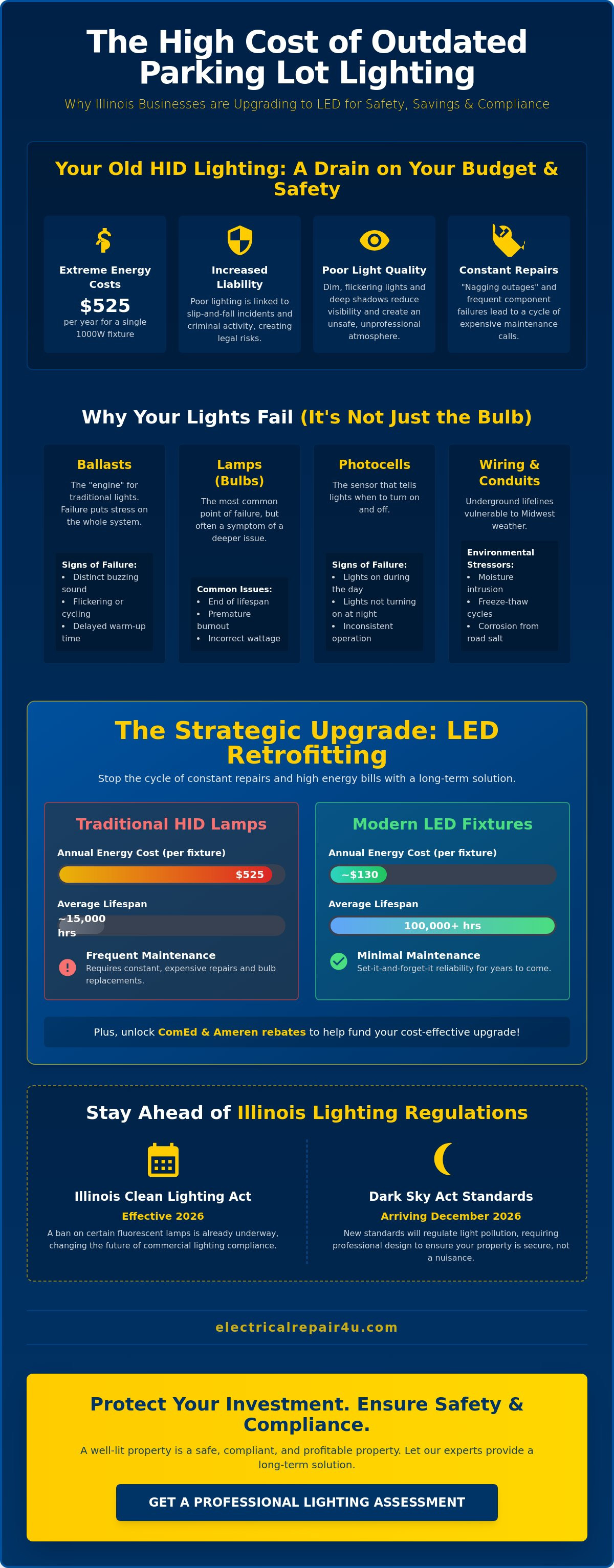
A single 1000W HID fixture can cost you $525 per year in electricity alone, yet many Illinois business owners are still paying for dim, flickering lots that invite liability and tenant complaints. It's frustrating to feel stuck between rising energy bills and unreliable contractors who offer temporary patches rather than long term solutions. You deserve a property that feels safe and professional the moment the sun goes down.
We understand that parking lot lighting repair is about more than just swapping bulbs; it's about protecting your investment and staying ahead of new regulations like the Illinois Clean Lighting Act. With the 2026 ban on certain fluorescent lamps already in effect and Dark Sky Act standards arriving in December 2026, the way you light your commercial space is changing fast. This guide will help you identify common failure points, reduce your premises liability, and use ComEd or Ameren rebates to fund cost-effective upgrades. We'll walk through everything you need to know to achieve a well-lit, compliant property while significantly lowering your monthly operating costs.
Key Takeaways
- Protect your business from premises liability by understanding the legal link between adequate illumination and tenant safety.
- Identify common technical failures in ballasts and photocells to ensure your next parking lot lighting repair addresses the root cause of the problem.
- See how professional high-reach equipment and safety cordons keep your customers safe while technicians work on elevated fixtures.
- Compare the long-term savings of LED retrofits against traditional HID lamps to stop the cycle of constant, expensive maintenance.
- Navigate local compliance requirements in Warrenville and Naperville with a team that understands the specific infrastructure of our community.
The Critical Link Between Parking Lot Lighting and Business Liability
In Illinois, owning a commercial property comes with a specific legal responsibility known as "Duty of Care." This means you're legally obligated to maintain a safe environment for anyone visiting your site. When the sun goes down, that responsibility shifts directly to your exterior illumination. If a customer trips over a curb or feels unsafe walking to their car because of a dark patch, the legal weight falls squarely on your shoulders. Neglecting a necessary parking lot lighting repair isn't just a maintenance oversight; it's a documented choice to ignore a known safety hazard.
Inadequate lighting is a primary factor in both slip-and-fall incidents and criminal activity. Dark corners provide cover for bad actors and hide physical hazards like ice, potholes, or uneven pavement. Beyond the courtroom, your lighting acts as a silent brand ambassador. A bright, evenly lit lot signals to your tenants and customers that you're a professional who cares about their well-being. Conversely, "nagging outages"—those flickering bulbs or dead fixtures you've meant to fix for weeks—act as red flags. They suggest a lack of oversight that can drive away business before a customer even reaches your front door.
Safety Standards and Lighting Requirements
Safe lighting isn't just about how many fixtures you have; it's about the quality and placement of the light. Professionals measure this in "foot-candles," which tells us exactly how much light is hitting the ground. There's a significant difference between "visible" light that lets you see your hand in front of your face and "safe" light levels that allow a driver to spot a pedestrian from a distance. We focus on uniform lighting because deep shadows between bright spots are actually more dangerous than a slightly dimmer, consistent glow. Proper design also helps manage light pollution, ensuring your lot is secure without becoming a nuisance to the surrounding neighborhood.
The Hidden Costs of Delayed Repairs
The price of a repair is often much lower than the hidden costs of waiting. If a preventable accident occurs on your property, your insurance premiums can skyrocket for years. We also see the "Broken Windows Theory" in action across local commercial strips. When a property looks neglected, it often attracts more vandalism and litter, creating a cycle of decline. Most importantly, you lose revenue when customers choose a competitor simply because their lot feels safer. Investing in parking lot lighting repair today protects your reputation and your bottom line tomorrow. It's a proactive step that removes anxiety for you and your visitors alike.
Diagnosing Failure: Why Commercial Outdoor Lighting Systems Fail
When a pole goes dark, most people assume it's just a burnt-out bulb. While lamps are the most common point of failure, they're rarely the only part of the story. Commercial lighting systems are complex ecosystems where the lamp, the ballast, and the photocell must work in perfect harmony. A failure in one often puts undue stress on the others. If you hear a distinct buzzing sound or notice a delayed warm-up time, your system is likely struggling with a failing ballast. This component acts as the engine for traditional lights; when it starts to go, it can cause the lamp to flicker or fail prematurely.
Sometimes the problem is buried deeper than the fixture itself. Underground wiring and conduits are the lifelines of your parking lot. A single dead pole can sometimes signal a looming circuit-wide issue, especially if moisture has breached a conduit. This is particularly concerning because reliable lighting is a core component of property security, a fact underscored by the National Institute of Justice report on parking facility safety. When your infrastructure fails, your security follows suit. If you're noticing systemic issues across multiple poles, it's time to look at your commercial electrical services to ensure your wiring is still intact and safe.
Environmental Stressors in the Midwest
Illinois weather is notoriously tough on exterior electrical systems. High wind loads across our flat landscape put immense physical stress on light pole foundations and the fixtures themselves. We also deal with intense freeze-thaw cycles. As the ground shifts, it can crack underground conduits, allowing water and corrosive road salt to reach the wiring. Salt is a silent killer for base plates and anchor bolts. It leads to structural instability that can turn a simple parking lot lighting repair into a major safety hazard. Regular inspections help catch this corrosion before the stability of the pole is compromised.
HID vs. LED: Understanding the Technology Gap
Many older lots still rely on High-Intensity Discharge (HID) technology, such as metal halide or high-pressure sodium. These lamps suffer from significant lumen depreciation. This means they lose a large percentage of their brightness long before they actually burn out. You might have lights that are technically "on" but aren't actually providing safe illumination. Traditional ballasts are also fragile in the face of extreme temperature fluctuations. In contrast, modern LED drivers are built for stability. They lack the sensitive components of old-school ballasts, offering a much higher level of reliability during our brutal Illinois winters and humid summers.
The Professional Repair Process: What to Expect from Your Electrician
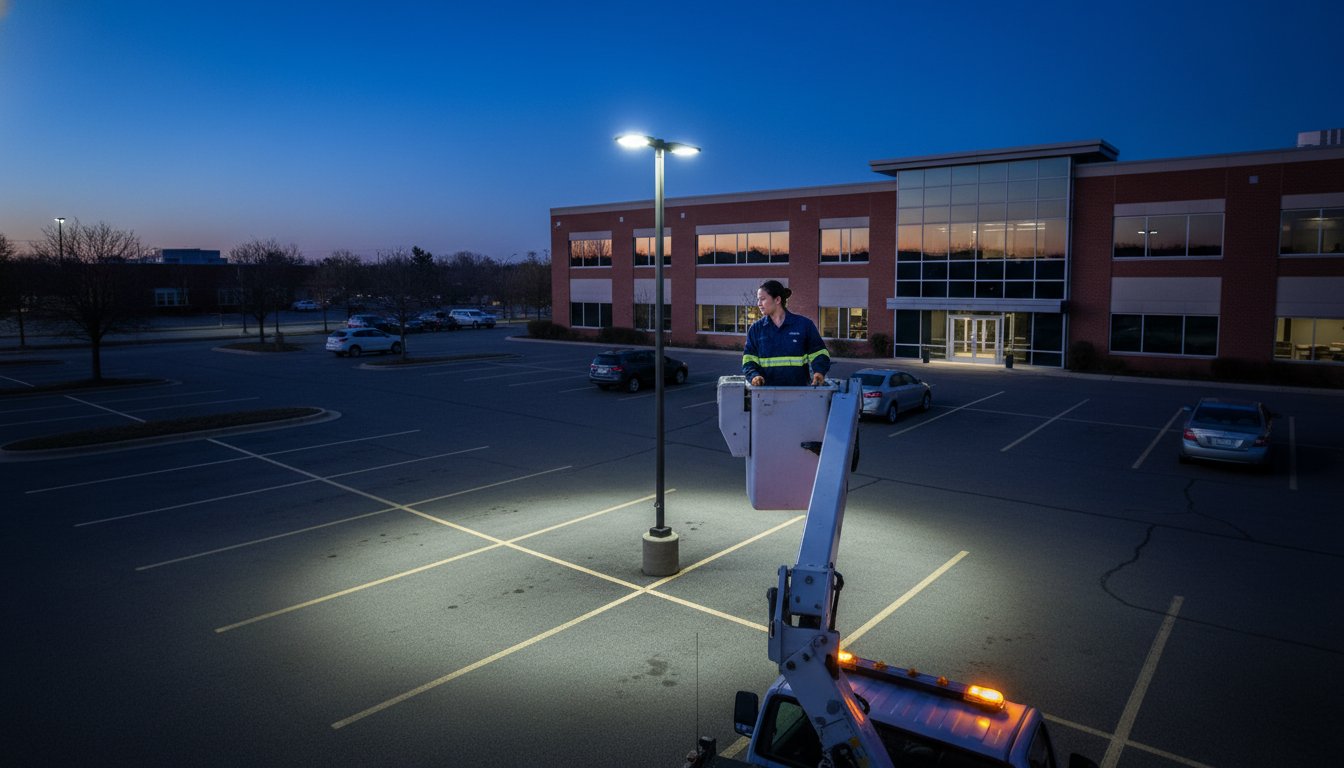
When you schedule a parking lot lighting repair, you're hiring more than just a technician with a toolbox. You're bringing specialized machinery and safety expertise to your property to handle high-reach logistics. Most commercial light poles stand between 20 and 40 feet tall, making standard ladders useless and dangerous. A professional team arrives with a bucket truck or an aerial lift to reach these fixtures safely. We don't just show up and start working. We prioritize the safety of your tenants and customers by cordoning off work zones with cones and caution tape. This prevents pedestrians or vehicles from entering the "drop zone" while we're working overhead.
A seasoned professional doesn't start by guessing. We begin the diagnostic phase at the ground level. By testing the electrical current at the pole base handhole, we can determine if the problem is in the underground wiring or up in the fixture itself. This step prevents unnecessary aerial work and ensures we target the right component the first time. We treat every call as a full system health check. We examine the socket for corrosion, check the internal wiring for heat damage, and ensure the lens is sealed against moisture. This thoroughness prevents the "callback" cycle that happens when a contractor simply swaps a bulb without addressing a failing socket or a loose connection.
Step-by-Step: The Service Call Workflow
Reliable service follows a logical path. We start with an initial site survey to map out specific outages or dimming fixtures. Once the bucket truck is positioned, we perform an aerial inspection of the housing and internal wiring. After replacing the necessary components, we test photocells and timers to ensure the lights activate at the right time. The job isn't finished until we verify light levels across the entire lot, confirming that your property meets safety standards and provides clear visibility for every visitor.
Underground Troubleshooting and Repair
Sometimes the issue isn't in the air; it's under your feet. We use specialized locators to find faults in buried wiring without digging up your entire lot. If we discover a collapsed or damaged conduit, we use precise trenching or boring techniques to replace the line with minimal disruption to your pavement. We focus on creating water-tight connections at the handhole and base. This attention to detail prevents the Midwest's moisture and road salt from causing another short circuit in the future.
LED Retrofitting: The Strategic Alternative to Constant Repairs
HID lamps are becoming a relic of the past, especially with the Illinois Clean Lighting Act phasing out certain mercury-containing bulbs starting in 2026. While traditional HID lamps might last 15,000 to 20,000 hours, modern LEDs provide 50,000 to 100,000 hours of reliable service. This translates to a "One and Done" philosophy that virtually eliminates the need for frequent bucket truck calls. Beyond longevity, LEDs offer instant-on capabilities. You no longer have to wait ten minutes for metal halide lamps to warm up after a power flicker. The crisp light quality also significantly improves security camera footage, providing better color rendering that helps identify vehicles and faces more clearly.
The ROI of a Lighting Retrofit
Upgrading your system is a financial strategy that pays for itself. LED fixtures can reduce energy consumption by 40% to 60% compared to traditional HID lights. While energy savings are impressive, the reduction in maintenance labor is often where local business owners see the most relief. Over a three-year period, maintaining a single traditional fixture can cost up to $1,200 in labor and equipment. In Illinois, utility programs make this transition even easier. For instance, ComEd offers instant rebates for exterior LED fixtures ranging from $25 to $375 depending on wattage. Ameren Illinois also provides incentives, with rebates for LED wall packs reaching up to $200. By choosing a permanent upgrade over a temporary parking lot lighting repair, you stabilize your maintenance budget and protect your bottom line.
Retrofit Kits vs. Full Fixture Replacement
You have two main paths when moving away from traditional parking lot lighting repair cycles. Retrofit kits allow us to keep your existing housings and simply swap the internal components for LED technology. This is often faster and preserves the architectural look of your property. However, full fixture replacement is frequently the better long-term choice. New LED housings are designed specifically for heat dissipation, which protects the sensitive drivers and extends the life of the unit. We ensure that any new installation is compatible with your existing poles and mounting hardware, giving you a seamless upgrade that meets the latest safety codes.
Ready to stop the cycle of flickering lights and high bills? Contact us for expert lighting solutions that secure your property for the long haul.
Securing Your Illinois Property: Local Expertise and Maintenance
Local codes in Warrenville and Naperville aren't just suggestions. They are strict requirements that dictate everything from pole height to light spill. We've spent over 40 years learning the specific infrastructure history of our community. This deep-rooted tenure means we often know the original wiring layouts of local business parks before we even open the handhole. When you call for a parking lot lighting repair, you aren't just getting a fix; you're getting decades of local wisdom that ensures your property stays compliant and safe. We understand how the original builders in this area laid their conduits, which helps us solve complex problems faster than "fly-by-night" contractors.
The most effective way to handle an electrical crisis is to prevent it entirely. By integrating your exterior fixtures into a preventative electrical maintenance schedule, you shift from reactive stress to proactive stability. This approach bridges the gap between urgent emergency repairs and long-term property health. It allows our licensed professionals to spot a fraying wire or a cracked base plate before it results in a total blackout. We don't just wait for things to break. We work as your collaborative partner to keep your facility running smoothly year-round.
Customized Maintenance Contracts
We offer "Night Patrol" services to identify outages before your tenants or customers ever have a reason to complain. This proactive monitoring ensures your lot is never the darkest one on the block. Our maintenance plans include regular cleaning of lenses to maximize light output and physical inspections of pole integrity to detect corrosion from road salt. These scheduled checks provide peace of mind through a predictable maintenance budget. You'll never be surprised by a massive repair bill because we catch the small issues during our routine visits.
Beyond the Parking Lot: Holistic Commercial Safety
Exterior safety is only one part of a professional environment. We often link your outdoor security to a high-quality office lighting installation to create a seamless, safe transition for employees leaving late at night. We also verify that your commercial electrical wiring is robust enough to support modern security cameras or smart controls. Our promise is simple: we provide neighborly reliability backed by high-stakes technical authority. When you choose us for your parking lot lighting repair, you're choosing a team that takes pride in keeping our Illinois community bright, secure, and open for business.
Secure Your Property's Future with Reliable Illumination
Maintaining a safe and inviting commercial space is a continuous commitment that protects both your reputation and your bottom line. You now understand how to spot the early warning signs of electrical failure and why moving toward modern LED technology is a vital strategic investment for your facility. Proactive maintenance does more than just lower your monthly energy bills; it removes the daily anxiety of potential liability while keeping your tenants and customers satisfied from the moment they arrive.
Our dedicated team brings over 40 years of local electrical expertise to every project in our community. As licensed and insured commercial contractors, we're fully equipped with specialized bucket trucks to handle high-reach parking lot lighting repair needs with precision and safety. We bridge the gap between high-stakes technical authority and neighborly service to ensure your property remains a pillar of security. Schedule your professional parking lot lighting assessment today to protect your investment and gain long term peace of mind. We look forward to helping you keep your business bright and secure for years to come.
Frequently Asked Questions
How often should I have my parking lot lighting inspected?
You should schedule a professional inspection at least twice a year. We recommend checks in the spring to assess winter damage and again in the fall to ensure everything is ready for the longer nights ahead. This proactive approach catches loose connections and failing photocells before they leave your lot in the dark and create a safety hazard.
What is the average lifespan of a commercial parking lot light bulb?
Traditional HID bulbs typically last between 15,000 and 20,000 hours. However, they often lose a significant amount of their brightness long before they actually burn out. Modern LED solutions offer a much longer life span, often reaching 50,000 to 100,000 hours. This longevity virtually eliminates the need for frequent maintenance calls and bulb swaps.
Why do my parking lot lights stay on during the day?
Day-burning is usually caused by a faulty photocell or a misconfigured timer. Most photocells are designed to fail in the "on" position as a safety precaution so your lot isn't dark at night. While this keeps the area lit, it wastes electricity and drastically shortens the life of your equipment. A quick sensor replacement usually resolves this issue.
Is it better to repair an old HID fixture or replace it with LED?
Replacing with LED is the smarter long-term move. The Illinois Clean Lighting Act will ban many fluorescent and HID-related bulbs by 2027, making a parking lot lighting repair on old technology a temporary fix. LED upgrades reduce energy use by up to 60% and often qualify for significant utility rebates from providers like ComEd or Ameren.
How much does a typical parking lot lighting repair service call cost?
Service costs vary based on the height of your poles and the specific components that need attention. Factors include the hourly labor rate for a licensed electrician and the operation of specialized equipment like a bucket truck. You should check with a local provider for a specific estimate based on your property's unique infrastructure and needs.
Can I change the parking lot light bulbs myself if I have a tall ladder?
No, you shouldn't attempt this yourself. Commercial poles often exceed 20 feet and carry high-voltage current that can be lethal if handled incorrectly. Professionals use bucket trucks and specialized safety gear to handle these heights safely. DIY attempts also risk violating local building codes and OSHA safety standards for commercial properties.
What are foot-candles, and why do they matter for my business?
A foot-candle is a unit that measures how much light actually reaches the surface of your pavement. Most Illinois municipalities have specific foot-candle requirements to ensure public safety and visibility. Maintaining proper levels helps prevent accidents and provides the visual clarity needed for security cameras to capture clear footage of your exterior.
Do you offer emergency parking lot lighting repair in Naperville and Aurora?
We provide dedicated parking lot lighting repair and maintenance for businesses throughout Naperville, Aurora, and the surrounding communities. Our team understands the local infrastructure and the specific wind-load requirements for our flat Illinois landscape. Contact us to check our current availability and schedule a technician to evaluate your commercial electrical needs.


