
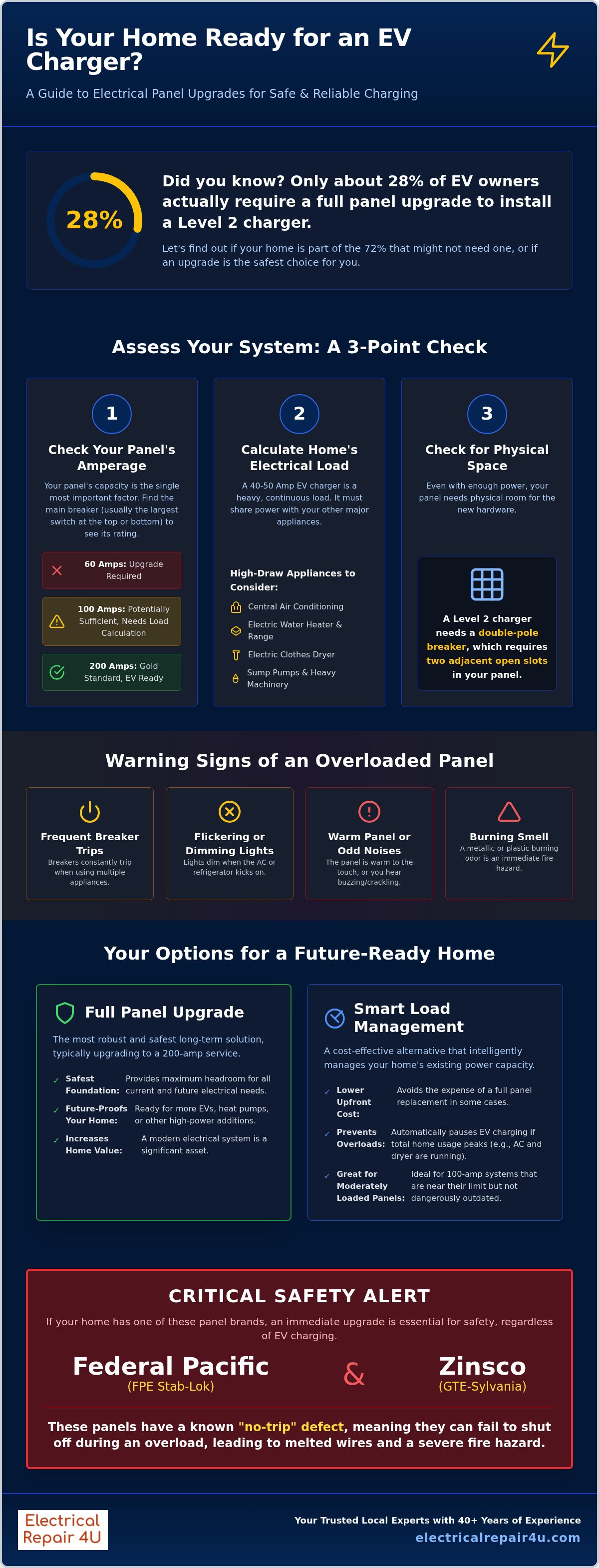
Did you know that only about 28% of EV owners actually require a full panel upgrade to support a Level 2 charger? It's completely normal to feel a bit of anxiety when you see a confusing range of quotes from different contractors. You want to charge your new car quickly, but you don't want to risk an electrical fire by overloading an aging system. We've spent over 40 years helping our neighbors in Warrenville and DuPage County navigate these technical hurdles safely.
This guide will help you determine if upgrading electrical panel for EV charger is a necessity for your specific home or if there's a more cost-effective path forward. We'll break down the specific safety benefits of a 200-amp service, explain the 2026 permit requirements for Illinois homeowners, and give you a clear framework to decide your next move. Our goal is to replace your uncertainty with the confidence of a stable, reliable installation that protects your family and your new investment.
Key Takeaways
- Learn how to spot the critical warning signs that your current breaker box is struggling before you plug in your new vehicle.
- Understand why upgrading electrical panel for EV charger to a 200-amp service provides the safest foundation for your home’s long-term power needs.
- Discover how Smart Load Management can offer a cost-effective alternative for homes where a full panel replacement isn't immediately necessary.
- Get a clear roadmap for navigating DuPage County permit requirements and local electrical codes to keep your installation worry-free.
- Benefit from 40 years of local experience to ensure your modern EV infrastructure is installed with the highest standards of safety and reliability.
Determining if Your Home Needs a Panel Upgrade for EV Charging
Most modern homes built in the last twenty years already come equipped with a 200-amp service. This is the gold standard for supporting a high-speed car charger. However, if you live in one of the many older homes in Warrenville or the surrounding DuPage County suburbs, your panel might only be rated for 100 or even 60 amps. While 100 amps was once plenty for a standard household, it often hits its limit once you introduce a Level 2 charger. This specific type of charging requires a dedicated circuit, usually drawing 40 to 50 amps on its own. Understanding EV charging station basics helps clarify why this massive draw is different from plugging in a toaster; it's a continuous load that runs for hours at a time.
Physical space is another factor homeowners often overlook. Even if your service has the capacity, your breaker box must have two adjacent open slots to accommodate the double-pole breaker required for a fast charger. If your panel is currently full, you might find yourself upgrading electrical panel for EV charger needs simply to make room for the hardware. We've spent 40 years helping neighbors identify these physical and electrical constraints before they buy their charging equipment.
Checking Your Main Breaker Amperage
You don't need to be an electrician to find your current capacity. Open the door to your electrical panel and look for the largest breaker, usually located at the very top or bottom of the stack. This is your main service disconnect. You’ll typically see a number stamped on the handle like 100 or 200. If you see a 60, your system is likely quite old and will almost certainly require an upgrade to handle modern demands safely. A 100-amp panel might scrape by if you have gas appliances, but it often struggles if you're running the air conditioning and an electric dryer simultaneously.
Calculating Your Current Home Electrical Load
Professional electricians use a specific Load Calculation to ensure your home remains safe. We look at your highest-draw appliances and how they interact. This list usually includes:
- Central Air Conditioning units and heat pumps
- Electric water heaters and kitchen ranges
- Clothes dryers and dishwashers
- Existing heavy machinery or sump pumps
Adding a 40-amp EV circuit to a 100-amp panel that's already supporting these items can tip the scales. This leads to nuisance tripping or heat buildup that damages your wiring. When we evaluate upgrading electrical panel for EV charger installations, we prioritize your home's stability over just getting the car charged. We make sure your entire system can handle the peak demand of a hot summer afternoon without breaking a sweat.
Warning Signs Your Current Electrical Panel Cannot Handle an EV Load
If your circuit breakers trip whenever you run the microwave and the hair dryer at the same time, your home is sending you a clear message. Your current system is already operating near its maximum capacity. Adding a high-demand vehicle charger to this environment is like asking a marathon runner to carry a piano; it simply isn't sustainable. While some homeowners assume a breaker that doesn't trip is a "strong" breaker, the opposite is often true. A healthy system should trip to prevent overheating, but a system that trips constantly is screaming for more headroom.
Flickering or dimming lights are another common red flag. This usually happens when a heavy-draw appliance like your refrigerator or air conditioner kicks in. It indicates a momentary voltage drop because the panel cannot distribute power quickly enough. When you begin upgrading electrical panel for EV charger installations, you eliminate these annoying brownout effects. Beyond just visual cues, pay attention to physical signs of distress. Warmth on the panel cover or a faint, metallic burning smell are signs of active electrical arcing or overheating. These are not minor issues. They are immediate fire hazards that require professional attention before any new equipment is connected.
Outdated Panel Brands and Safety Risks
In our 40 years of local service, we frequently encounter Federal Pacific Electric (FPE) and Zinsco panels in older Illinois homes. These specific brands are notorious among electricians because they often fail to trip even during a massive surge. This "no-trip" defect means the wires can melt or catch fire while the breaker stays in the "on" position. An EV charger creates a continuous load for hours, which can easily exacerbate these hidden flaws. Following the best practices for professional EV charger installation means replacing these legacy systems entirely to ensure your home meets modern safety codes. Protecting your family starts with removing these documented fire risks from your basement or garage.
Internal Corrosion and Mechanical Wear
Time is the enemy of electrical components. Over 20 or 30 years, the mechanical parts inside a breaker can seize up due to dust, humidity, or simple age. We often find rust or white powdery corrosion inside boxes located in damp basements. This buildup increases electrical resistance, creates heat, and prevents the breaker from snapping shut during an emergency. Breaker box maintenance is critical before adding an EV load because it allows a professional to verify that every mechanical connection is tight and free of life-threatening corrosion. If you're unsure about the age or condition of your system, having a licensed electrician perform a safety inspection can give you the peace of mind you need before you plug in for the first time.
Full Panel Upgrades vs. Smart Load Management Alternatives
Smart Load Management (LMS) acts as a digital traffic controller for your home’s electricity. These devices monitor your total power consumption and automatically throttle or pause your EV charger if other heavy appliances like your dryer or stove kick in. While this prevents your main breaker from tripping, it creates a different user experience compared to a full service upgrade. Choosing the right path depends on whether you want a temporary fix or a permanent solution for your home's infrastructure. We often see homeowners weigh the lower initial cost of an LMS device, which typically costs between $200 and $500, against the long-term reliability of a dedicated circuit.
Upgrading electrical panel for EV charger installations to a full 200-amp service provides a seamless, uninterrupted experience. You won't have to worry about your car charging slowly just because you decided to run a late-night load of laundry. For many of our neighbors, this total reliability is worth the investment, especially when compared to the limitations of "load shedding" technologies.
When Load Management Makes Sense
There are specific situations where the utility company's infrastructure makes a traditional upgrade cost-prohibitive. If your home's service entrance is buried under a concrete driveway or if the utility transformer is at its limit, the cost of a full upgrade can skyrocket. In these cases, a smart load management system or a "smart splitter" for your existing dryer outlet is a brilliant alternative. These splitters allow two heavy appliances to share one circuit by prioritizing one over the other. However, these are often best for drivers with short daily commutes. If you're a high-mileage driver who needs a guaranteed full charge every morning, relying on a system that pauses your charging can be a source of daily frustration.
The Long-Term Benefits of a 200-Amp Upgrade
Investing in a full upgrade is about more than just your car; it's about future-proofing your entire property. As we see more families in Warrenville move toward induction stoves, heat pumps, and electric water heaters, a 200-amp panel becomes a major selling point for your home's resale value. It transforms your electrical system from a bottleneck into a robust asset. During the process of upgrading electrical panel for EV charger service, we highly recommend a whole house surge protector installation. This simple addition shields your vehicle’s sensitive onboard computers and all your modern appliances from external power spikes. With 40 years of history in this community, we know that a solid electrical foundation is the best way to remove the anxiety of future technology shifts.
The Process of Upgrading Your Panel in Warrenville and DuPage County
The journey toward a faster, safer charge begins with a precise evaluation of your home's current capacity. When you consider upgrading electrical panel for EV charger needs, we start with a comprehensive site assessment. Our licensed electricians perform a formal load calculation to ensure your new 200-amp service meets the specific demands of your household. Our team evaluates everything from your HVAC system to your kitchen appliances to prevent future overloads. This proactive approach ensures your home remains a sanctuary of safety while your car powers up in the garage.
Navigating Local Illinois Permits and Codes
Navigating the legal requirements in Illinois can be a headache for many homeowners. In DuPage County, the minimum permit fee for residential electrical work is $50.00. However, the paperwork involved is often extensive and confusing for those outside the industry. Attempting DIY panel work isn't just dangerous; it's illegal in most of our local municipalities. We take that burden off your shoulders by handling all the necessary documentation for EV charger installation in Warrenville. This ensures your project meets the 2023 National Electrical Code standards currently enforced in cities like Wheaton.
Working with Your Utility Provider
Coordinating with ComEd is a critical step that out-of-town contractors sometimes overlook. A panel upgrade usually requires a temporary service disconnect. We schedule a specific window with the utility provider to cut power to your home while we swap the old breaker box for a modern 200-amp model. Our team manages this "Disconnect/Reconnect" process directly with ComEd to minimize your downtime. Most installations are completed within a single day. You should prepare for a power outage lasting several hours while our crew performs the high-precision work. When we handle upgrading electrical panel for EV charger projects, we prioritize efficiency to get your lights back on as quickly as possible.
Once the physical installation is complete, we arrange for a final municipal inspection. This third-party check confirms that every wire and breaker is code-compliant and safe for long-term use. We take pride in our 40-year history of passing these inspections on the first try. If you're ready to modernize your home and protect your new vehicle, contact our team to start your panel upgrade assessment. We'll walk you through every step to ensure your home is ready for the future of transportation.
Why Professional Panel Upgrades are the Safest Choice for Your Home
While it's tempting to hire a "side-job" electrician to save a few dollars, the risks of uncertified work far outweigh the initial savings. The 2026 National Electrical Code (NEC) updates now explicitly require a qualified person for EV equipment installation. This isn't just about technical skill; it's about total accountability. When you're upgrading electrical panel for EV charger service, you're modifying the very heart of your home's safety system. A professional ensures that every connection is torqued to specific standards and every breaker is sized correctly. This prevents the heat buildup that leads to electrical fires and ensures your new investment doesn't become a liability.
Professional service also provides a layer of protection for your sensitive electronics. Modern EV chargers and home appliances contain complex circuit boards that are vulnerable to power fluctuations. By choosing a seasoned expert, you're ensuring that your 200-amp upgrade includes the necessary grounding and bonding to stabilize your entire system. We've spent 40 years refining our craft to provide results that don't just work today, but stay reliable for the next several decades.
Insurance and Liability Considerations
Many homeowners don't realize that unpermitted electrical work can lead to a denied insurance claim if a fire occurs. By choosing a licensed, insured, and bonded professional, you protect your single largest investment. We provide the paper trail necessary to prove your residential electrical repair in Warrenville meets the latest 2026 safety standards. This documentation is also vital for claiming the 30% federal tax credit on charging equipment. To qualify for this credit, you must show the system was placed in service by a qualified professional. Our comprehensive warranty on parts and labor means we stand by our work long after our truck leaves your driveway.
Your Collaborative Partner in Home Safety
At Electrical Repair 4U, we don't view ourselves as just another contractor. We're your neighbors who have served this community for over 40 years. We treat your home with the same diligence we use on our own. This neighborly reliability means we're here to answer your questions and provide support even after the project is finished. Upgrading electrical panel for EV charger capacity is a significant step toward a modern, sustainable lifestyle. We want to make sure it's a positive, anxiety-free experience for your family. Your next step is simple. Reach out to schedule your home electrical capacity assessment today. We'll help you find the most cost-effective and secure way to power your future.
Powering Your Future with Confidence
Choosing the right path for your home's electrical system doesn't have to be a source of stress. Whether you decide on a full 200-amp service or a smart load management solution, the priority remains the same: protecting your family and your new investment. Upgrading electrical panel for EV charger capacity is a significant step that transforms your home into a modern, energy-efficient hub while ensuring your insurance remains valid and your electronics stay safe from surges.
Our team of Licensed and Insured Master Electricians brings over 40 years of local service in DuPage County to every project. We specialize in EV infrastructure and safety upgrades, handling everything from load calculations to final municipal inspections with neighborly reliability. Don't leave your home's safety to chance or uncertified contractors. Schedule Your Professional Panel Assessment with Electrical Repair 4U Today and get the expert guidance you deserve. We're ready to help you power your vehicle with total peace of mind.
Frequently Asked Questions
How much does it cost to upgrade an electrical panel for an EV charger in 2026?
Costs for a panel upgrade depend on several variables, including your home’s current infrastructure and local municipal requirements. Factors such as the distance from the utility transformer and the need for a new service drop can influence the final investment. Because every home in Warrenville is unique, we provide a detailed assessment to outline the specific requirements for your property. This ensures you receive a solution tailored to your safety needs without hidden surprises.
Can I install a Level 2 charger on a 100-amp panel?
It is possible, but it depends entirely on your home's existing electrical load. If you use gas appliances for heating, cooking, and drying clothes, you might have enough headroom. However, homes with electric HVAC and water heaters usually hit their limit quickly. A licensed electrician must perform a National Electrical Code load calculation to ensure you don't risk a fire or frequent breaker tripping. Safety should always come before convenience.
How long does a typical 200-amp panel upgrade take to complete?
Most residential panel swaps are completed within a single day. You can expect a planned power outage lasting between four and eight hours while we coordinate with ComEd to disconnect and reconnect your service. Our team works efficiently to minimize downtime so your household returns to normal by dinner. We handle all the prep work beforehand to ensure the physical installation goes smoothly on the day of your scheduled service.
Will my electricity bill go up significantly after a panel upgrade?
The upgrade itself won't increase your bill, but your usage habits will change. Charging an EV is cheaper than buying gasoline, but it adds a new load to your monthly statement. To keep costs low, consider ComEd’s time-of-use rates. These programs encourage off-peak charging at night when electricity is less expensive. Upgrading electrical panel for EV charger installations actually helps your home run more efficiently by reducing heat loss from old, overloaded circuits.
What is a load management system, and can it save me from a panel upgrade?
A load management system is a digital controller that monitors your home’s power draw. It can pause your EV charger if you turn on a high-demand appliance like an electric range. While this can sometimes bypass the need for a full upgrade, it means your car might charge slower during peak hours. It’s a great alternative for homes where utility-side upgrades are physically impossible or excessively expensive due to complex underground wiring.
Do I need a permit to upgrade my electrical panel in Illinois?
Yes, every municipality in Illinois requires a permit for panel work. In DuPage County, the minimum fee for residential electrical permits is $50.00. These permits ensure that a third-party inspector verifies the work meets current safety codes. Attempting this work without a permit is illegal and can void your homeowners insurance. We take care of the entire application process and coordinate the final inspection for your peace of mind and long-term security.
Is a 200-amp panel upgrade required for a Tesla Wall Connector?
While not strictly required by the hardware, it’s highly recommended for a full 48-amp charge. A Tesla Wall Connector can be commissioned at lower amperages to fit a 100-amp panel, but you’ll get much slower charging speeds. Upgrading electrical panel for EV charger capacity to 200 amps allows the connector to run at its maximum potential. This ensures you get a full battery every morning without worrying about which other appliances are running simultaneously.
What are the signs that my current breaker box is a fire hazard?
Watch for physical signs like a faint burning smell, buzzing sounds, or a panel cover that feels warm to the touch. Frequent tripping is a sign of an overloaded circuit, but a breaker that fails to trip is even more dangerous. If you see rust or white corrosion inside the box, the mechanical parts may be seized. These issues require immediate attention from a professional to prevent active arcing and potential house fires.


