
With Illinois aiming for one million electric vehicles on the road by 2030, your parking lot is quickly becoming a critical piece of your business infrastructure. You likely feel the pressure to keep up, but the jump from a standard outlet to a full-scale commercial EV charger installation is a high-stakes technical challenge. It's natural to worry about whether your existing electrical panel can handle the new load or how to navigate the specific building codes and utility requirements across the Chicago suburbs.
We understand that you want a solution that provides security and stability for your property, not just a new piece of hardware. This guide provides the expert clarity you need to choose between Level 2 and DC fast charging while ensuring your project remains safe and code-compliant. We'll walk you through the 2026 landscape of ComEd rebates and Illinois EPA grants so you can invest with total confidence. You'll learn how to integrate a scalable charging system that attracts top-tier employees and keeps your business ahead of the curve without the technical stress.
Key Takeaways
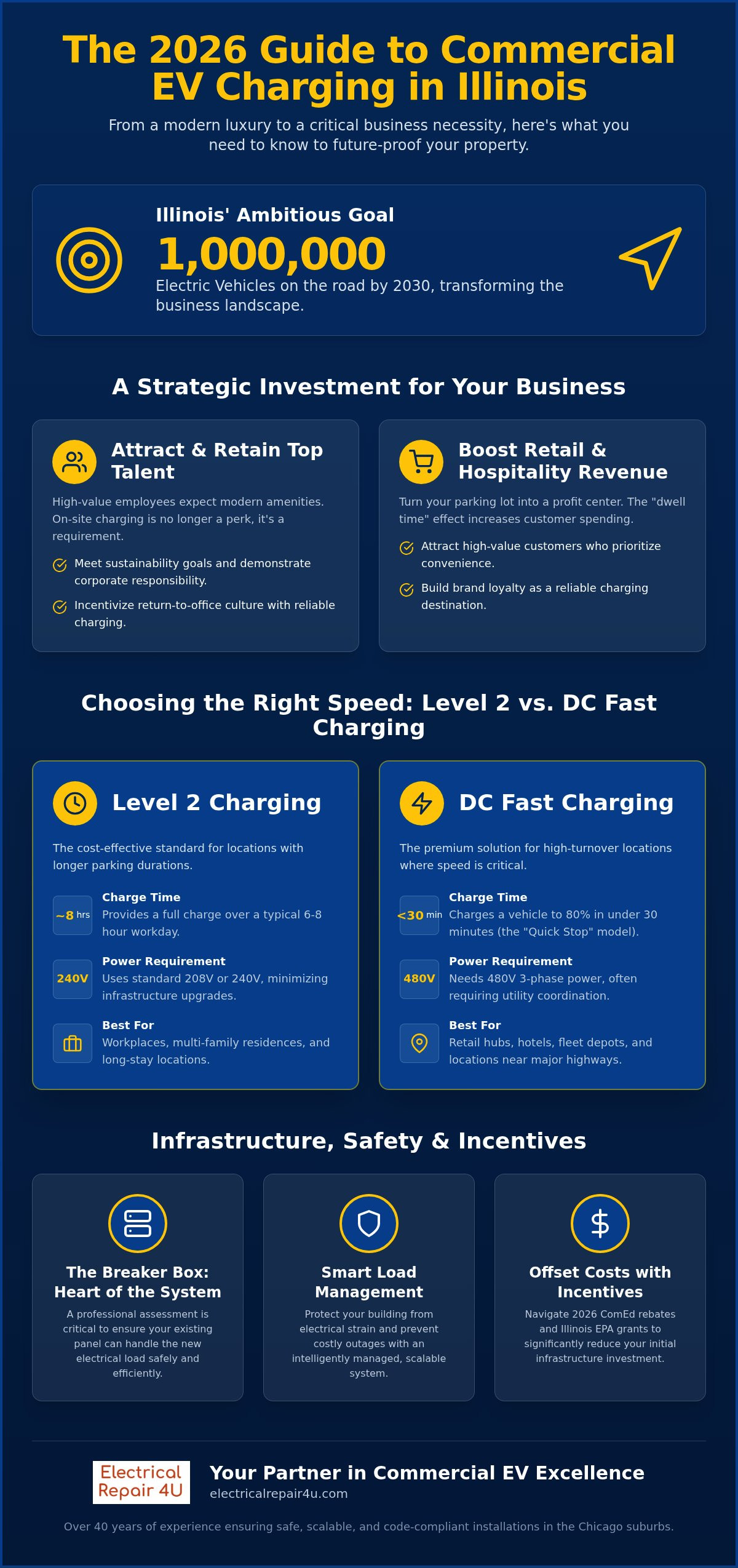
- Understand how Illinois’ goal of one million EVs by 2030 is transforming charging stations from a modern luxury into a critical business necessity for attracting top-tier talent and customers.
- Identify the technical differences between Level 2 and DC Fast Charging to select the equipment that best aligns with your property’s electrical capacity and typical parking durations.
- Learn why your breaker box is the heart of a successful commercial EV charger installation and how professional load management protects your building from electrical strain.
- Navigate the latest 2026 ComEd rebates and Illinois state incentives to significantly offset infrastructure costs while ensuring your project meets all local building codes.
- Discover how partnering with a seasoned local expert with over 40 years of experience removes the anxiety from complex rewiring and large-scale electrical upgrades.
The Strategic Importance of Commercial EV Charging in Illinois
The 2026 business landscape in Illinois has shifted. With the state's goal to have one million electric vehicles on the road by 2030, a commercial EV charger installation isn't just a tech upgrade. It's a foundational part of your property's long-term stability. We've seen this transition firsthand over our 40 years serving the Chicago suburbs. Modern business infrastructure requires more than a simple plug. It requires a dedicated electric vehicle charging station designed for high-frequency use and heavy electrical loads.
In towns like Warrenville and Naperville, climate-specific installation is non-negotiable. Our brutal winters and humid summers can wreak havoc on poorly planned outdoor systems. You need a setup that offers security and reliability year-round. Investing in your own infrastructure gives you total control over your power and your brand. It's about engineering a safe, scalable foundation that protects your property and your investment.
Attracting and Retaining Top Talent
High-value employees expect workplace amenities that align with their lifestyle. By 2026, on-site charging has moved from a "nice-to-have" luxury to a standard requirement for recruitment. Offering this service demonstrates a tangible commitment to corporate social responsibility. It helps your business meet sustainability goals while removing the anxiety of "range-watching" for your team. Many local offices in the Western Suburbs now use reliable charging access as a key incentive to encourage a return-to-office culture. When your staff feels supported, your building's value stays competitive.
Retail and Hospitality: Charging as a Revenue Driver
For retail and hospitality businesses, charging stations act as a powerful magnet. The "dwell time" effect is real. When customers know they can top off their battery while they shop or dine, they stay longer. This increased time on-site directly correlates with higher customer spend. It's a simple way to build brand loyalty through premium parking amenities.
- Attract High-Income Drivers: EV owners often represent a demographic that values convenience and premium services.
- Build Loyalty: Drivers will choose your location over a competitor if they know a reliable charge is waiting.
- Future-Proofing: As internal combustion engines age out, your property remains a destination of choice.
Building this infrastructure now ensures you aren't left behind. It turns a parking lot into a productive asset that serves your community and your bottom line.
Level 2 vs. DC Fast Charging: Selecting the Right Speed
Deciding on the right speed for your lot is the first step toward a successful commercial EV charger installation. It isn't just about picking the fastest unit on the market. It's about engineering a solution that fits your specific property and your customers' needs. We've spent over 40 years helping local business owners make these technical choices without the stress. Residential chargers are simple; commercial systems are a high-stakes technical jump that requires a steady, experienced hand. You need a setup that provides long-term stability for your building's infrastructure.
Level 2 Charging for Workplaces and Multifamily
Level 2 charging is often called the 'workplace standard' because it matches the natural rhythm of a business day. These units operate on 208V or 240V power. They provide a full charge over a six to eight-hour window. If your employees or tenants park for the long haul, this is your most cost-effective path. It allows you to install multiple ports without immediately triggering expensive transformer upgrades. We focus on scalability here. You want a system that can grow as more of your team switches to electric. Our team can evaluate your current breaker box maintenance needs to ensure your panel is ready for the new load.
DC Fast Charging for High-Turnover Locations
Speed is the priority for retail hubs, hotels, and fleet operations. A DC Fast Charging (DCFC) commercial EV charger installation can charge a vehicle to 80 percent in under 30 minutes. This 'Quick Stop' model is ideal for locations near major Illinois highways where drivers aren't staying for long. However, the infrastructure requirements are much higher. You typically need 480V three-phase power. This often means coordinating with the utility for a new transformer. These systems involve specialized high-voltage components that require expert handling to ensure safety.
While the equipment is more complex, the latest Illinois EV charging incentives often provide significant support for DCFC projects in specific corridors. We help you navigate these utility requirements so you can offer premium speed without compromising your building's safety. Ultimately, you have to balance charging speed with your available electrical capacity. Pushing a system too hard leads to technical failures. We take a collaborative approach. We look at your peak power usage and your future goals. This ensures your new charging station feels like a seamless part of your property, not a constant source of anxiety.
Infrastructure Assessment: Panels, Load Management, and Safety
Your charger is the most visible part of the project, but the electrical panel is the true heart of the operation. A successful commercial EV charger installation requires a deep dive into what's happening behind your walls. We've seen many businesses rush into buying hardware only to find their existing infrastructure can't support the draw. This leads to blown fuses, tripped breakers, and unnecessary stress. Our goal is to remove that anxiety by engineering a safe, stable foundation from the start. We treat your building's electrical health as our top priority.
Evaluating Your Current Electrical Capacity
We begin by evaluating your building's current capacity. It's a simple math problem with high stakes: can your facility handle 10 or more high-draw units running simultaneously during your peak business hours? This is why professional breaker box maintenance is a non-negotiable first step. We look for signs of aging, such as corrosion or loose connections, that might signal the need for a full panel upgrade. Every commercial-grade charger needs a dedicated circuit. This ensures that a problem with one unit doesn't shut down your entire parking lot or, worse, your office lights.
Smart Load Balancing and Energy Storage
Smart technology provides a safety net through dynamic load balancing. These intelligent chargers communicate with each other to distribute power based on real-time demand. This prevents your building from exceeding its maximum electrical limit and keeps your utility bills predictable. We can often integrate these systems directly with your building management software for seamless oversight. Safety doesn't stop at the software level, though. Just as we advocate for whole house surge protector installation in residential settings, commercial properties require industrial-grade surge protection. This guards your investment against Illinois' unpredictable storms and grid fluctuations.
Longevity comes from a proactive approach to fire prevention and heat management. High-voltage equipment creates significant heat during long charging cycles. We use high-caliber materials and proven installation techniques to ensure every connection is secure and every wire is properly rated. This neighborly reliability is what we've built our reputation on for over 40 years. You shouldn't have to worry about what's happening in your utility room. By focusing on the infrastructure first, we provide the security you need to grow your business with confidence.
The Installation Roadmap: Permits, Utilities, and Incentives
A successful commercial EV charger installation follows a strict roadmap. We've spent over 40 years guiding local businesses through this process, from the first site assessment to the moment the first vehicle plugs in. Taking a proactive approach removes the anxiety of unexpected delays. You need a partner who understands that this isn't just about wiring; it's about navigating the specific utility and municipal landscape of the Chicago suburbs. We handle the technical heavy lifting so you can focus on running your business.
Utility Coordination and Grid Connection
Your electrician must talk to the utility company early. If you're installing high-speed chargers, you might need a transformer upgrade. These upgrades involve coordination with ComEd and can take several months to finalize. As of August 2026, the ComEd Make-Ready Rebate program remains a powerful tool for local businesses. It offers up to $5,333 per port for Level 2 chargers and up to $667 per kW for DC fast chargers.
We also help you leverage Illinois EPA grants under the Climate and Equitable Jobs Act (CEJA), which provides up to $5,000 per Level 2 port. It's important to note that the Federal 30C tax credit expired on June 30, 2026, making these state and utility programs even more vital for your budget. Our team ensures your application is accurate and submitted promptly to secure these first-come, first-served funds.
Local Permitting and Code Compliance
Permitting in Warrenville, Naperville, and Aurora requires a deep understanding of local building codes. Inspectors in DuPage County look for specific safety features, including proper signage and ADA (Americans with Disabilities Act) compliance. Your charging spaces must be accessible, with correct reach ranges and clear floor space for drivers with disabilities. Failing to meet these standards can lead to costly rework and liability issues down the road.
Using a licensed and insured electrician is non-negotiable for commercial projects. It protects your property and ensures every connection meets the highest safety standards. We take pride in our "no-anxiety" approach, providing the documentation and expertise local officials expect during the inspection process. If you are ready to start your project with a team that knows the local requirements inside and out, contact our commercial electrical experts for a comprehensive site evaluation.
Electrical Repair 4U: Your Partner in Commercial EV Excellence
We've been a staple of the Warrenville community for over 40 years. That's four decades of watching technology evolve while our commitment to safety remains unchanged. When you choose us for your commercial EV charger installation, you aren't just hiring a contractor. You're partnering with licensed master electricians who treat your property like our own. We understand that complex electrical upgrades can be stressful. Our "No-Anxiety" approach is designed to remove that burden from your shoulders. We handle the technical details, the utility paperwork, and the local code requirements so you don't have to.
Our local history gives us a unique perspective on the Chicago suburbs. We know the specific electrical needs of businesses in Naperville, Aurora, and beyond. This isn't a faceless corporation; it's a dedicated team of professionals who take pride in their craft. We've built our reputation on honesty and high-caliber results. You can count on us for steady, logical solutions that move quickly from the problem to the resolution. We're here to ensure your business stays current in more ways than one.
The Advantage of a Full-Service Electrical Partner
We don't just bolt a charger to a wall. We secure your entire electrical system from the ground up. Our deep expertise in commercial electrical services spans retail, office, and industrial sectors. This means we understand how a new charging station interacts with your existing lighting, machinery, and office equipment. We look for the "hidden" risks that others might miss. Our team ensures your property is ready to handle the increased load without compromising daily operations.
Safety is our anchor. We prioritize longevity and stability in every project we touch. By positioning ourselves as collaborative partners, we foster a sense of long-term commitment to your success. Our work protects your property from the risks of high-draw equipment. We ensure your infrastructure is ready for 2026 and the decades that follow. You deserve a system that works reliably every time a customer or employee plugs in.
Ready to Power Your Business?
Getting started is straightforward and accessible. We begin with a comprehensive site assessment to evaluate your current capacity and future goals. This proactive attitude ensures we identify challenges before they become expensive problems. The Electrical Repair 4U guarantee is built on stability, safety, and professional results. We provide the emotional reassurance that your investment is in the hands of seasoned veterans.
Don't let technical confusion stall your progress. Our team is ready to help you navigate the complexities of modern infrastructure with confidence. We project a proactive attitude and constant availability because we genuinely desire to help our neighbors succeed. Contact Electrical Repair 4U for your commercial EV consultation today! and see how four decades of experience can empower your business.
Power Your Business for the Future
Transitioning to an electric future is a significant step for any Illinois property owner. You now understand how selecting the right charging speed and reinforcing your building's electrical foundation protects your long-term investment. By navigating the 2026 rebate landscape and local building codes today, you position your business as a leader in sustainability and customer convenience.
A successful commercial EV charger installation requires more than just hardware; it demands a safe, scalable infrastructure. With over 40 years of local electrical expertise, our licensed and insured master electricians specialize in the high-capacity commercial upgrades needed for modern charging networks. We remove technical anxiety by serving as your collaborative partner through every permit and inspection. Schedule Your Commercial EV Site Assessment with Our Experts to ensure your property is ready for the road ahead. Let's build a more stable and connected community together.
Frequently Asked Questions
How much does it cost to install a commercial EV charging station?
Total investment for a commercial EV charger installation depends on your building's current electrical capacity and the distance from the breaker box to the charging site. While equipment costs vary, the infrastructure work, such as trenching or panel upgrades, often represents the largest portion of the budget. We focus on engineering a stable, safe foundation that prevents technical failures. You should also consider current utility rebates that can significantly offset these initial expenses.
What is the difference between Level 2 and DC Fast Charging for businesses?
Level 2 chargers use 208/240V power and are perfect for employees or tenants who park for several hours. DC Fast Charging (DCFC) requires 480V three-phase power and can charge a vehicle to 80 percent in under 30 minutes. Choosing the right speed depends on how long your visitors typically stay. For retail hubs, speed is essential. For offices, Level 2 provides a cost-effective workplace standard that supports long-duration stays without overwhelming the grid.
Does my commercial building need a new transformer for EV chargers?
It depends on your building's peak load and the type of chargers you install. Level 2 stations often work with existing transformers if your panel has enough headroom. However, DC Fast Chargers almost always require a transformer upgrade to handle the high-voltage draw. We coordinate directly with ComEd to determine if your property needs more power. This ensures your installation provides long-term stability without causing outages for the rest of your facility.
Are there tax credits or incentives for commercial EV charging in Illinois in 2026?
Yes, Illinois offers robust incentives in 2026 through the ComEd Make-Ready program and IL EPA grants. ComEd provides rebates for infrastructure preparation, while the Climate and Equitable Jobs Act (CEJA) offers grants for the charging ports themselves. It's important to note that the Federal 30C tax credit expired on June 30, 2026. Because these state programs operate on a first-come, first-served basis, we recommend starting your project early to secure available funding.
How many EV charging ports should my business provide?
Most local businesses start with two to four ports and scale up as demand grows. If you are applying for ComEd rebates, they currently offer incentives for up to 10 ports per site. We look at your employee headcount and customer turnover to find the right balance. It's often smarter to prepare the underground infrastructure for more ports than you need today. This allows for seamless expansion without the stress of future construction.
What are the maintenance requirements for commercial EV chargers?
Professional maintenance involves regular software updates and physical inspections of the charging cables and connectors. High-use commercial chargers experience significant wear and tear from weather and frequent handling. We also recommend periodic breaker box maintenance to ensure the high-draw circuits remain secure. Keeping your system updated prevents technical failures and ensures a reliable experience for your drivers. Proactive care is the best way to protect your infrastructure investment for the long haul.
How long does a commercial EV charger installation typically take?
A standard install can take a few weeks, but utility coordination often extends the timeline to several months. The physical wiring and mounting usually happen in just a few days. The bottleneck is often waiting for permits or transformer upgrades from the utility company. We manage the entire roadmap for you, handling the technical heavy lifting and paperwork. This "no-anxiety" approach keeps your project moving steadily from the initial site assessment to the final inspection.
Is it possible to charge customers for using my EV charging stations?
You can absolutely charge a fee to customers or tenants for using your charging stations. Most modern commercial chargers include networking software that allows you to set pricing based on time or energy used. This can help you recoup your investment or cover the ongoing electricity costs. We help you select software that integrates with your current billing systems. It turns your parking lot into a premium amenity that can eventually pay for itself.


