
Did you know that a standard wall plug only adds about three miles of range to your electric vehicle for every hour it's plugged in? For most Illinois families, that's barely enough to cover a quick trip to the grocery store, let alone a daily commute. You've likely realized that a Level 2 upgrade is the only way to get 20 to 40 miles of range per hour, but finding a straight answer on the cost to install 240v outlet for EV charger often feels like a moving target. Between conflicting quotes from contractors and confusion over local building codes, the process can feel more stressful than it needs to be.
We understand the anxiety that comes with high-voltage upgrades, especially when you're unsure if your current electrical panel can handle the new demand. This 2026 guide provides a transparent look at the labor, material, and permit costs for a professional installation in your Illinois home. You'll learn exactly how to budget for your project, why professional safety standards matter for your home's longevity, and how to claim local ComEd rebates of up to $1,000. We'll walk you through the specifics of DuPage County permits and panel requirements so you can power up with total confidence.
Key Takeaways
- Learn why a 240V circuit is the gold standard for home charging, delivering up to 40 miles of range per hour to keep your vehicle ready for the daily commute.
- Discover the typical 2026 cost to install 240v outlet for EV charger and how the distance from your electrical panel determines your total investment.
- Understand the critical role of municipal permits in Naperville and Aurora to ensure your installation is safe, code-compliant, and fully covered by insurance.
- Find out how to maximize your savings by claiming ComEd rebates of up to $1,000 for your Level 2 charging equipment and installation.
- Compare the benefits of a flexible NEMA 14-50 outlet versus a hardwired connection to future-proof your garage for years to come.
What is a 240V EV Outlet and Why Do You Need One?
Think of a 240V outlet as the heavy-duty infrastructure your home needs to keep up with modern transportation. While your car likely came with a travel cord that fits into a standard 120V wall plug, that's really meant for emergencies or occasional top-offs. A dedicated 240V circuit, often called Level 2 charging, is the gold standard for residential setups. It provides the muscle needed to charge your battery quickly and safely. Using a standard household outlet for an EV is like trying to fill a swimming pool with a straw; it’s slow, inefficient, and puts a constant strain on wiring that wasn't built for that level of heat. Standard outlets aren't designed for the continuous high-amperage draw required by a vehicle, which can lead to overheating if the circuit isn't up to the task.
The emotional shift after an upgrade is immediate. You'll stop checking your range every time you pull into the driveway or worrying about whether you have enough "juice" for a spontaneous trip. Instead, you simply plug in and wake up every morning with a full tank. This peace of mind is one of the biggest reasons homeowners ask about the cost to install 240v outlet for EV charger. It removes the stress of hunting for a public station and ensures your vehicle is always ready for the unexpected.
Level 1 vs. Level 2: The Practical Difference
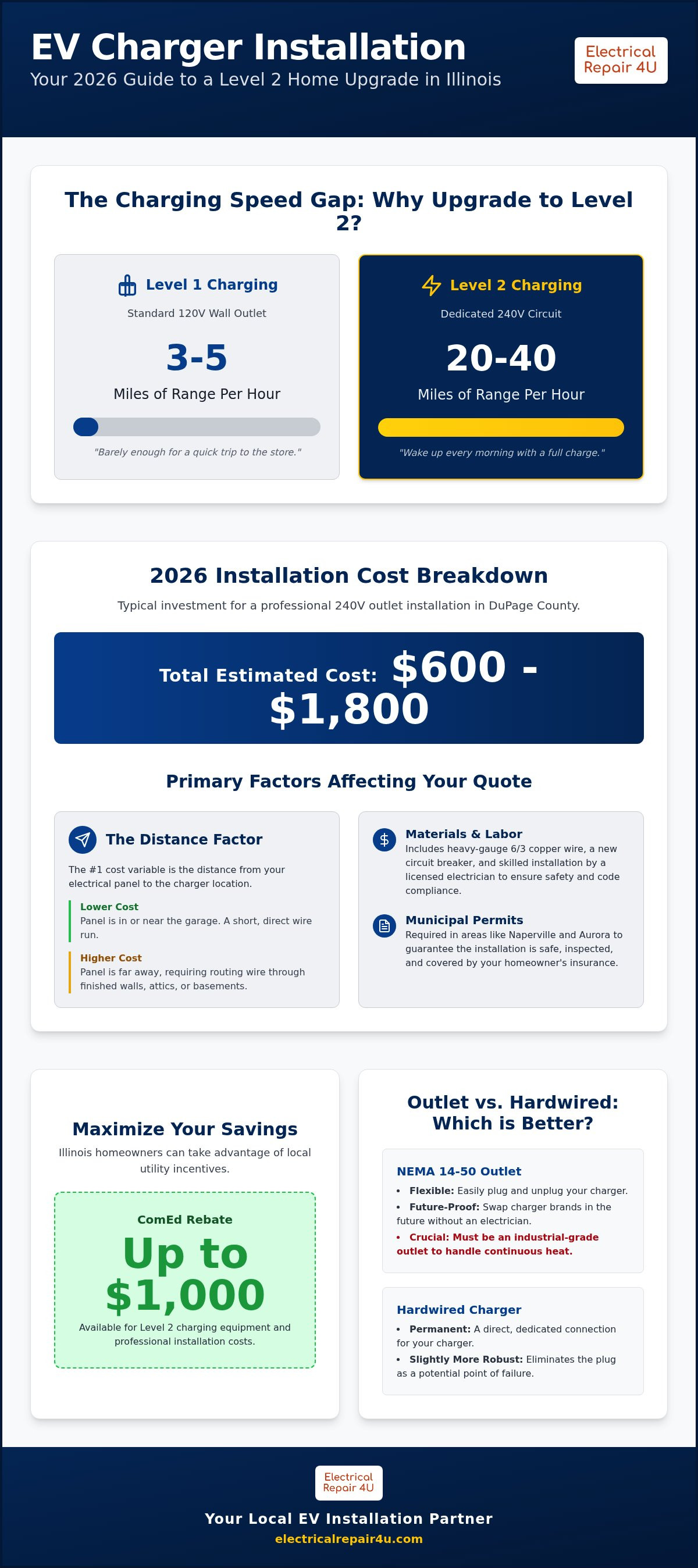
The technical jump from 120V to 240V isn't just a small step; it's a massive leap in efficiency. Standard Level 1 charging only adds about 3 to 5 miles of range per hour. If you have a long commute or drive a large electric SUV with a massive battery, that trickle charge won't even cover your daily mileage. By contrast, a Level 2 setup delivers 25 to 40 miles of range per hour. Level 2 charging is a dedicated 240V circuit typically providing 7.2kW to 11.5kW of power. This high-speed electric vehicle supply equipment (EVSE) ensures your car is fully replenished in hours rather than days.
The NEMA 14-50 Outlet Explained
Most homeowners choose the NEMA 14-50 outlet because it offers incredible versatility. This is the same type of heavy-duty plug used for electric ranges. It allows you to plug in your charger today and easily swap it for a different brand tomorrow without calling an electrician back. However, we always emphasize the importance of using industrial-grade outlets. The cheap versions often found at big-box stores are designed for appliances that cycle on and off. EV chargers draw maximum power for hours at a time. An industrial-grade outlet is built with more robust materials to handle that continuous heat without melting or failing. Investing in quality components now helps manage the long-term cost to install 240v outlet for EV charger by preventing future repairs and ensuring your home stays safe.
Average Cost to Install 240V Outlet for EV Charger in 2026
Pricing for residential electrical work in 2026 reflects a combination of specialized labor and fluctuating material markets. For a standard setup in the Chicago suburbs, the cost to install 240v outlet for EV charger typically ranges from $600 to $1,800. This estimate covers the essential components like the circuit breaker, heavy-duty wiring, and the professional labor required to ensure your home meets modern safety standards. In DuPage County, labor rates for licensed professionals stay consistent with the high level of expertise needed to navigate local building codes and inspection requirements.
Material costs play a massive role in your final investment. Copper pricing trends in 2026 continue to influence the price of heavy-gauge 6/3 wire, which is the industry standard for handling the continuous load of a Level 2 charger. Using the correct wire size is vital for preventing heat buildup over hours of charging. You can find a deeper dive into these technical requirements in the EPA’s home charging installation guide. Our team focuses on using high-quality materials that provide longevity and stability for your home infrastructure.
Breakdown of Installation Variables
The "Distance Factor" is the most significant variable in any quote. If your electrical panel is located in the garage near the desired outlet, the installation is straightforward and more affordable. However, if an electrician must route conduit through a finished basement, across an attic, or around the exterior of your home, the labor and material costs will rise. Wall penetration also adds to the complexity; drilling through simple drywall is far less labor-intensive than boring through solid brick or concrete foundations. Additionally, modern National Electrical Code (NEC) standards now require specialized GFCI breakers for EV circuits. These units are more expensive than standard breakers, but they offer superior protection against ground faults in damp garage environments.
When the Price Increases: Panel Upgrades
Sometimes your home's existing infrastructure isn't quite ready for the high-amperage draw of a vehicle. Before adding a new circuit, an electrician performs a load calculation to ensure your total home power usage won't exceed your panel's capacity. If you're currently living with an older 100-amp service, you may need a 200-amp panel upgrade to safely accommodate the charger along with your AC and kitchen appliances. When the main panel is healthy but simply lacks physical space for another breaker, installing a sub-panel can be a more cost-effective alternative. Our experts at Electrical Repair 4U can evaluate your current system to recommend the safest and most efficient path for your specific home layout.
Local Factors: Permits and Rebates in DuPage County
In municipalities like Naperville, Aurora, and Elmhurst, securing an electrical permit is a mandatory step for any Level 2 charging project. Local building departments enforce these rules to protect homeowners from the risks associated with high-voltage wiring. When an official inspector reviews the finished work, they verify that the installation won't compromise your home's electrical integrity. This verification is essential for maintaining your homeowner's insurance coverage, as many policies won't cover damages caused by unpermitted electrical modifications. Skipping a permit in Warrenville can lead to expensive fines or messy complications during a future home sale.
While the permit process adds a small administrative step, it serves as your ultimate safety net. The $50.00 residential electrical permit fee in DuPage County is a minor investment compared to the security of knowing your system is up to code. Professional contractors handle these details daily, ensuring that every wire and breaker meets the specific standards of your local village or city hall.
Navigating Illinois Building Codes
The 2026 landscape for electrical work is governed by updated National Electrical Code (NEC) standards, which mandate specific safety features like GFCI protection for garage outlets. In the Chicagoland area, local codes often require the use of metal conduit rather than flexible cabling to protect wires from physical damage in a garage environment. These technical details can impact the cost to install 240v outlet for EV charger, but they are vital for long-term reliability. Our team at Electrical Repair 4U has spent over 40 years mastering these local nuances. We handle all the permit applications and schedule the inspections for you, removing the administrative burden from your shoulders.
Maximizing Your ROI with Local Incentives
Several programs help offset the cost to install 240v outlet for EV charger in 2026, making the upgrade much more affordable. The ComEd "Charge Smart" program offers a rebate of up to $1,000 for the purchase and installation of a Level 2 charger through December 31, 2026. For those living in designated equity investment communities, this rebate can reach as high as $2,500. Additionally, the Illinois EPA’s EV Rebate Program accepts applications between August 1 and December 31, 2026, providing another layer of financial relief for local residents.
Beyond direct rebates, you can save money every month by enrolling in "Time of Use" (TOU) rates. These programs allow you to pay lower electricity prices when you charge during off-peak overnight hours. Federal tax credits also remain a powerful tool; you can claim 30% of your installation costs, up to $1,000, if the project is completed by June 30, 2026. A professional installation doesn't just save you money through rebates; it increases your home's marketability and value as EV adoption continues to climb across the Chicago suburbs.
NEMA 14-50 Outlet vs. Hardwired Charger: Which is Better?
Once you've decided to upgrade your home's infrastructure, the next big decision is choosing between a plug-in outlet or a hardwired connection. This choice doesn't just affect the cost to install 240v outlet for EV charger; it dictates your daily charging speed and long-term system reliability. While a NEMA 14-50 outlet is incredibly popular for its versatility, hardwiring is often the preferred choice for those seeking the highest levels of safety and performance. We see this as a balance between short-term convenience and long-term stability for your home.
Hardwired connections offer superior thermal safety because they eliminate the physical plug-and-socket connection. Every mechanical connection is a potential point of resistance and heat; by removing the plug, you remove a common failure point. For homeowners who plan on charging their vehicles for six to eight hours every night, reducing these risks is a smart move for total home security. Additionally, hardwiring unlocks faster charging speeds. A NEMA 14-50 outlet is typically capped at a 40-amp continuous draw on a 50-amp breaker. In contrast, a hardwired station can often support 48 amps or more on a 60-amp circuit. This provides a significant boost in miles added per hour, ensuring your vehicle is ready even after a late-night arrival.
Pros and Cons of the NEMA 14-50 Plug
The biggest advantage of an outlet is portability. If you move houses or want to take your mobile connector on a road trip, you can simply unplug the unit and go. It's an excellent choice for renters or families who might relocate within a few years. However, modern safety codes require these outlets to have GFCI protection. This can sometimes lead to "nuisance tripping," where the safety features in the charger and the breaker clash and shut off the power. This leaves you with an empty battery in the morning, which is exactly the kind of anxiety we want to help you avoid.
The Case for Professional Hardwiring
Premium stations like the Tesla Wall Connector are designed for a permanent, hardwired installation. This setup provides a cleaner, more streamlined aesthetic for your garage without bulky cords hanging from a wall socket. In many Illinois jurisdictions, hardwiring also allows you to bypass the need for an expensive GFCI breaker. This can help balance the overall cost to install 240v outlet for EV charger by simplifying the components in your electrical panel. Our team focuses on creating stable, long-term solutions that protect your family and your vehicle. If you're ready to future-proof your garage with a high-performance setup, contact our licensed electricians to discuss which configuration fits your driving habits best.
Why Electrical Repair 4U is Your Local EV Installation Partner
Choosing the right contractor is just as important as choosing the right charger. Electrical Repair 4U has spent over 40 years serving as a stable pillar for families in Naperville, Aurora, and Warrenville. We aren't a faceless national franchise; we're your neighbors who understand the specific demands of Illinois infrastructure. Every EV charger installation we perform begins with a comprehensive safety check of your existing system. We believe that adding a high-draw circuit requires more than just a new plug; it requires a professional assessment of your home's total electrical health to ensure long-term stability.
Our team is licensed, insured, and deeply familiar with local codes. We show up on time, respect your property, and provide the honest results you expect from a long-standing local business. This commitment to transparency helps you understand the true cost to install 240v outlet for EV charger without worrying about hidden fees or cutting corners on safety. When you work with us, you're getting a collaborative partner dedicated to removing the anxiety often associated with complex technical upgrades.
Our Process: From Quote to Charging
We've refined our workflow to make your transition to electric driving as smooth as possible. First, we perform a detailed load calculation to ensure your panel can safely handle the new equipment. We don't guess; we use precise technical data to protect your home from overloads. Second, we provide transparent pricing tailored to your specific garage layout, ensuring you have a realistic budget for the cost to install 240v outlet for EV charger. Finally, our seasoned veterans complete the install using industrial-grade components designed for longevity. We focus on high-caliber results that stand the test of time and keep your family secure.
Beyond the Outlet: Total Home Electrical Security
An EV charger is a significant investment, and it's wise to protect it from unpredictable power surges. Protect your car and your home with whole-house surge protection to shield your vehicle's sensitive electronics and your home appliances from external spikes. This proactive approach includes ensuring your breaker box maintenance is fully up to date for the new load. We take pride in our craft and aim to be your long-term service provider for all things electrical.
Ready to charge faster? Contact Electrical Repair 4U for a professional quote today! Our dedicated team of licensed professionals is ready to help you power your future safely and reliably.
Start Your Morning with a Full Charge
Transitioning to an electric vehicle is a major milestone for your home. As we've explored, the cost to install 240v outlet for EV charger depends on your garage layout, the distance to your panel, and whether you choose a flexible NEMA 14-50 plug or a high-performance hardwired station. By securing local permits and leveraging 2026 ComEd rebates, you're not just installing a plug; you're future-proofing your home infrastructure while maximizing your investment.
Don't let technical complexities cause unnecessary stress. Our team at Electrical Repair 4U brings 40+ years of local service and a dedicated focus on safety to every project. As licensed and insured Illinois electricians with an A+ rating, we handle the load calculations and industrial-grade installations so you can focus on the road ahead. We take pride in being your neighborly partners for this modern upgrade.
Get a Professional Quote for Your 240V EV Outlet Installation
Your garage is just one step away from becoming a high-speed refueling station. We look forward to helping you power your journey with safety and dependability.
Frequently Asked Questions
Can I use my existing 240V dryer outlet for an EV charger?
You shouldn't rely on a dryer outlet for daily charging because most use a 30-amp circuit, which is too weak for high-speed Level 2 charging. EV chargers typically require a 50-amp circuit to handle the continuous power draw safely. Additionally, dryer outlets aren't built for the daily wear and tear of plugging and unplugging a vehicle. It's much safer to have a dedicated circuit installed for your car.
How long does it take an electrician to install a 240V outlet?
A standard installation typically takes between two and four hours to complete. If your electrical panel is in the garage and has plenty of open space, the process is very efficient. More complex projects involving long wire runs through finished walls or attic spaces can take a full day. We always aim to minimize disruption and leave your home cleaner than we found it.
Do I need to upgrade my electrical panel to 200 amps for an EV?
You don't always need a 200-amp panel, but it's often the best move for long-term safety. If your home has a 100-amp service and several electric appliances like an AC and a range, adding an EV could overload the system. We perform a load calculation to see if your current panel can handle the extra weight. Upgrading ensures your home infrastructure remains stable as you add more technology.
What is the price difference between a NEMA 14-50 and a hardwired install?
The cost to install 240v outlet for EV charger via a plug-in setup is often comparable to hardwiring, though the components differ. A NEMA 14-50 install requires an expensive GFCI breaker to meet Illinois codes. Hardwiring removes the need for that specific breaker and the outlet itself but requires more precise labor at the charger. Hardwiring often provides a more reliable connection for those charging at high amperages every night.
Is a permit really necessary for a simple garage outlet in Illinois?
Yes, a permit is mandatory for every EV charging installation in Illinois. Municipalities like Naperville and Bolingbrook require inspections to verify that the high-voltage wiring is safe for your family. If you skip this step, you might face fines from the city or find that your homeowner's insurance refuses to cover a claim related to an unpermitted electrical fire. We handle the paperwork to keep you protected.
Can I install a 240V outlet myself if I have basic electrical knowledge?
We strongly advise against DIY installation for high-voltage circuits. EV charging involves a continuous heavy load that generates significant heat; even a small mistake in wire stripping or terminal tightening can lead to a fire. Professional electricians use specific torque tools and industrial-grade materials to prevent these failures. Plus, uncertified work won't pass the required local inspections or satisfy your insurance provider's safety standards.
Will a 240V outlet work with all EV brands like Tesla, Ford, and Chevy?
A 240V NEMA 14-50 outlet is compatible with every major EV brand, including Tesla, Ford, and Chevy. Most vehicles come with a mobile charging cord that plugs directly into this outlet. If you have a Tesla, you simply use the adapter that came with your car. This versatility is why many homeowners choose an outlet over hardwiring, as it allows you to switch vehicle brands easily in the future.
What happens if my EV charger trips the circuit breaker frequently?
Frequent tripping is a serious warning sign that your system is overloaded or has a loose connection. This often happens if the circuit breaker is overheating or if the charger is drawing more power than the wiring can handle. You should stop charging immediately and have a professional inspect the circuit. Ignoring this issue can lead to melted wires or damage to your vehicle's sensitive onboard computer.


