That burning smell near your breaker box isn't something to sleep on. When your electrical panel starts acting up, every minute of uncertainty feels like a minute closer to a fire, a failed appliance, or a house sitting in the dark. If you're wondering right now whether your panel is a genuine hazard or just a nuisance, you're not alone, and you deserve a straight answer fast.
That fear is completely valid. Electrical panel problems are one of the most stressful situations a homeowner can face, partly because the stakes are high and partly because it's hard to know who's actually responsible. Is it your panel? The utility company? Something else entirely? The confusion makes a scary situation even harder to manage.
This guide is here to cut through that uncertainty. You'll learn how to recognize the warning signs of a critical panel failure, what to do to keep your household safe while you wait for help, and how to tell the difference between a utility issue and a problem that needs emergency electrical panel repair on your own system. With over 40 years of serving Warrenville and DuPage County homeowners, the team at Electrical Repair 4U has seen every panel failure imaginable, and this guide reflects that hard-earned, local expertise.
Key Takeaways
- Certain warning signs — like an acrid burning smell or visible arcing inside your breaker enclosure — signal a critical emergency that demands immediate action, not a wait-and-see approach.
- Knowing how to safely shut off your main service disconnect (and when not to touch your panel at all) can protect your household while you wait for a licensed electrician to arrive.
- Everyday issues like humidity-corroded bus bars or loose terminal connections can quietly escalate into a full-blown emergency electrical panel repair situation faster than most homeowners expect.
- Not every panel crisis means a full replacement — understanding the difference between a repairable fault and a panel that's genuinely past saving can save you time, money, and unnecessary stress.
- Electrical Repair 4U has served Warrenville and DuPage County families for over 40 years, with rapid response extending to Naperville, Aurora, Bolingbrook, and Elmhurst when you need expert help most.
Recognizing Critical Electrical Panel Emergencies
Your senses are your first line of defense. Long before a panel failure becomes a full electrical fire, it announces itself in ways most homeowners either miss or dismiss. Learning to read those signals accurately is what separates a close call from a catastrophe.
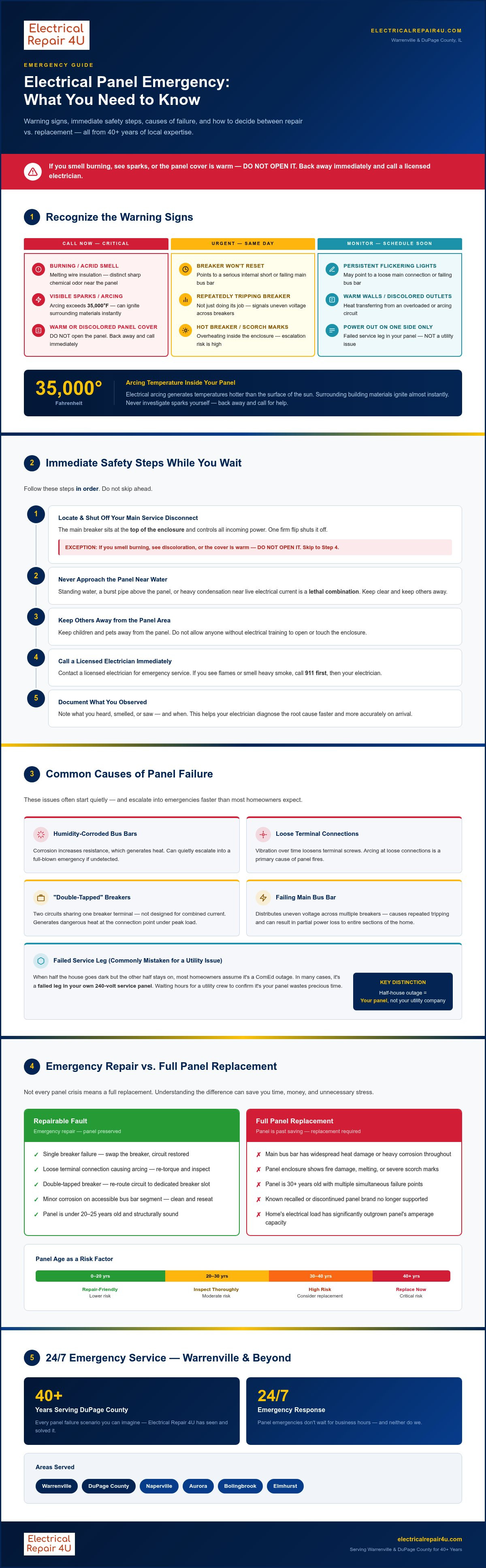
The most urgent warning is an acrid, sharp smell near your breaker box. That's not a general burning odor. It's the specific chemical bite of melting wire insulation, a smell that's distinctly different from a dusty heater or a nearby appliance. If you catch that smell, treat it as an emergency, not a curiosity. Visible sparks or arcing inside the breaker enclosure carry the same weight. Arcing produces temperatures that can exceed 35,000 degrees Fahrenheit, hot enough to ignite surrounding materials almost instantly. Don't open the panel cover to investigate. Back away and call for help.
Sounds matter just as much. A healthy panel is essentially silent. If yours is buzzing, humming, or producing a sizzling noise, that's electrical current traveling somewhere it shouldn't. Loose connections, failing breakers, and deteriorating bus bars all generate these sounds as resistance builds and heat accumulates. A circuit breaker that's hot to the touch or shows any scorch marks is telling you the same story in a different language: something inside that enclosure is already overheating.
When a Tripped Breaker Becomes an Emergency
A breaker that trips once and resets cleanly is doing exactly what it's designed to do. A breaker that won't reset, or that trips repeatedly under normal load, is a different situation entirely. That pattern often points to a serious internal short in the circuit, or worse, a failing main bus bar that's distributing uneven voltage across multiple breakers. "Double-tapped" breakers, where two separate circuits share a single breaker terminal, are a particularly dangerous setup during peak load periods. That configuration wasn't designed for combined current draw, and it generates heat at the connection point that can escalate quickly into an emergency electrical panel repair situation.
External Warning Signs in Your Home
The panel itself isn't always where the symptoms show up first. Watch for these red flags throughout your home:
- Persistent flickering lights that continue even after troubleshooting electrical problems at the fixture level, which often points back to a loose main connection or failing bus bar
- Discolored outlet covers or warm walls near the panel, which signal heat transferring through wiring from an overloaded or arcing circuit
- Partial power loss affecting only one side of your home, a classic sign of a failed leg in your 240-volt service, not a utility problem
That last point trips up a lot of homeowners. When half the house goes dark but the other half stays on, it feels like a utility issue. In many cases, it's a failed service leg inside your own panel, and it requires emergency electrical panel repair, not a call to ComEd. Knowing that distinction keeps you from waiting hours for a utility crew to tell you the problem was yours all along.
Immediate Safety Steps While Waiting for an Emergency Electrician
Knowing what triggered the warning signs is only half the battle. What you do in the minutes before help arrives matters just as much. These steps are sequenced deliberately, so follow them in order rather than jumping ahead.
Step 1: Locate your main service disconnect and shut it off, if it's safe to do so. On most residential panels in DuPage County, the main breaker sits at the top of the enclosure and controls all power flowing into the box. A single firm flip is all it takes. If you smell burning, see discoloration around the panel cover, or notice the cover itself is warm to the touch, do not open it. Back away and skip directly to Step 4.
Step 2: Never approach the panel if there's standing water or visible moisture nearby. Water and live electrical current are a lethal combination. A basement flood, a burst pipe above the panel, or even heavy condensation changes everything. Distance is your safeguard until a licensed electrician can assess the situation safely.
Step 3: Use a battery-powered flashlight for visibility. Candles near an electrical emergency introduce an open flame into an environment that may already contain arcing current or overheated insulation. Keep them out of the equation entirely.
Step 4: If you see active smoke or flames, evacuate immediately. Get everyone out, including pets. Don't stop to gather belongings. Call 911 from outside the home. Emergency electrical panel repair can wait; your family cannot.
Electrical Fire Safety Protocol
Water conducts electricity. Pouring it on a burning panel doesn't extinguish the fire; it creates a direct path for current to travel back to whoever is holding the hose. If you have a fire extinguisher in your home, check the label before you ever need it. Only a Class C rated extinguisher is appropriate for electrical fires. Class A or B units are not designed for energized equipment and can make the situation worse. If the fire is spreading beyond the panel itself, don't attempt to fight it. Get out and call 911. That's the moment to bypass the electrician entirely.
Preparing for the Technician's Arrival
A few minutes of preparation can meaningfully speed up the diagnostic process once your electrician arrives. Clear a direct path to the panel, move stored boxes, furniture, or anything else blocking access. Secure pets in a separate room so the technician can work without distraction or interruption. Then take a moment to recall and write down what was running when the failure occurred: specific appliances, which rooms were affected, whether any breakers tripped before the problem escalated. That information helps a licensed electrician pinpoint the fault faster than a cold inspection alone.
When you're ready to call for help, reach out to the Electrical Repair 4U team so our master electricians can get the right information from you before they arrive, making every minute count.
Common Causes of Panel Failure: When 'Simple' Becomes 'Emergency'
Most panel failures don't happen overnight. They build slowly, through years of minor neglect, environmental wear, or outdated equipment quietly reaching its limit. Understanding what actually drives a panel toward failure helps you catch problems before they demand emergency electrical panel repair, and it helps you have a more informed conversation when a licensed electrician arrives.
Loose terminal connections are one of the most underestimated culprits. When a wire isn't seated firmly against its terminal, the resulting high-resistance connection generates heat at that exact point. That heat doesn't announce itself loudly. It accumulates in silence, degrading insulation, charring the surrounding plastic, and eventually creating the kind of fault that turns a routine service call into an urgent one. It's a slow burn in the most literal sense.
Corroded bus bars tell a similar story. The main bus bar distributes power to every circuit breaker in your panel. When corrosion compromises that connection, voltage distribution becomes uneven, and individual breakers start working harder than they were designed to. Left alone, that imbalance accelerates wear across the entire panel.
Overloaded circuits are another pressure point that's grown more common in recent years. Modern homes run EV chargers, home office equipment, and high-draw kitchen appliances simultaneously, often on panels that were sized for a fraction of that demand. Circuits that were never designed for sustained high loads start tripping repeatedly, and as covered earlier, a breaker that trips repeatedly under normal conditions is signaling a deeper problem than simple overload.
Environmental Impacts on Local Panels
Illinois humidity is harder on electrical panels than most homeowners realize. Seasonal moisture cycles cause metal components to expand and contract, gradually loosening connections and accelerating oxidation on bus bars and breaker contacts. Older basements in Naperville and Aurora are particularly vulnerable, especially in homes where minor water infiltration has gone unaddressed for years. Routine breaker box maintenance is one of the most effective ways to catch corrosion before it compounds. Beyond moisture, animal-chewed wires reaching panel terminals are a genuine risk in older DuPage County homes, particularly those with unfinished basements or attached garages where rodents find easy entry points.
Component-Specific Failures
Some failures are tied directly to specific hardware. Federal Pacific and Zinsco panels, still found in a meaningful number of homes built before the 1990s, have well-documented histories of breakers that fail to trip under overload conditions. That single flaw removes the one safeguard standing between a circuit fault and a fire. Beyond legacy brands, main breakers themselves fatigue after decades of service, and arc-fault circuit interrupters can develop faults that prevent them from detecting the very arcing conditions they're designed to catch. Power surges from utility switching or lightning strikes compound all of these vulnerabilities when there's no whole-house surge protection in place to absorb the hit before it reaches panel internals.
Emergency Repair vs. Full Panel Replacement: Making the Right Call
Not every emergency electrical panel repair ends with a full replacement. That's a point worth making clearly, because too many homeowners get pushed toward a complete panel swap when a targeted repair would have resolved the problem safely and at a fraction of the cost. The right answer depends on what's actually failing, not on a one-size-fits-all recommendation.
When a single breaker fails or a loose terminal connection is the isolated culprit, repair is almost always the appropriate response. A licensed electrician can replace a faulty breaker or re-terminate a loose wire in a matter of hours, restoring safe operation without touching the rest of the panel. That's a legitimate, code-compliant fix, not a shortcut.
Replacement becomes the honest recommendation when the damage is structural. Melted bus bars can't be spot-repaired. Once the main current distribution point has sustained heat damage, the integrity of every connection downstream is compromised. The same logic applies to Federal Pacific and Zinsco panels discussed earlier: when the hardware itself is the hazard, repairing around it only delays the inevitable.
The True Cost of Patchwork Repairs
A quick fix on a failing bus bar might hold for a season. It won't hold indefinitely. Beyond the physical risk, there's a financial one: many homeowners insurance carriers in Illinois have begun scrutinizing panels with known recall histories or unlisted components. Maintaining a panel that's been flagged by your insurer can affect your coverage at exactly the moment you need it most. DuPage County electrical code also sets a clear threshold: if a repair requires bringing a panel up to current standards, and the scope of that work exceeds what the existing equipment can support, a full replacement isn't optional, it's required.
Planning for the Future
An emergency service call doesn't have to be purely reactive. When a licensed electrician is already on-site assessing your panel, it's the ideal moment to think one step ahead. A 200 amp panel upgrade during that same visit eliminates the capacity constraints that caused the failure in the first place, and it positions your home for an EV charger installation down the road without a second service disruption. Adding whole house surge protector installation during the same appointment protects every component in your upgraded system from the utility-side spikes that accelerate hardware wear over time.
That's the real return on a modern electrical distribution system: not just safety today, but fewer emergencies, lower repair costs, and a home that's ready for what's coming next. Talk to the Electrical Repair 4U team about whether your situation calls for a repair or a full upgrade, and get a straight answer from electricians who've been making that call for over 40 years.
Expert 24/7 Panel Services in Warrenville and Beyond
Forty years is a long time to serve one community. Over that span, the licensed master electricians at Electrical Repair 4U have worked inside virtually every panel configuration found in DuPage County homes, from the Federal Pacific boxes flagged earlier in this guide to modern 200-amp services that still develop faults under Illinois humidity cycles. That depth of local experience isn't a marketing claim. It's what allows our team to diagnose a failing bus bar or a corroded terminal connection faster than a generalist crew seeing your panel type for the first time.
Every technician who arrives at your door is licensed, insured, and operating at the master electrician level. There's no apprentice-only dispatch on emergency calls. When the stakes are highest, you get the most qualified person available.
Our Local Emergency Process
When you call during a panel crisis, a live dispatcher answers. No automated menus, no callback queues. You speak directly with someone who can ask the right questions, assess the severity of your situation, and route the appropriate technician to your address without delay. Our trucks arrive stocked with the components needed to resolve most emergency electrical panel repair situations on-site, including replacement breakers, terminal hardware, and surge protection equipment, so a single visit handles what other companies stretch across two or three.
Transparent communication starts the moment our electrician walks in. Before any work begins, you'll understand what failed, why it failed, and what the repair involves. Honest pricing means no surprises on the invoice after the job is done.
Serving the DuPage County Community
Local code knowledge matters more than most homeowners realize. DuPage County and Warrenville building departments have specific permit requirements for panel work, and what's acceptable in one municipality isn't always approved in the next. Our team works within those local regulatory frameworks every day, which means your repair or upgrade is done to code the first time, without a failed inspection forcing rework later. That same familiarity extends to Oak Brook, Naperville, Aurora, Bolingbrook, and Elmhurst, communities where our rapid response reaches homeowners who need expert help fast.
There's also something to be said for calling a company that's been a neighbor for four decades. We're not a national franchise dispatching unfamiliar crews. We're the team that's been in DuPage County basements and utility rooms long enough to know exactly what local homes are carrying. That stability translates directly into the confidence you feel when you need someone reliable during one of the most stressful situations a homeowner can face.
Don't wait on a panel problem that's already showing warning signs. Contact Electrical Repair 4U and let a master electrician give you a straight answer today.
Your Panel Deserves a Straight Answer Today
A burning smell, a breaker that won't reset, half a house sitting in the dark: none of these are problems you wait out. This guide has walked you through recognizing the signals that demand immediate action, the safety steps that protect your household while help is on the way, and the honest distinction between a targeted fix and a full replacement. The through-line is simple: the faster you act on the right information, the better the outcome.
What you need in that moment isn't guesswork. You need licensed master electricians who've seen every variation of emergency electrical panel repair that DuPage County homes produce, across four decades of local service.
Electrical Repair 4U brings that experience directly to Warrenville, Naperville, Aurora, and the surrounding communities, with insured, master-level technicians who give you straight answers before any work begins.
Don't let uncertainty turn a warning sign into a crisis. Contact Electrical Repair 4U now and get expert help from a team that's been your neighbor for over 40 years.
Frequently Asked Questions About Emergency Electrical Panel Repair
What should I do if my electrical panel is buzzing or sizzling?
Step away from the panel and don't open the cover. Buzzing or sizzling means current is traveling through a path it shouldn't, typically through a loose connection, a failing breaker, or a deteriorating bus bar. The sound itself is resistance converting to heat, and that heat compounds quickly. Call a licensed electrician immediately rather than trying to diagnose it yourself by poking around inside the enclosure.
Is a burning smell from the breaker box always an emergency?
Yes. A burning smell near your breaker box should always be treated as an emergency until a licensed electrician confirms otherwise. The specific acrid bite of melting wire insulation isn't something to monitor or wait out. Even if the smell fades, the underlying fault that caused it hasn't resolved itself. Intermittent odors often signal a connection that's heating and cooling in cycles, which is a pattern that precedes more serious failures.
How much does an emergency electrical panel repair usually cost?
We don't quote specific prices here because costs vary significantly based on what's actually failing, the age and condition of your panel, and whether local code requires bringing components up to current standards during the repair. What we can tell you is that getting an accurate diagnosis from a licensed electrician before agreeing to any scope of work is the best way to avoid overpaying. Ask for a clear explanation of what's failing and why before any work begins.
Can I replace a circuit breaker myself in an emergency?
It's not recommended, even if you're handy. The breaker itself may not be the root cause, and replacing it without understanding what drove it to failure can leave the underlying fault in place. Beyond the diagnostic risk, the bus bar and wiring inside the panel remain energized even when individual breakers are switched off. Working inside a live panel without proper training and equipment creates a serious risk of electrocution or arc flash injury.
Why does my main breaker keep tripping even when usage is low?
A main breaker that trips under light load is rarely about the load itself. More often, it points to a failing breaker that's lost its ability to hold rated current, a loose main terminal connection generating heat at the contact point, or a deteriorating bus bar creating uneven voltage distribution across the panel. This pattern is one of the clearer signals that emergency electrical panel repair is needed rather than a simple reset and wait-and-see approach.
Will my homeowners insurance cover emergency panel repairs?
Coverage depends on your specific policy and the cause of the failure. Many policies cover sudden and accidental damage but exclude repairs resulting from deferred maintenance or gradual deterioration. Panels with known recall histories, like certain Federal Pacific and Zinsco models, can complicate claims further. Your best move is to document everything before repairs begin, including photos and a written assessment from your electrician, and then contact your insurer directly to understand what your policy covers.
How long does it take to repair or replace a panel in an emergency?
A targeted repair, like replacing a failed breaker or re-terminating a loose connection, typically takes a few hours from arrival to completion. A full panel replacement is a larger scope of work and generally requires a permit and inspection through your local building department, which adds time depending on municipal scheduling. The Electrical Repair 4U team arrives with the components needed to handle most repairs in a single visit, which keeps that timeline as short as possible.
What is the difference between a fuse box and a circuit breaker panel?
A fuse box uses single-use fuses that physically burn out to interrupt an overloaded circuit, while a circuit breaker panel uses resettable switches that trip and can be restored after the fault is cleared. Fuse boxes are found in older homes and aren't inherently dangerous, but they're limited in capacity and can't support modern electrical demands. If your home still has a fuse box, a licensed electrician can assess whether it's a candidate for an upgrade to a current breaker panel.


