Why does one Naperville neighbor get a home EV charger installed for the price of a modest appliance while another in Warrenville faces a bill that feels like a down payment? It's a common frustration that makes the home EV charger installation cost feel like a moving target. You've likely heard confusing jargon about load calculations or 200-amp service and worried that your older home's electrical panel simply won't handle the transition. We understand that the fear of overpaying for labor or being surprised by hidden fees can make your new electric vehicle feel more like a burden than a benefit.
We agree that you deserve total transparency before any permits are pulled or wires are stripped. This guide promises to pull back the curtain on the real expenses involved, from hardware choices to the specific labor variables that affect DuPage County homes. You'll gain a clear understanding of the 2026 ComEd rebates that can put up to $2,500 back in your pocket. We'll also explain how our 40 years of local expertise helps you choose a safe, licensed installation that protects your investment and your peace of mind.
Key Takeaways
- Learn how to distinguish between basic hardware prices and the labor required for complex wiring runs in older DuPage County homes.
- Understand how your current electrical capacity influences the total home EV charger installation cost and when a 200-amp panel upgrade becomes a safety necessity.
- Discover how to maximize 2026 savings using the Federal Alternative Fuel Vehicle Refueling Property Credit and ComEd’s residential rebates before they expire.
- Identify the specific permit requirements and local code standards for Warrenville and Naperville to ensure your installation is both legal and safe.
- Find out why a professional assessment from a 40-year veteran prevents long-term infrastructure failures that "cheap" DIY alternatives often overlook.
Breaking Down the Total Home EV Charger Installation Cost
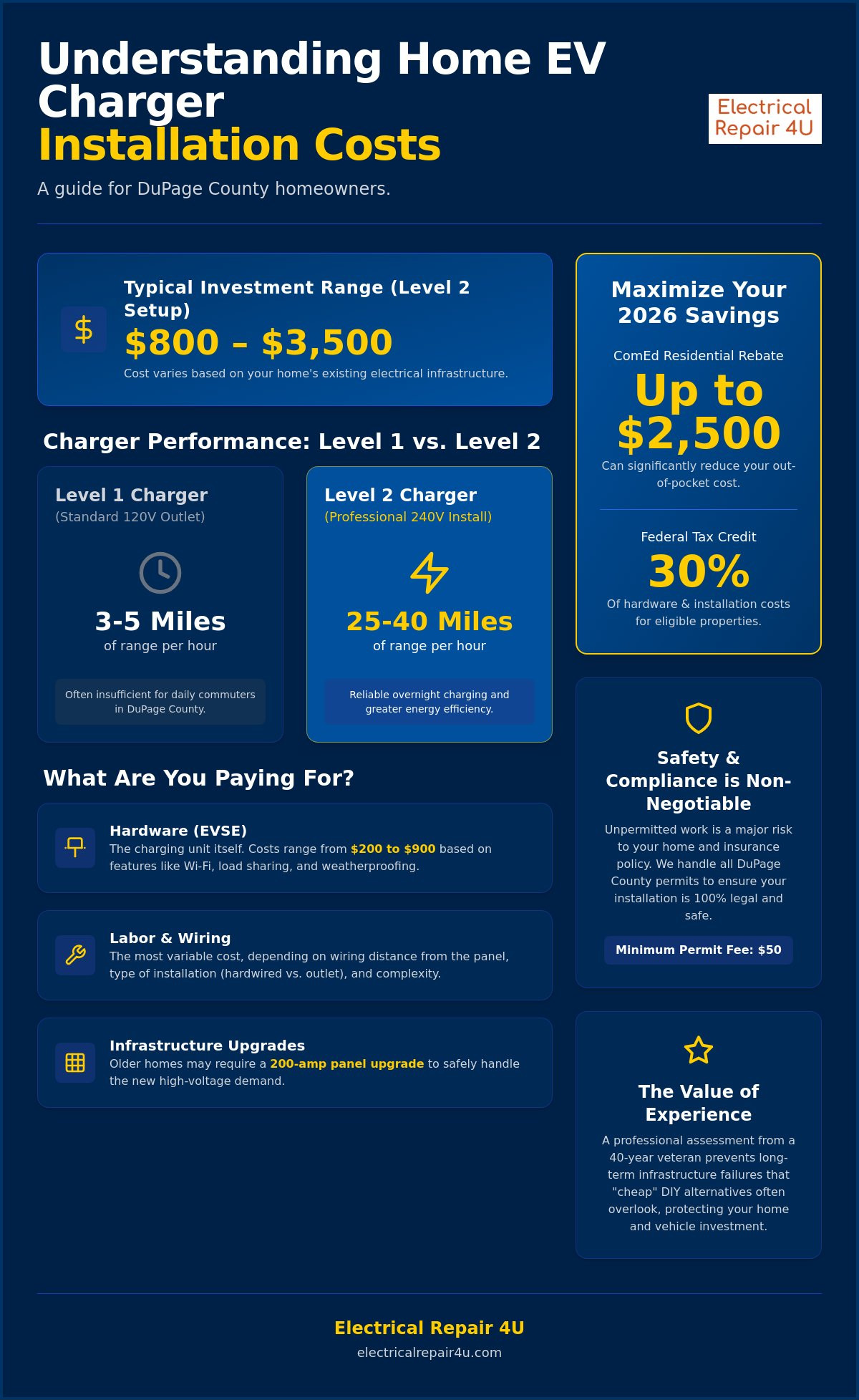
Calculating your home EV charger installation cost involves more than just a single invoice. We view the process as a three-legged stool. The first leg is the hardware, which is the actual charging unit you choose. The second leg is the labor, covering the time and specialized skill required to wire the system safely. The third, and often most variable leg, is infrastructure upgrades. If your home's electrical system is older, it might need a 200-amp panel upgrade to handle the high-voltage demand of a modern vehicle. For 2026, most homeowners in Naperville and Warrenville should prepare for an investment range between $800 and $3,500 for a professional Level 2 setup. While a "cheap" quote might look tempting, it often ignores the long-term stability and safety that a 40-year veteran brings to the job.
Hardware, formally known as electric vehicle supply equipment (EVSE), is only the beginning. Many drivers start with the Level 1 charger that came with their car. These "free" chargers plug into a standard 120V outlet. However, they are often insufficient for daily use. They charge at a glacial pace, and for many, the frustration of a half-empty battery every morning far outweighs the initial savings. Moving to a Level 2 system is a commitment to reliability and convenience.
Level 1 vs. Level 2: Why the Upgrade Matters
The difference in performance is night and day. A Level 1 charger provides about 3 to 5 miles of range per hour of charging. That's fine if you rarely drive, but it's a headache for the average DuPage County commuter. A Level 2 station delivers 25 to 40 miles of range per hour. This speed allows you to fully recharge overnight during off-peak hours. Beyond speed, Level 2 charging is typically more energy-efficient. It reduces the total time electricity flows through your home's wiring, which can lower your long-term utility impact and provide a better return on your home EV charger installation cost.
The "Invisible" Costs: Permits and Inspections
Safety shouldn't be a secret, and neither should the paperwork. In DuPage County, municipalities require electrical permits to ensure your system meets strict safety codes. The minimum permit fee for residential electrical work in our area is $50.00. While some contractors skip this step to lower their quote, unpermitted work is a massive risk. If a fire or failure occurs, your home insurance policy might not cover the damage because the work wasn't inspected. We handle the permit process for you, ensuring every connection is verified by local officials. This transparency removes the anxiety of "what if" and secures your home's value for years to come.
Hardware vs. Labor: What Are You Actually Paying For?
When you receive a quote, it's easy to focus solely on the physical unit. However, your home EV charger installation cost is split between the hardware and the technical labor required to make it run. Think of the hardware as the interface and the labor as the foundation. In 2026, many homeowners opt for smart, hardwired stations because they offer superior energy management compared to basic plug-in units. A hardwired installation connects the charger directly to your electrical circuit. This removes the need for a NEMA 14-50 outlet and reduces the number of potential failure points in your system. We want you to feel confident that your investment is built on a stable, long-term foundation rather than a quick fix.
Choosing Your EVSE Hardware
Electric Vehicle Supply Equipment (EVSE) acts as the safety gatekeeper between your home's power and your car's battery. In the 2026 market, popular brands like Tesla, ChargePoint, and Wallbox offer units ranging from $200 to $900. Specific features drive these costs. Wi-Fi connectivity allows you to schedule charging during off-peak hours when electricity is cheaper. Higher-end models also include load sharing, which is vital if you plan to charge two vehicles at once. High-quality weatherproofing is another factor if your charger will be mounted outdoors. Fortunately, the Federal Alternative Fuel Infrastructure Tax Credit can help offset up to 30% of these hardware costs for eligible properties, making high-end smart features more accessible.
Labor Costs for Professional Installation
Labor is where the most variation occurs. A simple "next-to-panel" install is the most budget-friendly scenario. If your breaker box is in the garage right where you park, the work is straightforward. However, many older Naperville homes require complex runs through attics, finished basements, or crawlspaces. Every foot of heavy-duty conduit and copper wire adds to the total. This complexity is why hiring a licensed and insured electrician is non-negotiable. Professionals ensure that the wire gauge matches the amperage of your charger to prevent overheating or fire risks. We've spent 40 years mastering these local builds, ensuring your installation is efficient, safe, and fully compliant with DuPage County codes. If you're ready for a clear assessment of your garage, we can help you explore your installation options today.
The Older Home Factor: Panel Upgrades and Trenching
Many of our neighbors in historic Naperville and Aurora neighborhoods worry their homes are too old for modern technology. We hear the objection "my house can't handle it" more than any other. It's a valid concern. Most homes built before the 1990s were designed for a much lighter electrical load. Adding a high-draw vehicle to an aging system can be the tipping point. However, being an older home owner doesn't mean you're locked out of the EV revolution. It simply means your home EV charger installation cost might include a few foundational improvements to ensure your family's safety and the stability of your local grid.
If your home currently runs on a 100-amp panel, you'll likely need a 200-amp panel upgrade. A Level 2 charger can pull 40 to 50 amps on its own. That's half of your entire home's capacity. While load shedding devices can sometimes manage the power by temporarily pausing the charger when your dryer or AC kicks on, a full upgrade is the gold standard for long-term security. These upgrades also qualify for the Federal Tax Credit for Home EV Charger Installation, which covers 30% of the cost up to $1,000. This incentive helps bridge the gap between a basic install and a comprehensive system modernization.
When is a Breaker Box Upgrade Necessary?
Your electrical panel is the heart of your home. If you notice flickering lights when the refrigerator starts or if the panel feels warm to the touch, it's already struggling. These are clear signs that your system is at capacity. Modernizing this infrastructure isn't just about the car; it protects every appliance you own. We recommend a full breaker box maintenance check before any new high-voltage equipment is added. This assessment identifies loose connections or corroded breakers that could lead to a failure under the heavy load of daily EV charging.
Detached Garages and Exterior Runs
Detached garages present a unique challenge in DuPage County. To get power from your main panel to a separate structure, we typically perform trenching. This involves burying heavy-gauge copper wire inside protective conduit at a depth required by local code. While overhead runs are sometimes possible, they are often less aesthetically pleasing and more vulnerable to Illinois storm damage. To protect the sensitive electronics in your vehicle and your home, we also suggest a whole house surge protector installation. This acts as a secondary shield against the power spikes that frequently occur during our summer thunderstorms, ensuring your investment stays safe regardless of the weather.
2026 Incentives: Federal Tax Credits and ComEd Rebates
While the hardware and labor for a new system represent a significant investment, local and federal incentives are designed to lower your net home EV charger installation cost. We believe that professional electrical work should be accessible to every homeowner in DuPage County. In 2026, the financial landscape for EV owners is particularly favorable, provided you know which deadlines to hit and which forms to file. These programs don't just save you money upfront. They reward you for making safety-conscious choices that benefit the entire Illinois power grid. By stacking these incentives, you can often offset a substantial portion of your total project expenses.
Maximizing the Federal Tax Credit
The Alternative Fuel Vehicle Refueling Property Credit, often referred to as the 30C credit, is a powerful tool for homeowners. For 2026, this credit covers 30% of your total project cost, up to a maximum of $1,000. What many people miss is that this credit isn't just for the charger itself. It applies to the hardware, the professional labor, and even the necessary infrastructure improvements like a panel upgrade. To qualify, your property must be located in an eligible low-income or non-urban census tract. You'll need to file IRS Form 8911 with your tax return. It's vital to act quickly, as this specific federal credit is currently set to expire on June 30, 2026. We provide detailed, professional invoices that clearly break down these costs to make your tax filing straightforward and stress-free.
Local Utility Programs in DuPage County
ComEd offers some of the most aggressive rebates in the country through their "Charge Smart" program. For 2026, residential customers can receive a rebate of up to $1,000 for the purchase and installation of a Level 2 charger. If you live in a designated "Equity Investment Eligible Community," that rebate can jump as high as $2,500. This program is scheduled to run through December 31, 2026, or until the $4 million in allocated funding is depleted. Beyond the initial rebate, ComEd provides time-of-use (TOU) electricity rates. By using a smart charger to schedule your sessions during off-peak hours, you can significantly reduce your monthly energy bill. These savings quickly pay back your initial home EV charger installation cost over the first few years of ownership.
If you live in a multi-unit dwelling like a condo or apartment in Naperville, you may also be eligible for Illinois state-specific grants aimed at expanding charging access. These programs often require applications to be submitted by an approved installer to ensure code compliance and safety. Because we've served this community for over 40 years, we understand the specific documentation these agencies require. Don't leave money on the table by trying to navigate these technical applications alone. You can schedule your rebate-eligible installation with our team today to ensure you secure every dollar available to you.
Why Professional Installation is a Safety Investment
Attempting a DIY approach to save on your home EV charger installation cost might seem tempting, but high-voltage electrical work is a different beast entirely. Installing an EV station isn't like swapping out a light fixture or a ceiling fan. Those devices draw minimal power intermittently. An EV charger, however, pulls a massive, continuous electrical load for hours at a time. This sustained high-amperage draw puts incredible stress on every connection, wire, and breaker in your system. We've spent 40 years keeping DuPage County safe, and we've seen firsthand how a single loose terminal or an undersized wire can lead to catastrophic failure. Choosing a licensed professional isn't just about following the law; it's about securing your home against the hidden risks of modern energy demands.
Our commitment to your security starts long before we mount the hardware. We treat every installation as a collaborative partnership. We don't just show up and start drilling. Our team performs a comprehensive assessment of your existing infrastructure to ensure it can handle the 2026 standards for fast charging. This proactive attitude allows us to identify potential issues, like aging busbars or corroded connections, before they become emergencies. Whether we are helping you with EVSE or integrating new Warrenville lighting solutions, our goal is to provide a stable, long-term result that removes the anxiety typically associated with complex electrical upgrades.
The Risk of Substandard Wiring
Substandard wiring is the primary cause of thermal runaway in residential EV setups. When a connection isn't perfectly torqued or a wire is too thin for the amperage, heat builds up rapidly. This heat can melt insulation and cause electrical fires that often start inside your walls. We perform a rigorous safety inspection before every install to prevent these disasters. Our seasoned veterans understand the specific nuances of Naperville and Warrenville homes, ensuring your project meets every local code requirement. This neighborly reliability is why so many families trust us to protect their homes and their new vehicles.
Next Steps: Getting Your Personalized Quote
Ready to move forward? Preparing for your on-site estimate is straightforward. We recommend taking a few clear photos of your main electrical panel and the area in your garage where you'd like the charger mounted. Having your vehicle's charging specifications handy also helps us determine the most efficient wiring path. We pride ourselves on a transparent, no-hidden-fee pricing model. You'll receive a clear breakdown that accounts for hardware, labor, and any necessary infrastructure needs discussed in this guide. Take the first step toward a faster, safer charge. Request your local EV charger installation quote today and let our 40 years of expertise work for you.
Ready to Power Your Future Safely?
Transitioning to an electric vehicle is a major milestone for your home and the environment. You now understand that your home EV charger installation cost depends on a strategic balance of hardware quality, labor complexity, and necessary infrastructure like panel upgrades. By taking advantage of 2026 ComEd rebates and federal tax credits before they expire, you can significantly lower your initial investment while modernizing your property's electrical heart. We believe that every homeowner in Naperville and Warrenville deserves a system that is as reliable as it is efficient.
We've spent over 40 years serving DuPage County as licensed, bonded, and insured professionals who prioritize your safety above all else. Our transparent pricing model ensures you never face hidden fees or unexpected surprises. We treat every project as a partnership to build a more sustainable community together. Get a Professional EV Installation Quote in DuPage County and let us help you drive into 2026 with total confidence. Your journey toward simpler, faster charging starts with a neighbor you can trust.
Frequently Asked Questions
Is it cheaper to install an EV charger myself?
Attempting a DIY install might seem like a way to save, but it often increases your long-term home EV charger installation cost through failed inspections or safety hazards. Professional electricians ensure your wiring handles a 50-amp continuous load without overheating. We handle the technical calculations and local permits so you don't have to worry about insurance claims or electrical fires down the road.
How much does the average EV charger permit cost in Naperville?
The minimum permit fee for residential electrical work in DuPage County is $50.00. This fee ensures that a local inspector verifies your system meets the National Electrical Code. While fees can vary slightly by municipality, we include permit management in our service to ensure your installation is fully legal and documented for your home's records.
Will I need to upgrade my electrical panel for a Level 2 charger?
You'll likely need an upgrade if your home currently runs on a 100-amp panel. A Level 2 charger pulls a significant amount of power, often requiring a 200-amp panel to operate safely alongside your AC and appliances. We assess your current load during our initial visit to determine if your breaker box can handle the new vehicle without risking a system failure.
Does the distance from my breaker box affect the installation price?
Yes, the distance is one of the biggest variables in any quote. Longer runs require more heavy-gauge copper wire and protective conduit, which adds to both material and labor costs. If your panel is on the opposite side of the house from your garage, we'll find the most efficient and aesthetic path to keep your home EV charger installation cost as low as possible.
Are there specific 2026 rebates for Illinois residents?
Illinois residents can access ComEd rebates of up to $1,000 for standard installs or $2,500 in designated equity communities through the end of 2026. You should also be aware that the federal tax credit covering 30% of your costs is currently set to expire on June 30, 2026. We help you document the installation properly so you can claim every dollar you're owed.
Can I install an EV charger in a detached garage?
You can definitely install a charger in a detached garage, though it usually involves trenching. We bury heavy-duty conduit at the depth required by local code to protect the wire from freezing temperatures and yard work. This creates a permanent, stable power source that keeps your vehicle ready to drive regardless of your garage's location.
What is the difference between a hardwired charger and a NEMA 14-50 plug?
Hardwired chargers connect directly to your electrical circuit, offering the most stable and high-capacity power flow for your car. A NEMA 14-50 setup uses a heavy-duty 240V outlet, which allows you to unplug the unit if you move. We typically recommend hardwiring for permanent home installations because it removes a potential point of failure and often looks much cleaner.
How long does a professional installation typically take?
Most standard installations are completed within two to four hours once we arrive at your home. If your project is more complex and involves a full panel upgrade or outdoor trenching, it may take a full day. We always provide a clear timeline before we start so you can plan your schedule with confidence and get back to your routine.


