
The most expensive part of your new electric vehicle setup isn't the sleek charger sitting in the box. For many Illinois residents, the true home EV charger installation cost depends entirely on the hidden infrastructure behind your garage walls. It's natural to feel a bit anxious when contractors give you conflicting quotes or mention the dreaded need for a panel upgrade. You deserve a straightforward partner who prioritizes your home's safety and your family's peace of mind.
We've put together this transparent guide to help you build a realistic budget for 2026. You'll get an expert breakdown of how the expiration of the federal 30C tax credit changes your math and how to qualify for ComEd rebates that could cover up to $2,500 of your project. We'll also clear up the confusion around local Illinois permits and the specific technical factors that influence your total investment. It's time to replace uncertainty with the confidence of a well-planned installation from a team that's served the community for over 40 years.
Key Takeaways
- Learn why your home’s existing electrical panel capacity is the single biggest factor in your total home EV charger installation cost.
- Discover how to secure up to $2,500 in ComEd rebates and navigate the recent expiration of federal tax credits to maximize your savings.
- Understand the specific material and labor requirements for a safe Level 2 setup that meets strict Illinois permit codes and safety standards.
- Protect your high-value vehicle and charging equipment by integrating whole-house surge protection into your installation plan to prevent costly damage.
- Find out how enrolling in time-of-use (TOU) rates can help you manage the new 2026 Illinois EV charging fee and lower your monthly energy bills.
Understanding the 2026 Home EV Charger Installation Price Range
Seeing a wide range of quotes for your home EV charger installation cost can be frustrating. You might see one number from a big-box retailer and another from a neighbor's contractor. In 2026, the total investment for a safe, reliable setup is more than just the price tag on a box. It's a combination of the hardware, professional labor, and local permit fees. As a team that's served Illinois for over 40 years, we know that cutting corners on high-voltage equipment isn't worth the risk to your home's safety.
When we discuss the hardware itself, we're referring to the electric vehicle supply equipment (EVSE). This is the wall-mounted unit that communicates with your car's battery to ensure a safe energy flow. You'll need to choose between a hardwired station and a plug-in unit. A hardwired station is permanently connected to your electrical system and is often the more reliable choice for high-power charging. Plug-in units use a heavy-duty NEMA 14-50 outlet, which offers flexibility if you ever need to move the charger to a different location.
Level 1 vs. Level 2: Why the Upgrade Cost is Worth It
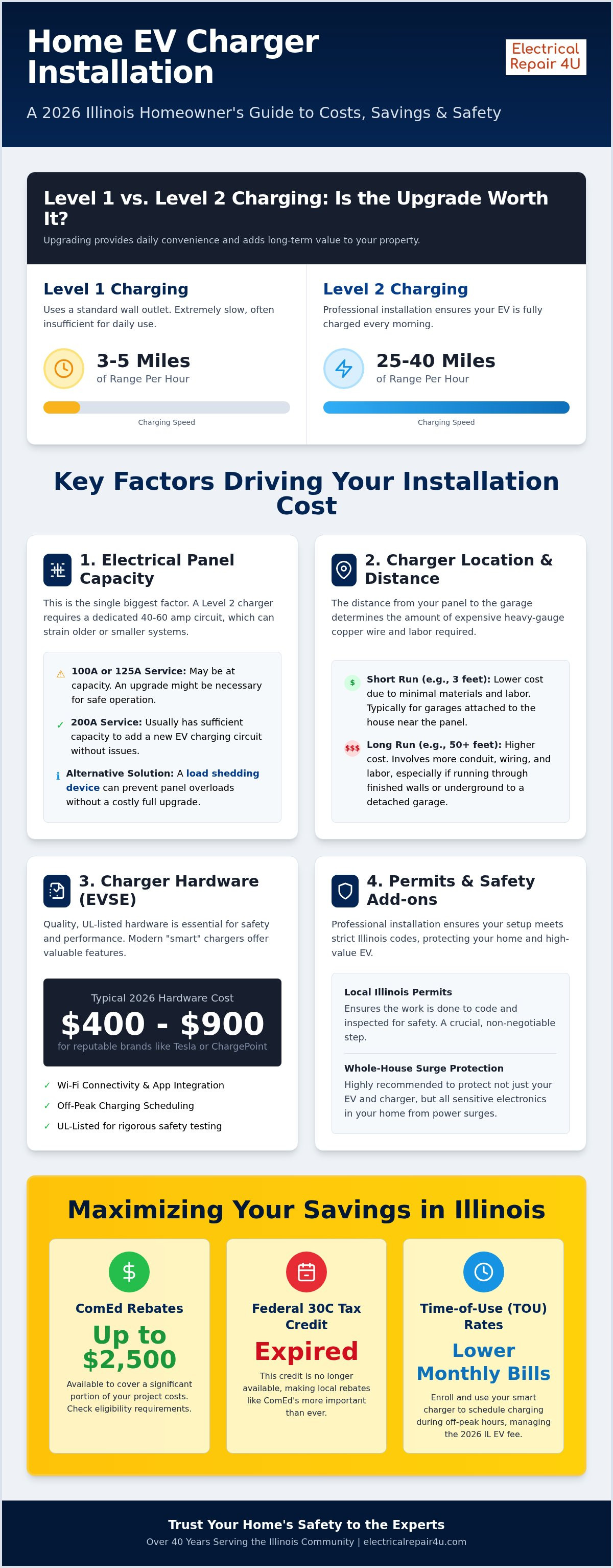
Level 1 charging is like filling a swimming pool with a garden hose. It works, but it's incredibly slow. Most homeowners find that getting only 3 to 5 miles of range per hour isn't enough to keep up with a busy schedule. Upgrading to a Level 2 station changes the game. You'll typically get 25 to 40 miles of range per hour, ensuring your vehicle is fully charged and ready every morning. This upgrade doesn't just provide daily convenience; it adds long-term value to your Illinois property as more buyers look for homes with existing EV infrastructure.
The 2026 Market Outlook for EV Charging Hardware
In 2026, smart features have become the standard for quality Level 2 chargers. You can expect hardware from reputable brands like Tesla or ChargePoint to range between $400 and $900. These units now include Wi-Fi connectivity and integrated apps that allow for easy scheduling. Scheduling is vital because it lets you charge during off-peak hours when electricity rates are at their lowest. We always insist on installing UL-listed hardware. These units have undergone rigorous safety testing, which provides essential peace of mind when you're running high-voltage power through your garage for several hours every night.
Critical Factors That Drive Your EV Charging Station Installation Costs
Every homeowner's first question is about the bottom line, but the truth is that your home EV charger installation cost is largely determined by the distance between your garage and your electrical service. While the charger itself is a fixed price, the infrastructure required to support it varies from house to house. In our 40 years of serving the Warrenville area, we've seen that the "hidden" variables, such as wiring runs and panel capacity, are what truly shape your investment. Understanding these variables helps you avoid sticker shock and ensures your home remains a safe haven for your family.
The location of your charger plays a massive role in the final tally. An indoor installation in a garage attached to the house is typically the most straightforward path. However, if you require a pedestal mount for a driveway or have a detached garage, the complexity increases. Outdoor units must be NEMA 4X rated to withstand Illinois winters, and mounting them on a pedestal involves additional hardware and specialized mounting labor that isn't necessary for a simple wall-mount setup.
The Electrical Panel Factor: Do You Need an Upgrade?
Your home's electrical capacity is the heart of the project. A Level 2 charger requires a dedicated 40 to 60 amp circuit, which is a significant load. If your home currently operates on a 100-amp or 125-amp service, you might be at the limit of what your system can handle safely. Regular breaker box maintenance can identify if your current panel is up to the task or if a 200-amp upgrade is necessary. For homes where a full upgrade isn't feasible, we often look at load shedding devices. These smart controllers temporarily pause your car's charging if your dryer or AC kicks on, preventing a tripped main breaker without the cost of a total panel replacement.
Distance and Complexity: The Labor Multiplier
Distance is the primary driver of labor and material expenses. A charger installed three feet from the panel requires very little conduit and heavy-gauge copper wire. Conversely, a 50-foot run through a finished basement or across a crawlspace requires significantly more time and materials. In suburbs like Naperville or Aurora, detached garages often require trenching. Digging a trench to bury conduit involves specialized equipment and careful navigation of existing underground utilities. Drilling through thick concrete foundations or neatly routing wire through finished drywall also adds to the labor hours. To get an accurate picture of your specific needs, it's always wise to schedule an expert electrical evaluation early in the process.
Local building codes also influence the process. Permit fees in the Chicago area can range from $50 to $300 depending on your municipality. For example, Bolingbrook or Elmhurst residents may face different administrative fees compared to those in more rural areas. While these costs are unavoidable, staying informed about Illinois rebates and tax credits can help offset these necessary expenses. Even though the federal 30C credit expired in mid-2026, local utility programs remain a strong resource for savvy homeowners.
Labor vs. Materials: A Detailed Cost Breakdown for Level 2 Charging
To truly understand your home EV charger installation cost, you have to look beyond the price tag of the charging unit itself. Your investment is split between physical assets and the technical expertise required to install them safely. Many homeowners are surprised to find that wiring and electrical service upgrades often account for a larger portion of the budget than the hardware. This is because your car pulls a massive, continuous load of electricity for hours at a time, requiring specialized components that your standard household outlets simply don't use.
The materials involved are the backbone of a safe system. We use heavy-gauge copper wire and durable conduit to protect your home from the intense heat generated during charging. In 2026, the price gap between copper and aluminum remains a significant factor; choosing copper for your high-amperage circuit ensures better heat management and long-term reliability despite the higher upfront material cost. Beyond the wire, your project includes a dedicated high-voltage circuit breaker and mounting hardware designed for longevity.
When you pay for professional labor, you're investing in more than just a few hours of work. You're paying for a comprehensive load calculation to ensure your panel won't overload. Our team uses specialized diagnostic tools to test the integrity of your ground and the torque of every connection. Cheap labor often skips these critical safety steps, which can lead to melted wires or even electrical fires months after the contractor has left. We've spent 40 years building a reputation for doing things the right way the first time.
Standard Installation vs. Custom Solutions
A "standard" installation generally refers to a charger mounted within 10 feet of your main electrical panel. These projects are predictable and move quickly. However, your home might require a custom solution, such as a sub-panel if your main breaker box is full or a smart load management system to avoid a total service upgrade. These additions ensure your home remains functional while your car charges. We always prioritize the most efficient path to get you powered up without compromising your home's infrastructure.
Hidden Costs: Permits, Inspections, and Compliance
Permit fees and inspections are unavoidable parts of a legal installation in DuPage County and the surrounding suburbs. These fees vary by municipality, but they provide an essential layer of security. A final inspection from a city official validates that the work meets the National Electrical Code, which is vital for your homeowner's insurance and future home resale value. Choosing licensed and insured electricians ensures that all your paperwork is filed correctly with the local building department. We handle the bureaucracy so you can focus on enjoying your new vehicle.
Maximizing Savings: Illinois Rebates, Tax Credits, and Permits
The gross home EV charger installation cost can seem daunting at first glance, but the net investment is often much lower once you tap into local incentives. In late 2026, the strategy for saving money has shifted. While national programs have changed, Illinois remains one of the most supportive states for EV adoption. Our team has spent decades helping neighbors in Warrenville and the surrounding suburbs find every available dollar to keep their projects affordable and safe.
Proper documentation is the key to unlocking these funds. You'll need itemized receipts, proof of your local building permit, and a signed-off inspection from your municipality. We handle the technical side of this paperwork to ensure you don't miss out on hundreds or even thousands of dollars in savings. Dealing with local building departments can be a headache, but it's a necessary step to protect your home's value and your insurance eligibility.
Navigating the Federal and State Incentive Landscape
Homeowners should be aware that the landscape for federal savings has changed recently. The Federal 30C tax credit, which previously offered a 30% credit up to $1,000, expired on June 30, 2026. If your installation happens after this date, you won't be able to claim this specific credit on your next tax return. However, the Illinois EPA continues to offer various "Green" initiatives and grants for residential properties that focus on infrastructure readiness. These programs are designed to lower your home EV charger installation cost by focusing on the "make-ready" components like wiring and panel upgrades.
Utility-Specific Programs: Saving with ComEd
ComEd offers the most significant financial relief for Illinois residents in 2026. Their residential rebate program is open until December 31, 2026, and works on a first-come, first-served basis. Standard residential customers can receive a rebate of up to $1,000. If you live in an Equity Investment Eligible Community or meet specific income requirements, that rebate can jump to $2,500. To qualify, you must use an ICC-certified electrician and install a Wi-Fi-enabled Level 2 smart charger.
Enrolling in a "Time of Use" (TOU) rate plan is another way to maximize your long-term savings. By charging your vehicle during off-peak hours, you can avoid the higher delivery rates that hit during the day. Smart chargers facilitate these utility-side savings automatically by scheduling your charge for the middle of the night. This approach helps you manage the new 2026 Illinois EV charging fee of $0.06 per kilowatt-hour more effectively. If you're ready to start your project with a team that understands these local programs, get a professional installation quote today and let us help you maximize your rebates.
Why Professional Installation is the Safest Investment for Your Home
Choosing a professional for your project isn't just about convenience; it's about protecting your largest asset. A DIY approach or hiring an unlicensed contractor might seem like a way to lower your initial home EV charger installation cost, but the long-term risks are substantial. Improperly torqued connections or incorrect wire gauges can lead to overheating and fire hazards. Additionally, many vehicle manufacturers will void your battery warranty if they discover the charging equipment wasn't installed by a licensed professional. We treat every garage as if it were our own, ensuring every connection is secure and every circuit is balanced.
Your new electric vehicle is a high-tech investment that deserves high-level protection. During your install, we highly recommend integrating whole house surge protection. Illinois is no stranger to powerful storms and grid fluctuations that can send damaging voltage spikes through your home. A dedicated surge protector shields your car's sensitive onboard computer and your charging station from being fried by an unexpected surge. This small addition to your infrastructure provides an essential layer of emotional and financial security.
The Long-Term ROI of Expert Craftsmanship
Expert installation pays for itself when the time comes to sell your property. Having a portfolio of professional documentation, including signed permits and inspection reports, gives future buyers confidence in your home's electrical integrity. Beyond resale value, proper wire sizing and superior heat management reduce your ongoing maintenance needs. Our 40 years of local experience ensures your project meets the specific, evolving building codes of DuPage and Kane counties without the need for costly future corrections. In 2026, you should look for an installation warranty that covers labor for at least three years, mirroring the expected reliability of your hardware.
Ready to Charge? Your Next Steps in Warrenville
Moving from a confusing quote to a finished installation is a straightforward process when you have a reliable partner. Your first step is to request a local load assessment. We'll visit your home to check your panel capacity and determine the most efficient path for your wiring. To prepare for installation day, please clear a path to your electrical panel and ensure the area where the charger will be mounted is easily accessible. We pride ourselves on being a stable pillar of the community, offering honest advice and high-caliber results. Contact Electrical Repair 4U for a safe, reliable EV charger installation in Warrenville and take the stress out of your home EV charger installation cost.
Take Control of Your Home’s Energy Future
Investing in a Level 2 charger is about more than just speed; it's about the security of a modern, efficient electrical system. You've learned how infrastructure and distance play the biggest roles in your home EV charger installation cost, and why acting before the 2026 ComEd rebate deadline is a smart financial move. Professional installation ensures your home remains a safe haven while your vehicle stays ready for the road ahead.
We bring over 40 years of local electrical expertise to every project. As licensed, bonded, and insured professionals, we take pride in delivering A+ rated safety and neighborly reliability to our friends in Warrenville. Don't let technical uncertainty stall your progress. Get a Professional Quote for Your Home EV Charger Installation and let us handle the heavy lifting. We're here to power your journey with confidence and care.
Frequently Asked Questions
How much does it cost to install a Level 2 EV charger in Illinois?
The total investment typically ranges between $800 and $2,500 for a standard setup, though complex projects involving long wire runs or trenching can reach $4,200. Your specific home EV charger installation cost depends on your existing electrical capacity and the distance between your panel and the charging port. Investing in quality materials now prevents expensive repairs or safety issues down the road.
Do I need a permit for an EV charger installation in DuPage County?
Yes, most municipalities in DuPage County and the surrounding Chicago suburbs require a building permit for high-voltage electrical work. Permit fees generally fall between $50 and $200 depending on your local village or city requirements. We handle the permit application process for you to ensure your installation is fully compliant with the latest safety codes and insurance requirements.
Can I install a home EV charger myself to save on costs?
Diy installation is highly discouraged due to the extreme fire risks and the potential to void your vehicle's battery warranty. Furthermore, utility programs like the ComEd rebate specifically require work to be performed by an ICC-certified electrician to qualify for savings. Hiring a licensed professional protects your home and ensures you can access up to $2,500 in available rebates.
Will I need to upgrade my electrical panel for an EV charger?
You may need an upgrade if your current breaker box is rated for 100 amps or is already near its maximum capacity. A Level 2 charger requires a dedicated 40 to 60 amp circuit, which often necessitates a move to a 200-amp service for safety. If a full upgrade isn't in your budget, we can often install smart load management devices as a reliable alternative.
How long does a professional EV charger installation take?
A standard installation usually takes between two and four hours once the necessary permits are secured. If your project requires a panel upgrade, trenching for a detached garage, or drilling through concrete, the timeline can extend to a full day. We work efficiently to minimize disruption to your schedule while maintaining our strict safety standards for every connection.
Are there any tax credits for EV charger installation in 2026?
The federal 30C tax credit for residential charging equipment expired on June 30, 2026, so it's no longer available for new projects. Instead, Illinois homeowners should focus on the 2026 ComEd rebate program, which offers up to $1,000 for standard customers and $2,500 for those in eligible communities. These local incentives are currently the best way to lower your home EV charger installation cost.
Does an EV charger increase my home’s property value?
Yes, installing a Level 2 charging station is a modern infrastructure upgrade that appeals to the growing number of EV drivers in the Illinois real estate market. Buyers view a pre-installed charger as a significant convenience, much like a finished basement or updated kitchen. It demonstrates that your home's electrical system is robust and ready for the technological demands of the future.
What is the difference between hardwired and NEMA 14-50 plug-in chargers?
Hardwired chargers are permanently connected to your home's electrical system, offering the highest level of reliability and weather resistance for outdoor use. NEMA 14-50 units plug into a heavy-duty 240V outlet, which provides flexibility if you need to move the charger later. While both options provide fast Level 2 speeds, hardwired units are often preferred for their cleaner look and more stable power delivery.


