
Could your home's electrical panel be a ticking time bomb disguised as a quiet gray box? Many homeowners in the Warrenville and Naperville areas assume that if the lights stay on, their electrical system is perfectly healthy. However, with the massive power demands of 2026, including EV chargers and sophisticated smart home networks, an aging panel often reaches its breaking point before you even notice a flicker. Recognizing the critical signs your breaker box needs an upgrade is the most important step you can take to protect your family from fire hazards and ensure your modern appliances run without constant interruption.
We understand the frustration of a circuit that trips every time you start the microwave or the anxiety that comes with a buzzing sound behind the drywall. You deserve a home that feels secure and a power system that supports your lifestyle. This guide will walk you through the clear red flags of an outdated system, clarify the confusion between 100-amp and 200-amp requirements, and explain why a simple repair isn't always enough to keep your household safe. Backed by over 40 years of local expertise, we'll help you gain total confidence in your home's electrical health.
Key Takeaways
- Spot the critical signs your breaker box needs an upgrade, such as breakers that trip frequently or lights that dim when major appliances kick on.
- Recognize hazardous obsolete equipment from brands like Federal Pacific and Zinsco that may compromise your household safety.
- Evaluate your current electrical capacity to determine if your home is ready for high-demand additions like EV charging points.
- Understand why moving to a 200-amp service is the gold standard for supporting modern smart home technology and high-power tools.
- Discover how a master electrician manages the complex logistics between your home, local inspectors, and utility providers for a stress-free experience.
What is a Breaker Box and Why Does It Need Upgrading?
Think of your breaker box as the traffic controller for every watt of power entering your Illinois home. It sits quietly in the basement or garage, distributing electricity to your kitchen, home office, and HVAC system. Watching for the signs your breaker box needs an upgrade is vital because this metal box is the primary safety valve protecting your property from electrical surges. While these units are built for durability, they aren't immortal. A standard residential panel has a life expectancy of 25 to 40 years. If your home was built before 1985, you're likely operating on borrowed time.
There's a big difference between a quick fix and a full service panel upgrade. A repair might involve swapping out a single faulty breaker that won't stay set. An upgrade, however, involves replacing the entire enclosure and interior components to meet modern National Electrical Code (NEC) standards. These safety standards update every three years to keep pace with new technology. A panel that was perfectly safe in the 90s often lacks the sophisticated protection required for today's high-tech environment. We've spent over 40 years helping neighbors transition from aging infrastructure to reliable, modern power.
The Difference Between Fuses and Circuit Breakers
If you're still twisting glass fuses into a socket, your system is officially obsolete. Fuse boxes were standard decades ago, but they weren't designed for the always-on lifestyle of 2026. A major risk in older Naperville homes is over-fusing. This happens when a homeowner installs a higher-amp fuse to stop it from blowing. This allows wires to overheat and creates a massive fire hazard. Modern circuit breakers offer superior technology. They include arc-fault and ground-fault protection that detects dangerous leaks and shuts off power in milliseconds.
Why 'Grandfathered' Systems May Still Be Dangerous
Many homeowners believe their system is fine because it was up to code when the house was built. This is a dangerous assumption. Just because a system is grandfathered in doesn't mean it can handle a modern load. In the Fox Valley area, our intense humidity and temperature swings cause copper wiring and bus bars to expand and contract. This leads to loose connections and corrosion over several decades. An outdated panel is simply one that cannot support modern peak loads safely. Recognizing the signs your breaker box needs an upgrade is the first step toward a more reliable home. We've seen how these aging systems struggle under the weight of new appliances. A proactive replacement is the smartest choice for long-term security.
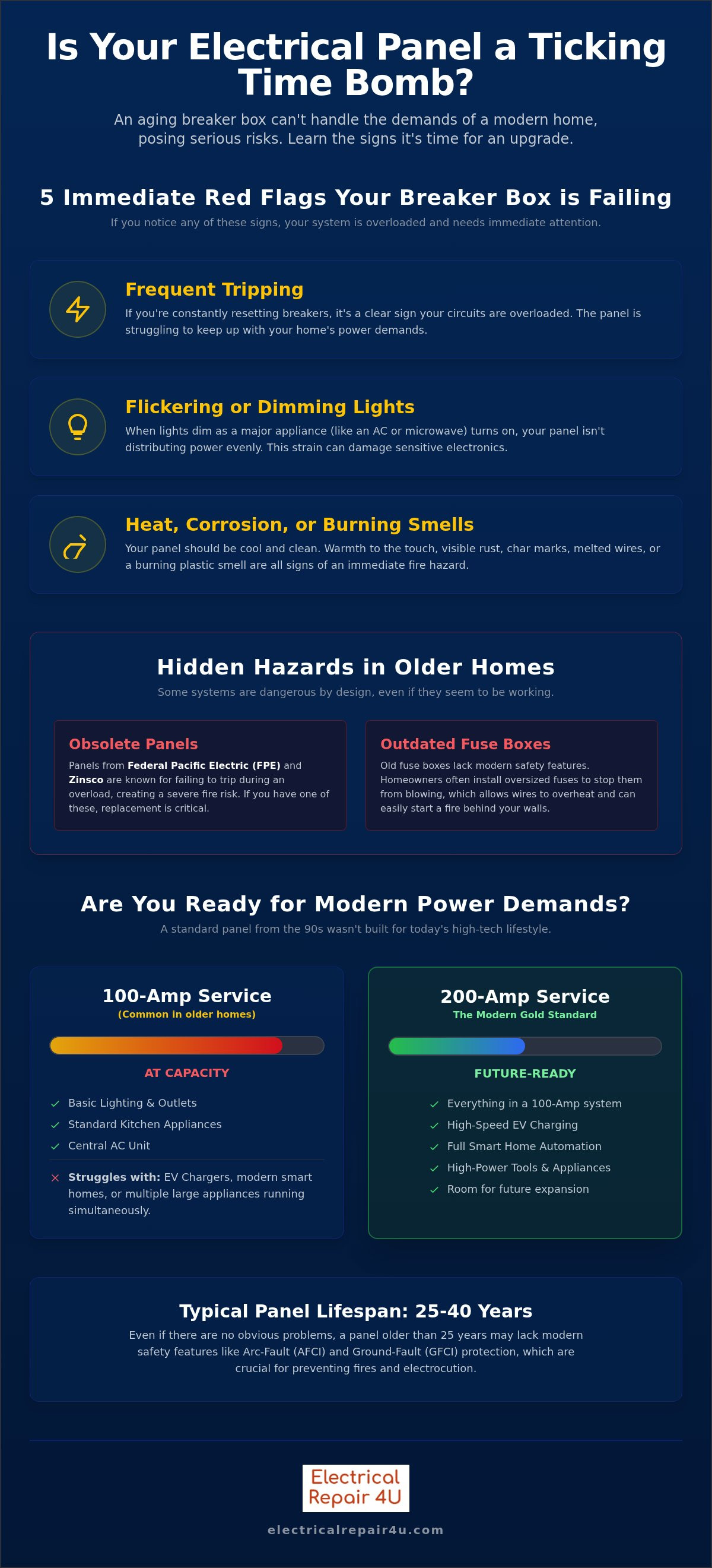
5 Immediate Red Flags: Signs Your Breaker Box is Failing
Your electrical panel is designed to be the ultimate safety net. It should shut down power instantly if a circuit becomes overloaded. However, when the panel itself begins to fail, the warnings become more obvious and potentially dangerous. Recognizing the signs your breaker box needs an upgrade before a total failure occurs can save you from costly emergency repairs or, worse, a house fire. We've spent 40 years helping homeowners identify these hazards before they become disasters.
- Frequent Tripping: If you find yourself walking to the basement once a week to flip a switch back on, your breakers are telling you they can't handle the load.
- Flickering or Dimming Lights: Do your lights dip when the refrigerator or air conditioner starts? This indicates your panel is struggling to distribute enough current to high-demand appliances.
- Physical Heat: Touch the door of your panel. It should feel cool. If the metal casing or individual breakers feel warm to the touch, you have a serious internal issue.
- Corrosion and Rust: In our humid Illinois climate, moisture can seep into panels located in basements or garages. Rust on the bus bars creates resistance, which generates heat and ruins connectivity.
- Visible Arcing: Black char marks, "scorch" spots, or melted insulation on the wires are signs of active electrical arcing. This is an immediate fire hazard.
The 'Smell and Sound' Diagnostic
Trust your senses. A healthy breaker box should operate with a very faint, barely audible hum. If you hear loud buzzing, persistent clicking, or popping sounds, the internal components are likely failing to seat properly. Even more urgent is the smell of ozone. This acrid, metallic, or burning plastic scent means wires are already overheating. If you detect these sensory warnings, turn off your main power and contact a professional for an immediate electrical repair assessment to secure your home.
Appliance Performance and Power Surges
Modern high-end appliances are essentially computers with motors. They require a steady, clean flow of electricity to function correctly. When an old panel fails to provide this, your appliances "starve," which causes motors to burn out prematurely. You might also experience micro-surges. These are tiny spikes in voltage that don't trip a breaker but slowly destroy the sensitive circuitry in your smart TV or laptop. Pairing a new panel with a whole house surge protector installation ensures your modern tech stays safe from these invisible threats. Watching for these signs your breaker box needs an upgrade is the best way to protect your long-term investments and maintain a reliable home environment.
Hidden Hazards: Dangerous Brands and Obsolete Infrastructure
While flickering lights or a warm panel door are obvious warnings, some of the most critical signs your breaker box needs an upgrade are completely invisible to the naked eye. These hazards aren't caused by how you use your electricity, but by the brand of equipment installed when your home was built. Several manufacturers that were once industry leaders are now known to produce panels with significant design flaws. If your home features any of the following brands, your safety infrastructure may be compromised.
- Federal Pacific Electric (FPE) Stab-Lok: These are perhaps the most notorious panels in the industry. Their primary failure is a "no-trip" defect. During an overload, the breaker stays in the "on" position, allowing the wires to overheat until a fire starts.
- Zinsco and Sylvania: These panels often suffer from bus bar corrosion. The breakers can actually vibrate loose or fuse directly to the bus bar. This makes it impossible for the system to shut off power during a surge.
- Challenger: Widely installed in the 1980s and 1990s, these units are prone to overheating specifically within the 15-amp and 20-amp breakers. The heat often causes the plastic casing to melt before the breaker ever trips.
- Split-Bus Panels: These are older designs that lack a single "Main" disconnect. To kill all power to the house, you might have to flip up to six different switches. Modern safety codes now require a single point of disconnect for emergency responders.
Identifying Obsolete Brands in Your Basement
You can usually find the manufacturer's name on a large sticker inside the panel door or embossed directly onto the metal cover. If you see the Federal Pacific or Zinsco name, it's time for a professional evaluation. Many insurance companies across Illinois now keep lists of these hazardous brands and may deny your homeowner's coverage or significantly increase premiums until the panel is replaced. A "working" FPE panel is often just a ticking time bomb that won't trip during a surge, giving you a false sense of security while the internal temperature rises to dangerous levels.
The Risk of Aluminum Wiring Connections
If your home was built between 1965 and 1973, there's a high probability it contains aluminum branch circuit wiring. Aluminum expands and contracts much more than copper when electricity flows through it. Over time, this movement causes connections at the breaker terminals to loosen. This leads to oxidation, which creates resistance and intense heat. When we perform an upgrade, we ensure all connections use CO/ALR rated components or specialized connectors to safely bridge the gap between old wiring and modern technology. Addressing these hidden signs your breaker box needs an upgrade is the only way to ensure your home remains a stable, secure environment for your family.
Modern Capacity: Why 2026 Homes Need a 200-Amp Upgrade
The way we use electricity has changed fundamentally since the late 20th century. In the 1990s, a 100-amp panel was the gold standard, easily handling a dishwasher, a few televisions, and a central air unit. Today, the "Load Growth" of the average American household has surged. We now power high-performance home offices, sophisticated kitchen gadgets, and intensive climate control systems. One of the most common signs your breaker box needs an upgrade is the simple realization that your current system is constantly running at its maximum capacity.
Adding an electric vehicle into the mix changes the equation entirely. A professional EV charger installation in Warrenville typically requires a dedicated 40 to 60-amp circuit. If you're working with a 100-amp total budget, that single charger could claim more than half of your available power. When you factor in future-proofing for electric heat pumps or induction cooktops, a 200-amp upgrade becomes a necessity rather than a luxury. We've spent 40 years helping neighbors transition to these higher capacities to keep their homes running smoothly.
EV Charging and Your Electrical Budget
Level 2 chargers are high-demand devices that pull significant current for hours at a time. If you add one to a maxed-out 100-amp box, you risk tripping the main breaker every time the car charges while the dryer is running. This creates a stressful environment where you have to "schedule" your appliance use. Modern smart panels offer a sophisticated solution through digital load shedding, which prioritizes power to essential circuits. However, the most reliable foundation for these technologies remains a robust 200-amp service that removes the need for power rationing.
Adding Space for New Circuits
Beyond raw amperage, physical space is a major factor. When a panel is full, some might use "tandem breakers" or "cheater breakers" to cram two circuits into one slot. This is often a temporary fix that leads to overcrowding and dangerous heat buildup. You need actual physical slots for dedicated lines to support a new home office, a hot tub, or a basement remodel. A 200-amp upgrade provides the physical and electrical room to grow, ensuring your home is ready for whatever tech 2026 and beyond might bring. Recognizing these signs your breaker box needs an upgrade early allows you to plan for a safe and efficient transition. If you're ready to modernize your home's infrastructure, our team of master electricians can install a new breaker box that provides the stability your family deserves.
The Upgrade Process: What to Expect from a Local Expert
Once you've identified the signs your breaker box needs an upgrade, the path to a safer home begins with a thorough breaker box maintenance inspection. We don't just look at the surface of the metal enclosure. Our master electricians dive deep into the internal health of your system to confirm exactly what your household needs to handle 2026 power demands. This initial assessment ensures we aren't just putting a bandage on a larger problem. We want to provide a permanent, stable solution that gives you total peace of mind.
Effective coordination is the secret to a smooth, stress-free upgrade. We manage the entire schedule with ComEd to handle the power disconnect and reconnect, so you aren't left in the dark longer than necessary. Our team works directly with local inspectors to ensure every wire and terminal meets the strictest safety standards. This collaborative approach removes the typical anxiety associated with major home repairs. We act as your partner throughout the entire project, handling the high-stakes technical details so you don't have to.
The physical upgrade is a precise, methodical operation. We carefully remove the outdated infrastructure and install a high-capacity new box that meets all current codes. Every circuit is meticulously labeled with clear, professional tags. This gives you a reliable map of your home's power distribution for the next several decades. We finish every job with a comprehensive final walkthrough. We test every outlet and high-draw appliance to guarantee your new system is flawless and ready for your modern tech.
Navigating Permits in DuPage and Kane Counties
Navigating the specific building codes in DuPage and Kane counties requires deep local knowledge. DIY panel swaps are illegal and extremely dangerous in the Warrenville area. They can also void your homeowner's insurance. We handle all the paperwork and permit filings for building departments in Aurora, Naperville, and Elgin. You won't have to worry about the logistics of rough-in or final electrical inspections. We've spent 40 years building relationships with local officials, which helps us move your project through the system efficiently and correctly.
The Value of a Professional 40-Year Veteran
Choosing a 40-year veteran means you're getting more than just a contractor. You're getting a community pillar who understands the specific wiring quirks of older Fox Valley homes. We provide the emotional reassurance that your family is protected by licensed, insured professionals who take genuine pride in their craft. We don't believe in high-pressure sales; we believe in honest, neighborly service that keeps our community safe. If you've noticed the signs your breaker box needs an upgrade, don't wait for a failure to occur. Schedule your panel safety inspection with Electrical Repair 4U today! and let us secure your home's future with the dependable power you deserve.
Secure Your Home's Future with Reliable Power
Your electrical panel is the silent foundation of your home's safety and modern convenience. By recognizing the critical signs your breaker box needs an upgrade, you've taken the most important step toward preventing fire hazards and supporting the high-tech demands of 2026. Whether you're replacing a hazardous obsolete brand or expanding capacity for a new EV charger, a proactive modernization ensures your power remains stable and your family stays protected.
Our team of licensed master electricians brings over 40 years of local expertise to every project in Naperville, Warrenville, and the greater Fox Valley area. We specialize in transforming aging infrastructure into robust, code-compliant systems that stand the test of time. You deserve a home that can handle your modern lifestyle without the stress of frequent trips or flickering lights. Secure your home with a professional breaker box upgrade from Electrical Repair 4U. We're ready to provide the dependable results and neighborly service you've come to expect from a local veteran. Let's make your home's electrical system a source of security rather than worry.
Frequently Asked Questions
How much does it cost to upgrade an electrical panel in 2026?
The total investment for a panel upgrade depends on several local factors, including the size of your home and the specific amperage required. Costs are influenced by the complexity of your existing wiring and current permit fees in DuPage or Kane County. We recommend a professional on-site evaluation to provide an accurate estimate tailored to your home's unique infrastructure.
How long does a typical breaker box replacement take?
A standard replacement usually takes between four and eight hours of active work. We coordinate closely with the utility company to manage the power disconnect and reconnect on the same day. While the physical swap is efficient, the entire project window includes time for the city inspector to verify the work and ensure everything meets local safety codes.
Can I just add a subpanel instead of upgrading my main breaker box?
A subpanel provides more physical slots for circuits but it doesn't increase the total amount of power coming into your home. If your main service is already maxed out or shows physical signs your breaker box needs an upgrade, adding a subpanel is only a temporary fix. A full upgrade is the only way to safely increase your home's total electrical capacity.
Will the power be off during the entire panel upgrade process?
Yes, your electricity must be completely shut off while we remove the old equipment and install the new panel. We prioritize your comfort by scheduling this work during daylight hours and completing the transition as quickly as possible. Most homeowners only experience a power outage for a single business day while our master electricians secure the new system.
What is the difference between a 100-amp and a 200-amp panel?
A 200-amp panel provides double the electrical capacity of a traditional 100-amp unit. This extra "headroom" allows you to run multiple high-demand appliances, like an air conditioner and an EV charger, at the same time without overloading the system. It's the current industry standard for modern households that rely on a wide range of digital and electric technologies.
Does a new electrical panel increase my home's resale value?
A modern 200-amp electrical service is a significant asset during a home sale. Prospective buyers and home inspectors look for updated infrastructure that can handle modern loads without safety concerns. An upgraded panel removes a major hurdle during the inspection process and gives buyers confidence that the home's core systems are stable and secure.
Is it normal for a breaker box to make a slight humming sound?
A very faint, low-level hum is common due to the natural vibration of the magnetic coils inside the breakers. However, you should never hear loud buzzing, persistent clicking, or sizzling noises. These sounds often indicate loose connections or internal arcing, which are serious issues that require immediate professional attention to prevent a potential fire.
Why do my lights flicker even though my breakers never trip?
Flickering lights often signal that your electrical system is struggling to maintain a steady voltage under load. This can be caused by loose wiring connections or corroded bus bars inside the panel. These are subtle signs your breaker box needs an upgrade because they indicate the system is failing to distribute power cleanly, even if the safety switches haven't flipped yet.


