
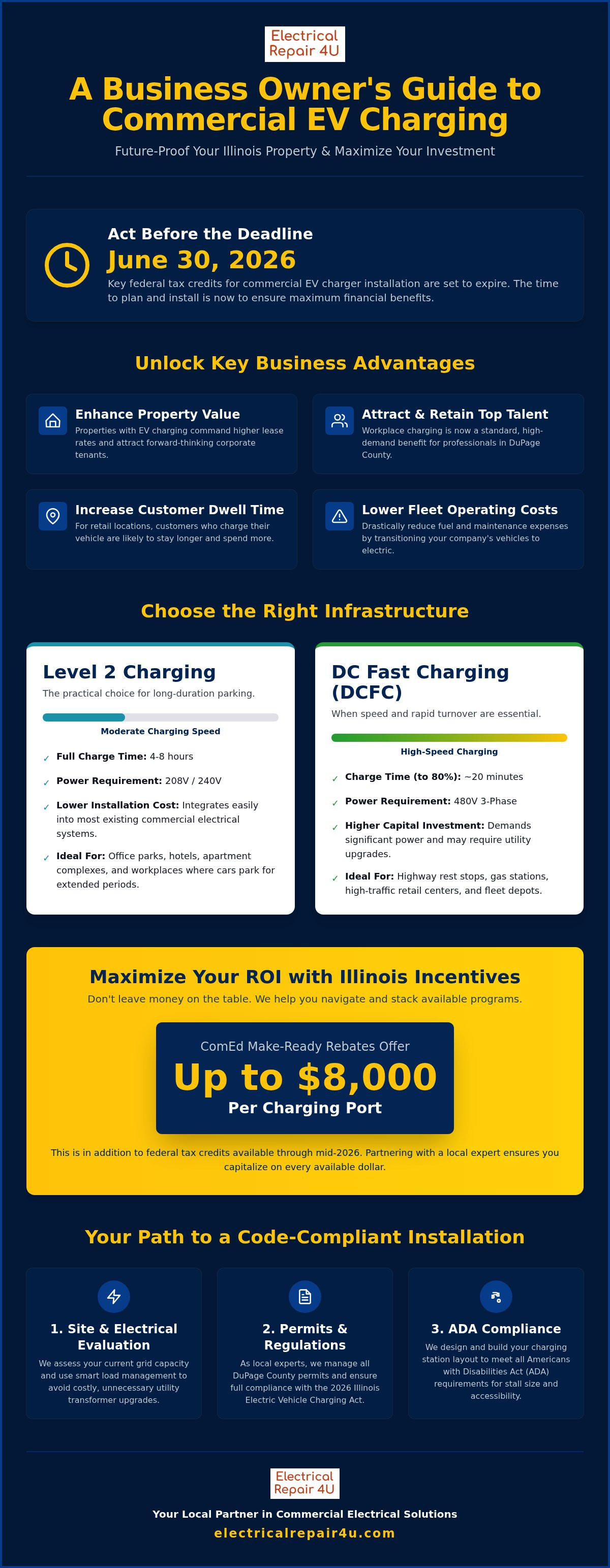
With federal tax credits for commercial EV charger installation set to expire on June 30, 2026, the window to maximize your investment is closing faster than most Illinois business owners realize. You've likely noticed that electric vehicles aren't just a trend anymore; they're a requirement for attracting high-quality tenants and keeping your property competitive. It's natural to feel some anxiety about grid capacity, panel upgrades, or the maze of ADA requirements and local permits required across DuPage County.
We're here to remove that stress and act as your technical partner. This guide will show you how to future-proof your business with scalable, code-compliant solutions tailored for our local community. You'll learn how to leverage ComEd Make-Ready rebates that offer up to $8,000 per port and navigate the 2026 Illinois Electric Vehicle Charging Act with confidence. We'll walk through everything from technical infrastructure to stacking state and federal incentives so you can build a reliable system that enhances your property value and tenant satisfaction for years to come.
Key Takeaways
- Discover how professional commercial EV charger installation enhances your property's value and helps you attract top-tier talent in the 2026 job market.
- Identify whether Level 2 chargers or high-speed DC Fast Charging infrastructure best serves your specific business model, from hotels to fleet operations.
- Learn to evaluate your site's electrical capacity and utilize smart load management to avoid the high costs of unnecessary utility transformer upgrades.
- Navigate the complexities of the 2026 Illinois Electric Vehicle Charging Act, including specific ADA stall requirements and available ComEd rebates.
- Understand the importance of partnering with a local veteran who manages everything from DuPage County permits to final inspections for a stress-free project.
Why Your Business Needs Commercial EV Charger Installation
Commercial EV charging isn't just a convenience for your employees; it's a high-capacity infrastructure investment designed for durability and speed. Unlike residential setups, commercial EV charger installation involves deploying Level 2 or DC Fast Charging (DCFC) stations that can handle constant public or fleet use. Understanding the nuances of EV charging station technology is the first step toward securing your property's future. By July 2026, electric vehicles have become a staple on Illinois roads. Businesses that haven't adapted are already falling behind.
Attracting and retaining top talent in DuPage County now requires more than just a competitive salary. Many professionals view workplace charging as a standard benefit. If your office or retail space doesn't offer it, you're giving candidates a reason to look elsewhere. Beyond staffing, your real estate itself gains immediate value. Commercial properties equipped with specialized charging infrastructure often command higher lease rates. You establish yourself as a green leader in the community, gaining a "first-mover" advantage that builds trust with eco-conscious customers and partners alike.
The ROI of Workplace Charging
Investing in charging stations provides a measurable return. For retail locations, providing a place to plug in increases customer "dwell time." While a vehicle charges, the driver is more likely to spend money in your shop or restaurant. Businesses also see improved employee retention metrics when they offer subsidized charging as a perk. Additionally, installing these stations can significantly improve your LEED certification scores. This makes your building more attractive to corporate tenants with strict sustainability mandates.
Fleet Electrification Benefits
If your business operates a vehicle fleet, the transition to electric is a financial game-changer. You'll drastically reduce long-term fuel and maintenance costs because electric motors have fewer moving parts than internal combustion engines. Networked commercial EV charger installation allows you to track energy usage and generate detailed reports for tax or compliance purposes. You don't have to overhaul everything at once. We've helped many local companies start with a single charger and scale up to a full-fleet depot as their needs grew. With over 40 years of local electrical experience, we ensure your system is built to last.
Level 2 vs. DC Fast Charging: Choosing the Right Infrastructure
Selecting the right hardware for your commercial EV charger installation depends entirely on how your visitors use your property. It's a choice between long-term convenience and high-speed turnover. Most local businesses find that Level 2 stations offer the most logical balance of cost and utility. These units operate on 208V or 240V power, which is standard for most commercial buildings. They're perfect for locations where cars sit for several hours, such as office parks, hotels, or multi-family residential complexes. Because they require less intensive infrastructure, you can often install multiple ports without overwhelming your current service.
DC Fast Charging (DCFC) serves a different purpose. These 480V three-phase systems are built for speed, providing an 80% charge in as little as 20 minutes. This makes them essential for highway rest stops, traditional gas stations, or fleet depots that need vehicles back on the road immediately. While the hardware is more complex, the revenue-generating potential is higher for high-traffic retail centers. You can check the latest Illinois EV charging incentives to see how state programs help offset these larger capital investments. We've spent 40 years helping local owners navigate these technical decisions, ensuring you don't overspend on capacity you don't actually need.
Level 2: The Practical Choice for Offices
For most DuPage County employers, Level 2 is the gold standard. Employees typically park for 4 to 8 hours, which is more than enough time for a Level 2 unit to provide a full charge. These systems integrate easily into existing electrical setups, meaning lower equipment and installation costs. It's a straightforward way to provide a high-value perk without a massive construction project.
DC Fast Charging: When Speed is Non-Negotiable
If your business model relies on rapid customer turnover, DCFC is the answer. However, these units demand significant power. You'll likely need specialized breaker box maintenance and potentially a new utility transformer to handle the load. We recommend starting with a thorough load calculation to see if your current panel can handle the 480V requirement. If you're unsure which path fits your property, you can consult with our master electricians to review your site's current capacity.
A common mistake in multi-unit installations is failing to plan for simultaneous charging. If ten cars plug in at once, your peak demand could skyrocket. We solve this through smart load management. This technology distributes power dynamically across all active ports, preventing your system from tripping breakers or incurring heavy utility demand charges. It's a seasoned approach that protects your equipment and your bottom line.
Evaluating Your Site’s Electrical Capacity
Before you commit to a specific hardware brand, your first step should always be a comprehensive site audit. Your building's electrical system has a finite capacity, and adding several high-draw chargers can push it to the limit. We start with a precise load calculation to determine if your current service can handle the additional demand without compromising your existing operations. It's much better to identify these needs early than to face a tripped main breaker during business hours. Our team provides the expert commercial electrical services required to assess your infrastructure safely and accurately.
Smart load management is a game-changer for modern businesses. This technology allows multiple chargers to share a fixed amount of power, which helps you avoid the massive expense of a utility transformer upgrade. By balancing the load, you ensure every vehicle gets charged without overtaxing the grid. We also recommend future-proofing your commercial EV charger installation by laying oversized conduit during the initial phase. Digging once and installing larger pipes now saves you a fortune in labor and asphalt repair when you're ready to expand from two chargers to ten.
Panel Upgrades and Distribution
Older commercial buildings in the DuPage area often operate on 200-amp or 400-amp services that were never designed for EV loads. To support a robust charging network, we often perform upgrades to 800-amp or even 1,200-amp service. We can also integrate your chargers with your building management system (BMS) to optimize energy flow. This setup allows for "peak demand shaving," which is the practice of reducing charger power during times of high building usage to avoid expensive utility demand charges. It's a smart way to keep your monthly bills predictable.
Trenching and Hardware Placement
Strategic placement of your stations can drastically reduce your project costs. We look for ways to minimize trenching through existing asphalt, as repaving is often one of the hidden expenses of a project. Depending on your layout, you might choose wall-mount units for parking garages to save space or pedestal-mount options for open lots. Regardless of the style, we always recommend protecting your investment with heavy-duty bollards and weather-resistant housing. Our 40 years of local experience ensures that your equipment stays safe from both the elements and accidental fender-benders.
Permits, ADA Compliance, and Illinois Incentives
Managing the legal and financial side of commercial EV charger installation can feel like a full-time job. Between local building codes and federal deadlines, there's a lot to track. The most urgent factor for Illinois business owners in 2026 is the Federal 30C Tax Credit. This program offers a credit of up to 30% for installation costs, capped at $100,000 per station. However, this specific credit is set to expire on June 30, 2026. If you want to maximize your return on investment, starting your project now is a smart move. We help you document the necessary technical details to ensure your filing is accurate and defensible.
State-level support is equally robust through the Illinois EPA "Driving a Cleaner Illinois" grant program. This initiative can cover up to 80% of your total project costs for public-access stations. When you combine these grants with ComEd Make-Ready rebates, which offer up to $5,333 per port for Level 2 chargers, the upfront cost of your infrastructure drops significantly. Our team has spent four decades building relationships with local inspectors and utility providers, so we know exactly how to "stack" these incentives to your advantage.
The Permitting Process in Warrenville and Naperville
Each municipality in DuPage County has its own set of hoops to jump through. In Warrenville and Naperville, local officials require detailed site plans, load calculations, and specific equipment specifications before they'll issue an electrical permit. These permits typically cost between $50 and $200. We handle the entire paperwork trail for you, ensuring your EV charger installation in Warrenville meets the latest 2026 National Electrical Code (NEC) standards. This proactive approach prevents failed inspections and costly mid-project delays.
Accessibility and Safety Standards
Your charging stations must comply with the Illinois Accessibility Code to be considered public accommodations. This means at least one out of every 25 charging spaces must be accessible. These stalls require a specific 5-foot wide access aisle and charger controls positioned between 15 and 48 inches from the ground. Beyond parking width, safety is paramount. We integrate whole-building surge protection to shield your expensive charging hardware from grid spikes. Proper lighting and clear signage aren't just for convenience; they're legal requirements that protect you from liability. If you're ready to start your project with a team that knows the local rules inside and out, contact our master electricians today for a professional site evaluation.
Partnering with a Local Veteran: Electrical Repair 4U
Choosing a contractor for commercial EV charger installation is about more than just finding someone who can pull wire. It's about finding a partner who understands the long-standing stability of your property. With over 40 years of local history in Warrenville and the surrounding DuPage County area, we've seen technology evolve from simple breaker boxes to complex, networked EV infrastructure. This tenure matters because we don't just guess at solutions. We apply decades of technical mastery to ensure your system is safe, efficient, and built to last. We're a stable pillar of the community, and we take pride in helping our neighbors grow.
We view every project as a reassuring partnership rather than a one-time transaction. Our team handles the heavy lifting from the very beginning, starting with precise load calculations and moving all the way through to the final city inspections. We live and work in the same Illinois communities you serve, which means we're personally invested in your success. Once your stations are live, we provide the ongoing preventative maintenance needed to ensure your chargers stay online and functional. You'll never have to worry about a technical failure leaving your tenants or customers stranded when they need a charge most.
Why Choose a Licensed Master Electrician?
High-voltage EV work is no place for non-specialized contractors. The risks of improper installation include everything from persistent system downtime to serious electrical hazards. Our licensed master electricians maintain a tireless commitment to safety and 100% code compliance. We've successfully completed numerous commercial fit-outs, including recent retail projects where we integrated multi-port charging stations into existing 480V systems without disrupting daily business. This proactive attitude ensures that your project is done right the first time, protecting your investment and your reputation.
Get Started with a Site Consultation
Your journey toward a future-proof property starts with a straightforward, professional walk-through. During our initial commercial consultation, we'll evaluate your current panel capacity, discuss hardware placement, and identify the most cost-effective path for your specific goals. You can expect transparent pricing and a detailed project timeline that respects your business operations. We're here to remove the anxiety from the process and provide the steady, logical guidance you deserve. Schedule your commercial EV consultation today!
Power Your Business for the Road Ahead
Investing in commercial EV charger installation is about more than just adding a plug. It's a strategic move to secure your property's long-term value and meet the rising expectations of your workforce. You've seen how stacking federal tax credits and local ComEd rebates can drastically lower your initial costs. By acting before the June 2026 federal deadline, you'll ensure your business stays ahead of the curve while maximizing your financial return.
You don't have to handle the stress of load calculations or complex ADA compliance alone. With 40+ years of local service and a team of licensed and insured master electricians, we provide the professional authority you need. We take pride in our A+ rating for commercial safety and our deep roots in the DuPage County community. We're ready to help you transition to a sustainable future with confidence and ease.
Request a Commercial EV Site Audit from Electrical Repair 4U
Frequently Asked Questions
How much does a commercial EV charger installation cost in Illinois?
Commercial EV charger installation costs depend on your site's specific infrastructure and the distance from your electrical panel to the parking stalls. While every project is unique, factors like trenching, concrete work, and necessary panel upgrades play a major role in the total investment. Many local businesses successfully offset these expenses by utilizing ComEd Make-Ready rebates and federal tax credits before the June 2026 deadlines.
Can my existing electrical panel handle multiple EV chargers?
Your panel's ability to support new chargers depends on a professional load calculation. Many older commercial buildings require an upgrade to 400-amp or 800-amp service to manage the high demand of multiple vehicles charging at once. If your current capacity is limited, we can implement smart load management technology to distribute power safely without the need for an immediate, expensive utility transformer upgrade.
What is the difference between networked and non-networked commercial chargers?
Networked chargers connect to the internet to provide remote monitoring, usage data, and payment processing capabilities. They're the standard choice for retail locations or multi-family properties where you want to collect revenue or track specific user energy consumption. Non-networked units are simpler "plug and play" stations that lack data tracking, making them more suitable for private fleets or secure employee parking areas.
Are there specific ADA requirements for EV charging stations in Naperville?
Yes, all commercial installations in Naperville must comply with the Illinois Accessibility Code. You're required to designate at least one accessible charging stall per 25 spaces, featuring a 5-foot wide access aisle for wheelchair clearance. Additionally, the physical charger controls and connectors must be positioned between 15 and 48 inches from the ground to ensure they're reachable for all drivers.
How long does the commercial EV charger installation process typically take?
The timeline for commercial EV charger installation usually spans two to six weeks from the initial audit to the final inspection. While the physical construction and wiring often only take a few days, the majority of the time is spent securing municipal permits and coordinating with utility providers. We manage this entire schedule for you to ensure your stations go live as quickly and smoothly as possible.
What maintenance is required for commercial EV charging stations?
Commercial stations require regular cable inspections, connector cleaning, and periodic software updates for networked models. It's important to check for physical wear or damage to ensure the equipment remains safe for public use and doesn't become a liability. Because these units sit outdoors, we also verify that weather-resistant seals and housings remain intact to protect the sensitive internal electronics from the Illinois elements.
Do I need a separate utility meter for my commercial EV chargers?
A separate meter isn't always required, but it's highly recommended for tracking energy costs and accessing specific utility incentives. Having a dedicated meter allows you to separate EV power consumption from your building's general usage, which simplifies accounting and helps you document data for tax credit claims. Some utility programs even offer discounted "off-peak" rates for charging that are only available through a dedicated meter setup.
What tax credits are available for Illinois businesses installing EV chargers in 2026?
Illinois businesses can currently claim the Federal 30C Tax Credit, which provides a 30% credit on installation costs up to $100,000 per station. It's important to act quickly, as this federal credit is scheduled to expire on June 30, 2026. You can also stack this with state-level grants and ComEd rebates that offer up to $5,333 per port for Level 2 chargers to maximize your total savings.


