
Plugging your new electric vehicle into a standard garage outlet isn't just slow; it's a gamble with your home's electrical integrity. Most homeowners don't realize that EV charging is a continuous load that can easily overwhelm older wiring. Installing a dedicated circuit for EV charger setups is the only way to ensure your home stays protected while your car powers up. We've spent over 40 years helping our neighbors in Warrenville and Naperville navigate these technical shifts. We know the anxiety that comes with high-voltage upgrades, especially when you're worried about electrical fires or whether your old breaker box can handle the pressure.
It's completely normal to feel overwhelmed by the technical jargon of 2026 NEC codes and the confusion between 120V and 240V requirements. You deserve a fast charge without the constant worry of a tripped breaker or a safety hazard. This guide will show you exactly why a dedicated circuit is the most critical safety requirement for your home setup. We'll break down local Illinois building codes, explain the 80% rule for continuous loads, and help you determine if your current electrical panel is ready for the future of transportation.
Key Takeaways
- Understand why a dedicated circuit for EV charger installation is a non-negotiable safety requirement to prevent electrical fires and system overloads.
- Learn how the "80% Rule" for continuous loads determines the specific amperage and breaker size your home requires for safe charging.
- Stay compliant with 2026 NEC standards that mandate professional installation by a licensed expert for all hardwired charging units.
- Assess your electrical panel's capacity and understand why local DuPage County codes often require specific conduit routing for garage setups.
- Find out how to secure the necessary permits in Warrenville or Naperville to protect your home's insurance coverage and long-term value.
What is a Dedicated Circuit for an EV Charger and Why is it Essential?
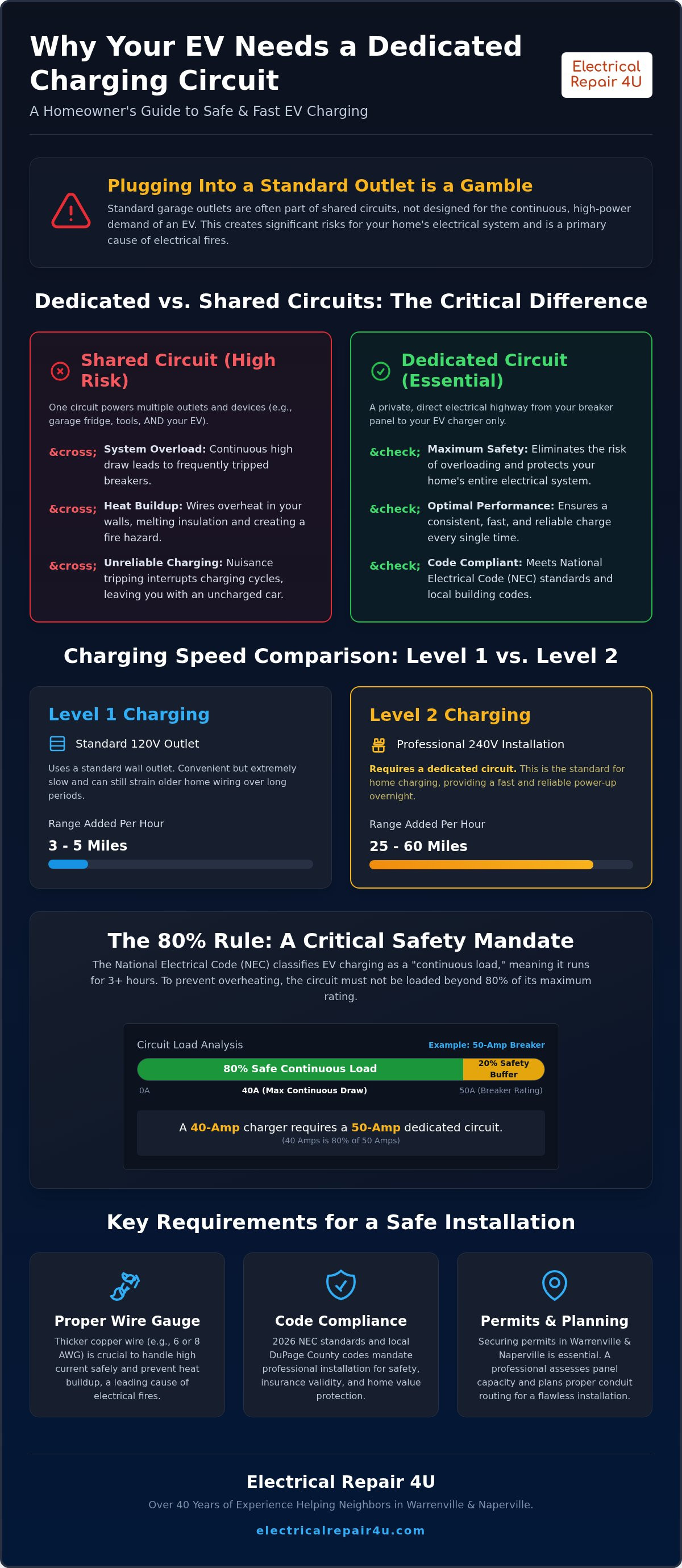
A dedicated circuit is an electrical line that runs directly from your breaker box to a single outlet or hardwired appliance. Unlike the shared circuits found in your kitchen or garage, no other devices or light fixtures draw power from this specific line. When you plan a dedicated circuit for EV charger installations, you're essentially creating a private highway for electricity to reach your car. This isolation is vital because your vehicle isn't like a lamp or a television. It's a high-demand appliance that requires a massive amount of energy for many hours at a time. A dedicated circuit is the ONLY safe way to handle the continuous load of an electric vehicle.
We've spent over 40 years helping our neighbors in Warrenville and Naperville upgrade their homes, and we've seen how quickly high-current appliances can strain older systems. Without a dedicated line, the high current generates heat that builds up in your walls. Over time, this heat can degrade the integrity of your wiring and lead to dangerous failures. By separating your car's power from the rest of your home, you ensure that your lights don't flicker and your kitchen appliances don't lose power every time you plug in your car.
Dedicated vs. Shared Circuits: The Danger of Overloading
In many older homes, garage outlets are daisy-chained together on a single 15-amp or 20-amp circuit. If you plug your car into an outlet that shares a connection with a garage refrigerator, a deep freezer, or heavy-duty power tools, you create a significant safety risk. The primary symptom of this problem is nuisance tripping. While it's tempting to just flip the breaker back on, that trip is a critical warning. It means the wires are reaching temperatures they weren't designed to handle. This heat can melt the plastic insulation on your shared wiring, leading to arc faults or even electrical fires. A dedicated line eliminates this stress by providing a clear, unobstructed path for electricity.
Level 1 vs. Level 2 Charging Requirements
Most electric vehicles come with a Level 1 charger that plugs into a standard 120V outlet. While this might seem convenient, it's the slowest way to power up. Even with Level 1, we often find that older garage wiring isn't up to the task of a 12-hour continuous draw. To truly enjoy the benefits of your vehicle, you'll likely want an electric vehicle charging station that utilizes Level 2 power. A dedicated circuit for EV charger setups is non-negotiable for these faster 240V systems. The performance gap is staggering. A Level 1 charger typically adds only 3 to 5 miles of range per hour. In contrast, a professionally installed Level 2 circuit can provide between 25 and 60 miles of range per hour. This speed ensures your car is fully charged every single morning, giving you the reliability you need for your daily commute.
Technical Requirements: Amperage, Voltage, and the 80% Rule
EV charging isn't like running a toaster or a vacuum. Those devices run for minutes. Your car charges for hours. The National Electrical Code (NEC) calls this a continuous load. This classification triggers the 80% Rule. This rule states that a circuit breaker should only be loaded to 80% of its maximum capacity for long durations. For example, a 40-amp charger requires a 50-amp dedicated circuit for EV charger safety. This 10-amp buffer prevents the breaker from overheating and tripping during an overnight session. If you try to pull 40 amps through a 40-amp breaker for eight hours, the heat will eventually cause the internal components to fail or even melt.
Wire gauge is another non-negotiable safety factor. Thicker copper wire, like 6 AWG or 8 AWG, is necessary to carry high current without excessive heat buildup. Using undersized wire is one of the most common causes of electrical fires in DIY installations. Thicker wire has less resistance. Less resistance means less heat. We always prioritize these heavy-duty materials to ensure your home remains a safe haven while you sleep. Our 40 years of experience in DuPage County has taught us that cutting corners on wire quality is never worth the risk.
Choosing the Right Amperage for Your Home
Most residential chargers operate at specific amperage tiers. Your car's onboard charger determines the maximum intake. If your vehicle is capped at 32 amps, a 60-amp circuit won't speed up the process. Common circuit sizes include:
- 30-amp circuits for older EVs or plug-in hybrids.
- 40-amp and 50-amp circuits for standard long-range vehicles.
- 60-amp circuits for high-performance trucks and SUVs.
We often recommend future-proofing. Technology moves fast. Installing a 50-amp or 60-amp circuit now means you won't have to pay for a second installation when you buy your next EV. As experts suggest, installing home EV charging is an investment in your property's infrastructure. It's better to over-build the circuit once than to pay for a total rewire three years later.
Voltage and Phase Considerations for Illinois Homes
Standard Illinois homes use 240V split-phase power. This is the same high-voltage power that runs your central AC or electric range. When setting up your charger, you'll choose between a NEMA 14-50 outlet or a hardwired unit. While outlets offer flexibility, hardwiring is the gold standard for 48-amp or higher speeds. It eliminates the plug as a potential point of failure. Hardwired units are also more resilient against the elements if your charger is located in a semi-enclosed area. If you're worried about your existing setup, a professional breaker box maintenance assessment can clarify your home's capacity before you buy your charger. We take the guesswork out of the process, ensuring your new equipment works perfectly from day one.
Safety and Code Compliance in Warrenville and Naperville
Compliance with the 2026 National Electrical Code (NEC) isn't just a technicality. It is a legal requirement that protects your family and your financial investment. In DuPage County, local building departments require an electrical permit for any new circuit installation. This ensures that a third-party inspector verifies the work meets strict safety standards. Unpermitted electrical work can void your homeowner's insurance policy in Illinois, leaving you liable for damages if a fire occurs. We've seen how stressful these regulations can feel, but they exist to ensure your home remains a safe haven.
The 2026 NEC mandates 5mA Class A Ground-Fault Circuit Interrupter (GFCI) protection for all EV charging circuits. This is a stricter requirement than previous years. It's designed to detect even tiny leaks of electricity, cutting power before they can cause a shock or fire. When we install a dedicated circuit for EV charger use, we utilize these high-spec breakers to meet both national and local standards in Naperville and Warrenville. It's about more than just passing an inspection; it's about long-term reliability for your home.
Preventing Fire Risks and Heat Buildup
Sustained high-amperage draw creates significant heat. In older homes, thinner wiring or poor connections become immediate failure points. One common danger is "back-stabbing" wires into the back of an outlet rather than using secure screw terminals. While back-stabbing is faster for some contractors, it creates a weak contact point that can melt under the stress of an EV load. A dedicated line uses heavy-duty terminals and appropriately gauged copper to handle the heat safely. This is why breaker box maintenance is a prerequisite for a new EV circuit. We check for loose connections and signs of wear in your existing system before adding any new high-demand loads.
The Importance of Professional Permitting Services
Navigating the paperwork for a permit in Warrenville or Naperville can be a headache. We handle the entire application process for you. Our team coordinates directly with the city to schedule the final electrical inspection. During this visit, an official confirms that the wire gauge, breaker size, and conduit routing are perfect. This ensures your installation meets the specific EV charger installation Warrenville standards. By the time we finish the project, you'll have a certificate of inspection and the peace of mind that comes with a job done right. We take pride in being a stable pillar of the community, ensuring every installation is documented and compliant.
Planning Your Installation: Panel Capacity and Conduit Routing
Before pulling a single wire, you must determine if your home's electrical heart can handle the extra beat. A load calculation is the first step in planning a dedicated circuit for EV charger installation. This isn't just about counting empty slots in your breaker box. It's about calculating the total demand of your existing appliances against your panel's limit. A 100-amp panel might look empty, but if you have an electric range, dryer, and central air, it might already be near its safe capacity. Upgrading to a 200-amp system provides the necessary headroom for modern electric-heavy homes.
Distance also plays a major role in your project's scope. The longer the run from your main panel to the garage, the more labor and materials are required. If your panel is on the opposite side of the house, we have to plan a route that is both efficient and safe. We've spent 40 years solving these logistical puzzles for homeowners in DuPage County, ensuring that every installation is as cost-effective as possible without sacrificing quality or safety.
Solutions for Full Electrical Panels
If your panel is physically full, you aren't necessarily out of luck. Depending on your panel's manufacturer and local code, we might use tandem breakers to consolidate space. Another popular option is installing a sub-panel in the garage. This creates a secondary hub for your EV charger and any future garage circuits. However, if your total home demand exceeds your service's limit, a 200 amp panel upgrade is the most reliable long-term solution. This ensures your home infrastructure remains stable as you add more smart technology and electric appliances.
Conduit Routing and Aesthetic Considerations
In many parts of Illinois, local building codes require metal conduit (EMT) for any wiring exposed in a garage. Unlike Romex, which is the plastic-sheathed wire found inside your walls, metal conduit protects your dedicated circuit for EV charger from physical damage. This is crucial in high-traffic garage areas where a stray ladder or bicycle could otherwise nick a wire. We can mount conduit on the surface for a clean, industrial look, or run it through finished walls if you prefer a seamless appearance. If you're planning for an outdoor charger, we use weatherproof enclosures and specialized fittings to keep the connection bone-dry through our harsh Midwestern winters. If you're unsure where to start, you can request a professional site assessment to get a clear roadmap for your installation.
Professional EV Circuit Installation in Warrenville & Beyond
High-voltage electrical work is high-stakes. The 2026 NEC standards are clear: Section 625.4 mandates that all permanently installed chargers must be handled by a "qualified person." In our local community, that means a licensed professional who understands the specific nuances of DuPage County infrastructure. When you choose a pro for your dedicated circuit for EV charger, you aren't just paying for labor. You're paying for the peace of mind that your home's foundation is secure. We've spent four decades mastering these standards so you don't have to worry about the technical fine print.
Our process at Electrical Repair 4U is built on 40 years of neighborly reliability. We start with a comprehensive site assessment to verify your panel capacity and plan the most efficient conduit route. Once the permits are in hand, we handle the heavy lifting. We don't just pull wires; we optimize your entire system. This often includes a whole house surge protector installation. This added layer of defense protects your expensive new vehicle and your home’s sensitive electronics from unpredictable power spikes. We finish every job with rigorous final testing to ensure the voltage is stable and the grounding is perfect.
The Stress-Free Professional Experience
We believe in transparent pricing and clear communication. There are no hidden fees or "gotcha" moments when we're in your home. Our team ensures every single connection is torqued to exact manufacturer specifications. This technical precision prevents the loose connections that lead to heat buildup and failure over time. We view ourselves as your collaborative partners rather than just contractors. We treat your garage and your electrical panel with the same care we'd give our own. You'll know exactly what's happening at every stage of the installation.
Long-Term Reliability and Support
Our commitment to your safety doesn't end when the charger's status light turns green. We've been a stable pillar of the Warrenville and Naperville communities since we opened our doors over 40 years ago. We're here for the long haul. Whether you need a future panel check-up or any other residential electrical repair Warrenville service, our team is ready to help. We take pride in our craft and our reputation for honesty. Contact us today for a professional consultation on your dedicated circuit for EV charger. Let's make your transition to electric driving safe, fast, and completely stress-free.
Secure Your Home for the Road Ahead
Your new electric vehicle represents a significant investment in a cleaner future. Protecting that investment begins with a rock-solid electrical foundation. By strictly adhering to the latest 2026 NEC standards and respecting the 80% rule for continuous loads, you eliminate the dangerous risks of overheating and circuit failure. Installing a dedicated circuit for EV charger safety is the most important step you can take to ensure your home remains a safe haven while your car powers up overnight. To further safeguard your investment, you can explore Mobile EV Battery Testing to verify that your vehicle's power system is performing at its peak.
We've served as a stable pillar in the Warrenville and Naperville communities for over 40 years. Our team of fully licensed and insured master electricians takes pride in delivering A+ rated local service with the transparent pricing you expect from a neighbor. We handle the permits, the load calculations, and the technical heavy lifting so you can focus on the drive. Don't leave your high-voltage infrastructure to chance when expert help is just a click away.
Schedule your professional EV circuit installation today with Electrical Repair 4U!
We look forward to helping you power your journey with total peace of mind.
Common Questions About Home EV Charging
Can I use an existing 240V dryer outlet for my EV charger?
You generally shouldn't use a dryer outlet for your vehicle. Most dryers run on 30-amp circuits, while modern Level 2 chargers typically require a 50-amp or 60-amp line to operate efficiently. Sharing an existing outlet also risks frequent plugging and unplugging, which can wear out the receptacle and lead to loose connections or electrical arcing.
What is the 80% rule for EV charging circuits?
The 80% rule is a National Electrical Code requirement for "continuous loads" like electric vehicles. It means a circuit should only handle 80% of its maximum rating for long periods. If your car draws 40 amps, you need a 50-amp breaker. This safety buffer prevents the circuit from overheating during an eight-hour charging session.
Do I need a permit to install a dedicated EV circuit in Warrenville, IL?
Yes, local building departments in Warrenville and Naperville require an electrical permit for this work. A permit ensures that a city official inspects the installation for safety and code compliance. Skipping this step can lead to fines and might even void your homeowner's insurance policy if an electrical issue occurs later.
How much does it cost to run a dedicated circuit to my garage?
The total investment depends on the distance between your electrical panel and your garage. Longer wire runs require more labor and heavy-duty conduit materials. Your current panel's capacity also matters. If your breaker box is already full, you might need a sub-panel or a full service upgrade to safely support the new load.
Can an EV charger be installed on a 100-amp electrical panel?
You can install a charger on a 100-amp panel, but only if your home's total electrical demand allows it. We perform a load calculation to see if your current system has enough "headroom." If you have other high-draw appliances like an electric range or central air, we'll often recommend a 200-amp upgrade for better reliability.
What happens if I don't use a dedicated circuit for my charger?
Failing to use a dedicated circuit for EV charger setups leads to nuisance tripping and dangerous heat buildup in your walls. Standard garage outlets often share power with refrigerators or lights. When your car pulls a heavy current for hours, it can overwhelm these shared wires, potentially causing an electrical fire or damaging other electronics.
Is hardwiring better than using a NEMA 14-50 plug?
Hardwiring is generally better for safety and allows for faster charging speeds. While a NEMA 14-50 plug is convenient, it adds a physical connection point that can fail under high heat. Hardwired installations are required for chargers pulling more than 40 amps and offer a cleaner, more permanent look in your garage.
Does a dedicated circuit for an EV charger increase home value?
Installing a dedicated circuit for EV charger use is a smart infrastructure upgrade that boosts home value. Many homebuyers in DuPage County now look for "EV-ready" garages as a standard feature. It demonstrates that your home's electrical system is modern, safe, and ready for the next generation of vehicles.


