
What if that quote for an electrical panel upgrade for EV charger installation isn't just another hidden cost of going green, but actually the most important safety upgrade your home will ever receive? It's completely normal to feel a bit of sticker shock when you realize your existing service might not be ready for a Level 2 charger. You've likely heard conflicting advice about whether you truly need a 200-amp panel or if you're just being upsold on work you don't need.
We understand that anxiety because we've been helping our neighbors in the western suburbs stay safe for over 40 years. You want a fast, reliable charge without worrying about overloaded circuits or potential fire hazards. This guide breaks down exactly how to determine your home's capacity and how to navigate the 2026 Illinois landscape. You'll discover how to secure ComEd rebates of up to $2,500 and whether new smart load management technology could save you from a full service overhaul. We're here to help you move from confusion to a clear, code-compliant plan for your home's modern needs.
Key Takeaways
- Learn how to perform a professional load calculation to see if an electrical panel upgrade for EV charger installation is truly necessary for your home’s safety.
- Identify the critical differences between 100-amp and 200-amp services to ensure your Level 2 charger won't overload your existing breaker box.
- Discover how smart load management and circuit-sharing devices can provide a safe, high-speed charge without the need for a full service replacement.
- Navigate the 2026 Illinois rebate landscape to claim up to $2,500 in ComEd incentives while staying fully compliant with local DuPage County building codes.
- Understand why licensed installation is the only way to protect your home insurance and guarantee the long-term stability of your modern electrical system.
Does Your EV Charger Require an Electrical Panel Upgrade?
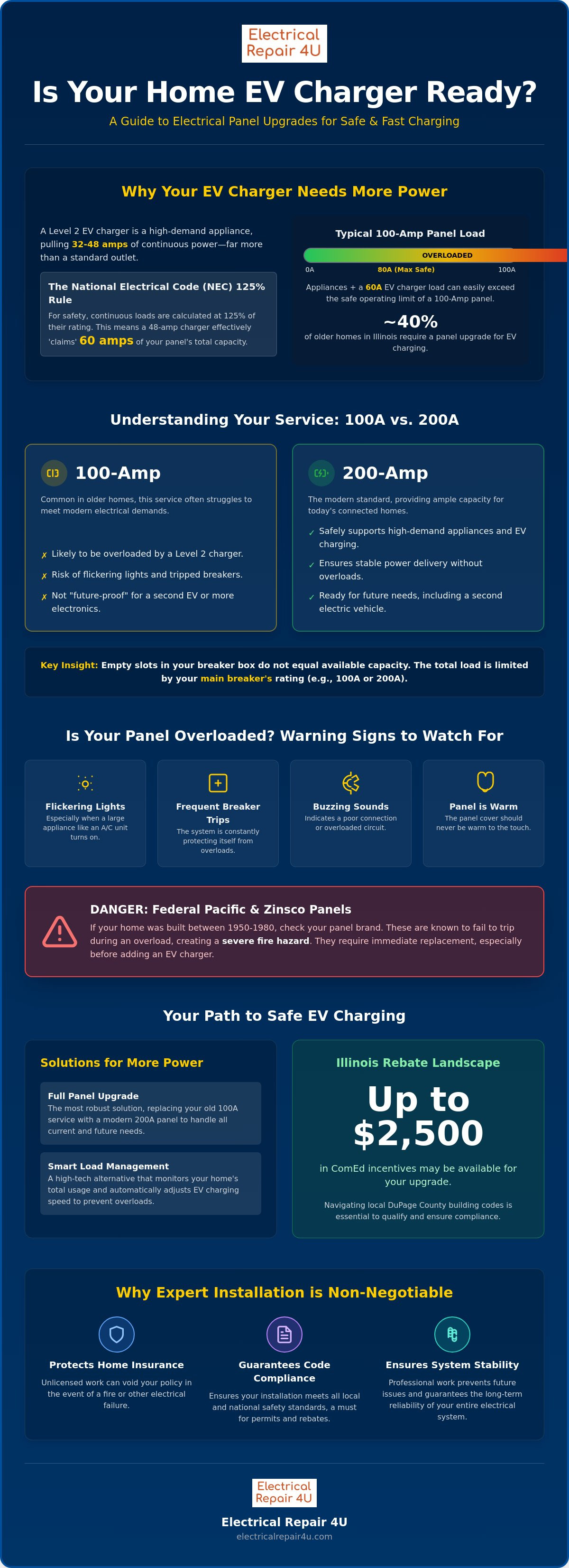
Adding a fast charger to your home is a major milestone, but it isn't as simple as plugging in a new appliance. Most Level 2 chargers pull between 32 and 48 amps of continuous power. To put that in perspective, many older homes in the Warrenville area still operate on a 100-amp service. When you consider the different levels of charging available, it's clear that high-speed home units place a unique stress on your infrastructure. Since the National Electrical Code requires us to calculate continuous loads at 125% of their rating, a 48-amp charger actually "claims" 60 amps of your panel's total capacity.
We often find that approximately 40% of older homes in Illinois require an electrical panel upgrade for EV charger setups to operate without risk. If you have a 100-amp panel and you're running your air conditioner, electric dryer, and oven simultaneously, adding an EV to the mix will likely push you over the limit. A 200-amp upgrade becomes non-negotiable when your total household load exceeds 80% of your panel’s rated capacity. This isn't just about convenience; it's about preventing the heat buildup that leads to catastrophic failures.
Don't be fooled by "available space" in your breaker box. Having an empty slot for a new breaker doesn't mean your main bus bars can handle the additional current. Think of your panel like a bridge. Just because there's room for one more truck doesn't mean the structure can support the extra weight. Overloading a panel that lacks the necessary capacity creates a silent danger that often goes unnoticed until a component melts or sparks.
Signs Your Current Panel is at Its Limit
Your home often tries to tell you when the electrical system is struggling. You might notice your lights flickering momentarily when the central air or the dryer kicks on. This indicates a significant voltage drop because the panel is gasping for power. Frequent circuit breaker tripping is another red flag. If your breakers are doing their job, they'll shut down to prevent a fire, but a system that trips constantly is a system that's failing to meet your needs. You should also listen for any faint buzzing sounds or feel for warmth on the panel cover itself. These are signs of poor connections or overloaded circuits that require professional attention.
The Age Factor: Federal Pacific and Zinsco Panels
If your home was built between 1950 and 1980, you might have a Federal Pacific or Zinsco panel. In our 40 years of local service, we've identified these brands as immediate candidates for replacement. These specific panels have a documented history of failing to trip during an overcurrent event. This means the breaker stays "on" even when the wires are melting. Modern energy demands are simply too high for this outdated technology. Combining an EV charger with a Zinsco or FPE panel is a recipe for disaster. Upgrading these units isn't just a recommendation; it's a critical safety step to protect your family and your investment.
Evaluating Your Home’s Electrical Capacity for Charging
Before you commit to a specific charger, you need to know what your home can actually handle. Start by finding your main electrical panel, which is often in the basement, garage, or utility closet. Look for the largest switch, usually located at the very top or bottom of the breaker rows. This main breaker should have a number stamped on it, such as 100, 150, or 200. This number represents your total household amperage. If you see a 100 on that switch, an electrical panel upgrade for EV charger installation is likely on your horizon, especially if your home uses electric heating or a large AC unit.
Modern EV charging relies on 240V circuits to deliver the speed you expect. While a standard 120V outlet works in a pinch, it's like filling a swimming pool with a garden hose. A 240V setup provides the gold standard for overnight charging. As you evaluate your current setup, think about the future. Many of our neighbors in Naperville and Aurora are already planning for a second electric vehicle. Considering an electrical panel upgrade for EV charger readiness now is a smart move that saves you from paying for a second round of upgrades down the road.
How to Read Your Electrical Panel Label
The paper label on the inside of your panel door is your system’s roadmap. It lists the maximum service rating, which tells you the total amount of power the panel can safely manage. Don't confuse the number of available circuit slots with the total amperage capacity. You might have ten empty spaces, but if your main service is already maxed out, those slots are effectively useless. A bus bar is the heavy metal rail inside your panel that carries electricity from the main service to all your individual breakers.
Why a Professional Load Calculation Matters
The National Electrical Code (NEC) has strict rules about how much load a single panel can carry. We use specialized software to perform a detailed load calculation, which accounts for your HVAC system, kitchen appliances, and lighting. This ensures your charger is safely installed by a qualified electrician who understands local Illinois requirements. Trying to do this math yourself is a common DIY trap. Missing a single high-draw appliance in your calculation can lead to code violations or a fire hazard. If you're unsure about your current capacity, our team can provide a professional breaker box maintenance check to give you total peace of mind.
Smart Alternatives to a Full Panel Replacement
You might feel a sense of relief knowing that a full service overhaul isn't your only option. If your existing system is healthy but lacks the headroom for a continuous 48-amp draw, smart technology can bridge the gap. These solutions are especially helpful when Evaluating Your Home’s Electrical Capacity reveals you are just slightly over the limit. Instead of a massive construction project, we can often install devices that manage your power flow dynamically. This approach keeps your home safe without the immediate need for a total rewire.
Smart load management works like a digital traffic cop for your electricity. It monitors your home's total energy consumption in real-time. If you start your electric dryer while your car is charging, the system automatically throttles or pauses the EV charger to prevent a tripped main breaker. This ensures you never exceed your panel's safety threshold. While an electrical panel upgrade for EV charger installation is the gold standard for long-term stability, these smart controllers offer a sophisticated way to live within your current 100-amp or 150-amp limits.
Circuit sharing devices are another practical workaround we often recommend for specific situations. These allow your EV to share a 240V circuit with an existing appliance, such as a clothes dryer or a water heater. Since you rarely dry clothes at 2 AM, the device prioritizes the car when the dryer is idle. Industry data indicates these devices can cost 85-90% less than a full-service upgrade. It’s a clever way to get Level 2 speeds without the heavy lifting of a complete infrastructure change. However, we also use sub-panels to add physical breaker space when your main panel is crowded, though this doesn't increase your total amperage capacity.
What is an EV Energy Management System (EVEMS)?
An EVEMS is a specialized controller that sits between your panel and your charger. It's compatible with most major brands, including Tesla and ChargePoint. These systems are lifesavers for older homes in historic Illinois districts where upgrading the utility line from the street is physically impossible or prohibitively expensive. By keeping your total draw under the limit, an EVEMS keeps you code-compliant and removes the anxiety of an overloaded system.
Comparing Costs: Upgrade vs. Smart Management
Choosing between a workaround and a full 200-amp service often comes down to your future plans. Smart controllers have lower upfront hardware costs, but they don't increase your home’s total power "budget." A full electrical panel upgrade for EV charger readiness significantly boosts your home's resale value and prepares you for future additions like heat pumps or induction stoves. If you aren't sure which path fits your specific needs, a professional Breaker Box Maintenance assessment can help you weigh the pros and cons of each approach.
If you are also exploring solar energy or battery storage options to complement your electrical upgrades, click here for the latest insights.
Navigating Permits and Rebates in DuPage County
Doing things by the book isn't just about following rules; it's about protecting your biggest investment. We often see homeowners tempted by "side-work" quotes from unlicensed individuals, but an unpermitted electrical panel upgrade for EV charger installation can lead to a denied claim if a fire ever occurs. In DuPage County, the law is very specific. A licensed electrician must pull the permit and schedule the required inspections to ensure everything meets the 2020 National Electric Code (NEC). This process provides an essential layer of security for your family.
The permit process in towns like Warrenville, Naperville, and Aurora is straightforward when you have a partner who handles the paperwork. You can typically expect permit fees to range between $50 and $200. This small investment guarantees that your new system is stable and safe for years to come. It's important to stay current with the latest regulations, as the federal 30C tax credit expired on June 30, 2026. Even though that specific credit is gone, there are still significant local incentives available to help offset your modernization costs.
Local Building Code Requirements
Local inspectors in our area pay close attention to dedicated circuits. Your EVSE must have its own line that doesn't share power with any other appliances. If you're mounting a charger outdoors, the requirements for conduit and weatherproofing are even more strict than for a garage install. We've spent four decades learning these local nuances, making us the ideal choice for an EV Charger Installation Warrenville homeowners can trust for long-term reliability. We ensure every bolt and wire meets the highest safety standards before the inspector even arrives.
Maximizing Your 2026 Utility Rebates
As of January 1, 2026, ComEd offers a substantial rebate for Level 2 installations that can make your project much more affordable. You could receive up to $2,500 if you live in an equity-eligible community, while the standard rebate is $1,000. To qualify for these funds, you must use an Illinois Commerce Commission (ICC) certified installer. The application process requires specific documentation, including a detailed invoice, proof of the local permit, and photos of the completed installation. We handle the heavy lifting by providing all the technical paperwork you need to secure your rebate.
A panel upgrade can also qualify you for broader energy efficiency credits, especially if you're moving toward a fully electric home. Because we stay current on every local and state update, we ensure your project meets every criteria for these high-value incentives. If you're ready to modernize your home safely and affordably, contact us for a professional assessment today. We’ll help you navigate the paperwork while ensuring your electrical system is ready for the future.
Why Expert Installation is the Safest Choice
Choosing a partner for your home’s modernization shouldn't feel like a gamble. While national corporations might offer a streamlined app experience, they often lack the deep-rooted understanding of the specific wiring challenges found in our older Illinois neighborhoods. We've spent over 40 years working inside the basements and garages of Warrenville, Naperville, and Aurora. This local history means we don't just see a breaker box; we see the evolution of home safety. When you invest in an electrical panel upgrade for EV charger installation with us, you aren't just getting a new piece of hardware. You’re gaining the security that comes from four decades of proven results and neighborly reliability.
Safety in 2026 goes beyond just following a manual. Because an EV charger draws a massive amount of current for hours at a time, every connection must be perfect. We utilize infrared thermal imaging to detect hidden hot spots that the naked eye would never catch. Our technicians also perform precision torque checks on every terminal. These steps ensure your connections won't loosen over time due to heat expansion. This proactive attitude prevents the small failures that lead to emergency repairs later, keeping your home’s infrastructure stable and dependable. We believe that a job done right the first time is the only way to build lasting trust.
The Electrical Repair 4U Difference
We handle the heavy lifting so you don't have to. From coordinating with your local utility provider to pulling the necessary permits, our team manages every detail. This collaborative approach removes the stress of technical logistics. You get the peace of mind that comes from a licensed and insured team who treats your home like their own. If you have other concerns about your home's power, we also provide comprehensive Residential Electrical Repair Warrenville families have relied on for generations. We take pride in our craft and never cut corners on your safety.
Request Your Local Panel Assessment
Modernizing your home starts with a clear, honest conversation. During a professional EV readiness consultation, we perform a thorough inspection of your existing service. We don't believe in high-pressure sales or hidden fees. You’ll receive a detailed quote that explains every line item, from the copper wiring to the new breaker box. Our goal is to empower you with the facts so you can make the best decision for your family’s safety. A proper electrical panel upgrade for EV charger readiness is an investment in your home's longevity. Don't leave your home's security to chance. Schedule your electrical panel inspection today and let our seasoned experts help you power your future with confidence.
Power Your Future with Confidence
Transitioning to an electric vehicle is a major step toward a modern lifestyle, but your home's infrastructure must be ready to support that change. Whether you choose a full electrical panel upgrade for EV charger installation or a smart load management solution, your priority should always be safety and long-term stability. You now have the tools to navigate 2026 ComEd rebates and understand why following local DuPage County building codes is essential for your home insurance and peace of mind.
Don't let technical confusion or the fear of hidden costs stall your progress. Our licensed and insured master electricians bring over 40 years of local experience and specialized knowledge of Illinois electrical standards to every project. We're here to act as your collaborative partner, ensuring your installation is efficient, safe, and code-compliant. Get a Professional EV Readiness Quote from Electrical Repair 4U to start your journey today. Your modern, high-speed charging setup is just one professional assessment away.
Frequently Asked Questions
Can I install a Level 2 EV charger on a 100-amp panel?
You can sometimes install a charger on a 100-amp panel, but it depends entirely on your home's existing power draw. A licensed electrician must perform a load calculation to see if your HVAC, appliances, and lighting leave enough "headroom" for the charger. If your panel is near its limit, an electrical panel upgrade for EV charger installation is the safest way to prevent tripped breakers or fire hazards.
How much does it cost to upgrade an electrical panel for an EV charger in Illinois?
The total investment for a panel upgrade depends on the complexity of your home's wiring and local permit requirements. Factors that influence the final cost include the distance from the utility service, the need for new grounding rods, and specific municipal fees in towns like Naperville or Aurora. While we don't provide flat-rate pricing without an inspection, we ensure every quote is transparent and covers all necessary safety components.
Will a smart load manager save me from needing a full panel upgrade?
A smart load manager can often prevent the need for a full service overhaul by automatically pausing your car's charging when high-draw appliances are running. This technology allows you to stay within your current amperage limit while still enjoying Level 2 charging speeds. It's a highly effective alternative for homeowners in older Illinois districts where a utility service upgrade might be physically difficult or prohibitively expensive.
How long does a typical electrical panel upgrade take to complete?
Most electrical panel upgrades are completed within a single working day, typically taking between four and eight hours. During this time, your power will be temporarily disconnected while we install the new breaker box and hardware. We coordinate closely with your local utility company and municipal inspectors to ensure the power is restored as quickly as possible so your daily routine isn't disrupted.
Do I need a permit to install an EV charger in Naperville or Warrenville?
Yes, you must obtain a permit for any EV charger installation or panel modification in DuPage County. Permit fees in our area generally range from $50 to $200 depending on the specific municipality. This requirement ensures that a third-party inspector verifies the work meets the 2020 National Electric Code, which protects your home's safety and keeps your homeowner's insurance policy valid.
Can I use my existing dryer outlet to charge my electric car?
You can use a 240V dryer outlet if you install a certified circuit-sharing device. These devices act as an intelligent switch, prioritizing your dryer when it's running and switching power back to your EV when the cycle finishes. This is a great way to avoid an immediate electrical panel upgrade for EV charger use, though it doesn't increase your home's overall electrical capacity for future upgrades.
Does a panel upgrade increase the value of my home?
Upgrading your electrical panel significantly boosts your home's resale value by modernizing its core infrastructure. Potential buyers in 2026 view "EV readiness" as a premium feature, much like a newer roof or HVAC system. By moving to a 200-amp service, you're also making the home ready for other modern additions like heat pumps or high-efficiency induction stoves, which appeals to energy-conscious shoppers.
Are there federal tax credits for upgrading my breaker box for an EV?
The federal 30C tax credit, which previously covered up to 30% of installation costs, expired on June 30, 2026. While that specific federal incentive is no longer available, Illinois residents can still take advantage of ComEd rebates. As of early 2026, these rebates offer up to $2,500 for qualifying Level 2 installations, providing a substantial way to offset the cost of modernizing your home's electrical system.


