
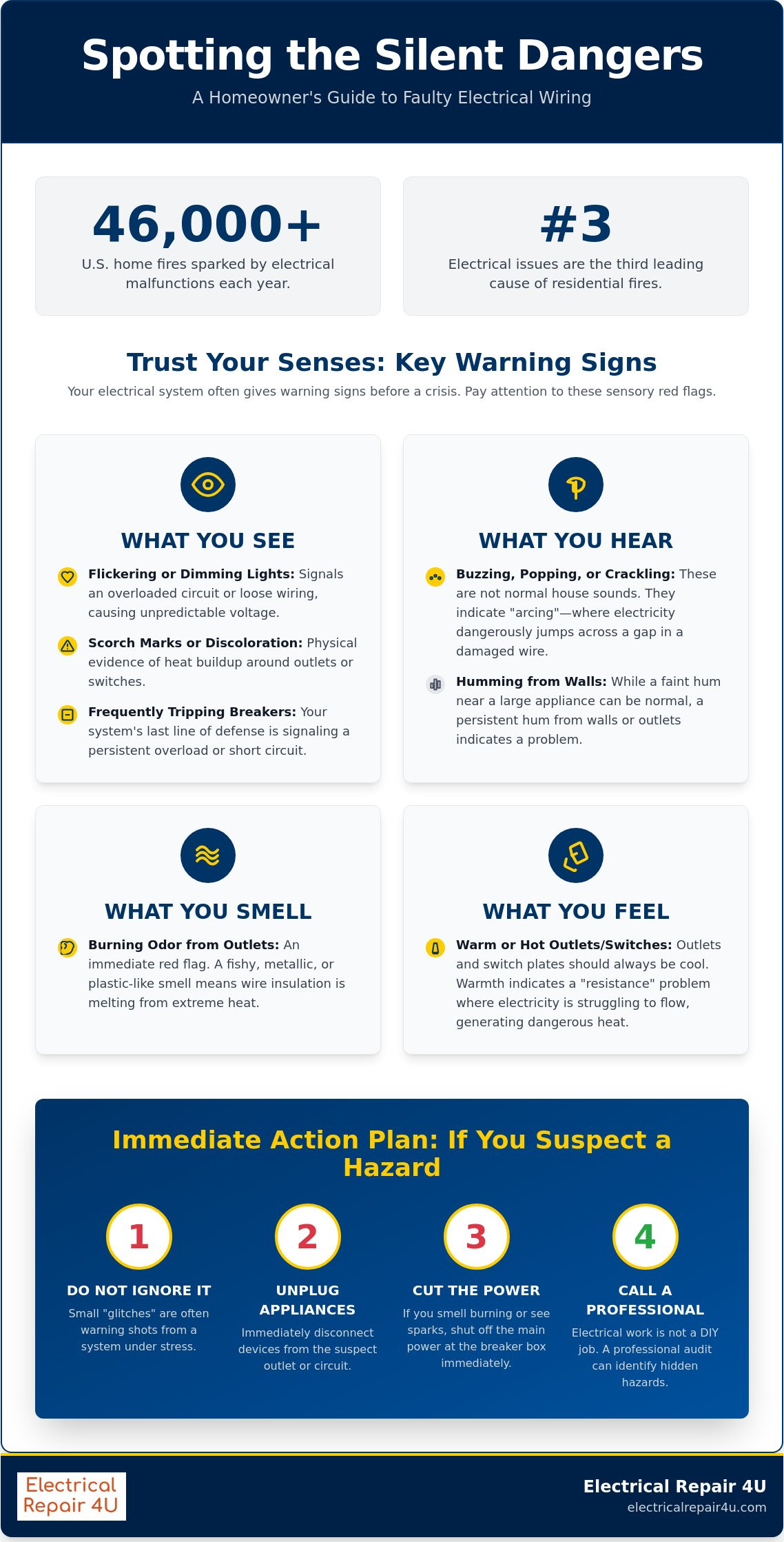
Did you know that electrical malfunctions are the third leading cause of residential fires in the United States, sparking over 46,000 home fires every year? In the Chicago area, where the median home age is now 53 years, the signs of faulty wiring are often tucked away behind old drywall and outdated renovations. It's completely normal to feel a spike of anxiety when you notice a flickering lamp or a strange humming sound. You want to keep your family safe, but the confusion over whether a problem is a minor fix or a major emergency can be paralyzing.
We've spent more than 40 years serving as a reliable partner for families across DuPage and Kane Counties, and we believe that home safety shouldn't be a source of stress. This guide will teach you how to identify critical sensory red flags of a deteriorating electrical system so you can act before a hazard develops. We'll provide a clear list of danger signs and a practical plan of action to help you regain your peace of mind. You'll learn how to spot the risks and exactly what to do to keep your household secure.
Key Takeaways
- Learn to identify the specific visual and scent-based signs of faulty wiring, such as flickering lights or the distinct smell of burning plastic, before they escalate into an emergency.
- Understand the unique risks associated with aging Illinois infrastructure, including the specific dangers posed by outdated knob-and-tube or aluminum wiring systems.
- Master a simple triage protocol to follow if you suspect a hazard, including when to cut your main power at the breaker to prevent a potential fire.
- Discover how a professional electrical safety audit can transform hidden hazards into a clear, manageable plan for a secure and modernized home.
Common Signs of Faulty Wiring in Your Home
Faulty wiring isn't just a single broken wire. It is the gradual deterioration, physical damage, or improper installation of the Electrical wiring system that keeps your home running. In Illinois, where the median age of a home is 53 years, these systems were often designed for a few lamps and a radio; they weren't built for the power-hungry demands of 2026 life. When your system is compromised, it stops being a convenience and starts being a liability.
Your circuit breakers act as the primary line of defense. They are designed to trip and cut power when they sense a surge or a short circuit. However, in older homes throughout Naperville and Warrenville, these breakers can become weary from decades of service. If they fail to trip when the internal temperature of your walls begins to climb, the results can be devastating. Identifying the signs of faulty wiring early is the most effective way to prevent a small hiccup from becoming a household tragedy. National data shows that electrical malfunctions are the third leading cause of residential fires, so staying vigilant is your best protection.
Why Faulty Wiring is a 'Silent' Threat
Most electrical hazards are tucked away behind your drywall. This makes them incredibly dangerous because you can't see the insulation fraying or the connections loosening. Heat can build up within a junction box for months before a visible spark ever occurs. We often hear homeowners describe small "glitches," like a microwave that makes the kitchen lights flicker or a switch that feels slightly warm to the touch. These aren't just quirks of an old house. They are warning shots from a system that is struggling to keep up with your modern lifestyle. Don't wait for a "silent" problem to speak up in the form of a fire.
The Cost of Ignoring Electrical Warning Signs
The price of neglect goes far beyond the risk of a catastrophic fire. While property loss is the ultimate fear, faulty systems also take a toll on your wallet and your technology. Poor connections cause "bleeding" electricity, which forces your system to work harder and drives up your monthly energy bills. Even worse, consistent power fluctuations can fry the sensitive circuit boards in your new EV charging station, high-end computers, or smart appliances. Recognizing the signs of faulty wiring allows you to protect these major investments before the damage becomes permanent. We’ve seen how a proactive safety audit can save a homeowner thousands in avoided repairs and provide the security every family deserves.
Sensory Red Flags: How to Spot Bad Electrical Wiring
Your home shouldn't keep secrets from you, especially when those secrets involve your family's safety. While electrical systems are mostly invisible, they often broadcast their distress through your senses of sight, sound, and smell. Trusting your instincts when something feels "off" is the first step in identifying the signs of faulty wiring before they lead to a crisis. You don't need to be a technical expert to notice these red flags; you just need to know what to look for during your daily routine.
Visual and Auditory Warning Signs
If you notice flickering lights in house, don't just assume it's a loose bulb or a quirk of an old building. This often signals an overloaded circuit or a loose neutral wire, which can cause voltage to jump unpredictably. You should also watch for scorch marks or subtle discoloration around your outlets. These marks are physical evidence that heat is building up at the terminal. Beyond what you see, listen to your walls. A healthy electrical system is silent. While a very faint hum near a large appliance can be normal, any persistent buzzing, popping, or crackling sounds are major warning signs of faulty wiring. These sounds usually indicate "arcing," where electricity is literally jumping across a gap in a damaged wire or a loose connection.
Olfactory and Tactile Dangers
Your nose is often the most sensitive detector in your home. A burning smell from outlet is an immediate red flag that requires your attention. This scent is typically described as fishy, metallic, or like burning plastic. It means that the protective insulation on your wires is melting due to extreme heat. Similarly, pay attention to how your switches and outlets feel. They should never be warm to the touch. If a switch plate feels hot or if you notice a faint vibration when you flip it, you're likely dealing with a "resistance" problem. This happens when electricity struggles to flow through a poor connection, generating heat that can eventually ignite nearby building materials. Catching these signs of faulty wiring early protects your property from hidden hazards.
If any of these sensory cues feel familiar, a quick professional safety inspection can help pinpoint the source and restore your peace of mind.
Why Wiring Fails: Aging Infrastructure in Illinois Homes
The infrastructure in our local Illinois communities is beautiful, but it's often dated. In cities like Naperville and Aurora, many residential properties rely on electrical systems that are well past their prime. While the standard lifespan of modern copper wiring is roughly 50 to 70 years, the actual performance depends heavily on the load we put on it. As we move through 2026, the signs of faulty wiring are becoming more common simply because our homes are working harder than ever before. We see this daily in our 40 years of service; a system built for the 1970s just isn't prepared for the digital age.
Beyond simple age, environmental factors in DuPage County play a major role in system failure. We frequently specialize in repairing animal-chewed wires, where squirrels or mice in crawlspaces have stripped away protective insulation. Since pest management is a critical part of home maintenance, you can learn more about Battle Born Pest Control to see how professionals address these environmental risks. Moisture in older basements can also lead to terminal corrosion, which increases electrical resistance and creates heat. These hidden issues often go unnoticed until they manifest as the sensory red flags we've already discussed. Understanding the "why" behind these failures helps you move from anxiety to a clear plan for your home's longevity.
The Legacy of Older Illinois Wiring
In heritage homes built before 1950, we frequently encounter knob-and-tube wiring. This system relies on ceramic knobs and tubes to run wires through the framing. It lacks a grounding wire, which is a major safety concern for modern electronics. Even more prevalent in our area is the 1960s and 70s legacy of aluminum branch circuit wiring. Aluminum expands and contracts more than copper. This leads to loose connections at outlets and switches over time. These loose points are exactly where heat builds up, creating those invisible signs of faulty wiring that can eventually lead to a fire. If your home still uses two-prong outlets, it's a clear signal that your system isn't equipped to handle the safety grounding requirements of today's technology.
Modern Power Demands vs. Old Infrastructure
Our 20th-century wiring is now facing 21st-century stress. A professional EV charger installation Warrenville requires a robust wiring backbone that many older panels simply can't provide without an upgrade. When you add high-wattage induction stoves, smart home hubs, and powerful climate control systems, the strain on vintage breaker boxes becomes immense. To protect your sensitive modern gadgets from these infrastructure failures, a whole house surge protector installation is no longer a luxury; it's a critical safety net. We've spent decades helping neighbors navigate these upgrades, ensuring their historic homes can handle the demands of the future without compromising safety.
Triage Guide: What to Do if You Suspect an Electrical Issue
Discovering the signs of faulty wiring in your home can be an unsettling experience. Your first instinct might be to panic, but having a clear plan of action can replace that fear with a sense of control. Safety is always the priority. Taking immediate, logical steps can prevent a minor electrical glitch from escalating into a dangerous house fire. We've spent decades helping families navigate these moments with calm, professional guidance.
Step-by-Step Emergency Triage
If you detect an active hazard like a burning smell or a sizzling sound, move quickly. Unplug your sensitive computers, televisions, and high-end appliances from the affected area immediately to protect their circuitry. Next, locate your main service disconnect. This is usually the largest switch at the top of your breaker box. Flipping this switch cuts all power to your home and instantly stops the flow of electricity to a potential fire source. Once the power is off, use a piece of painter's tape to label the specific outlet or switch where the problem started. This simple step helps your electrician pinpoint the issue much faster during the service call.
When to Call a Professional vs. When to Monitor
Not every electrical issue is an immediate emergency, but every issue deserves a professional look. We categorize hazards into two main groups to help you decide on your next steps:
- Red Alerts: If you see active sparks, smoke, or a glowing outlet, this is an emergency. Shut off the power at the main breaker and call for professional assistance right away.
- Yellow Flags: Flickering lights, warm switch plates, or occasional buzzing are serious warnings. These don't require a midnight emergency call, but they do need a scheduled safety inspection within 24 to 48 hours.
DIY electrical repair is a high-stakes gamble that often leads to more damage or personal injury. Modern building codes are complex, and a small mistake in a junction box can have hidden consequences months later. A professional diagnosis is the only way to ensure 100% safety for your family. We take pride in being more than just contractors; we are your partners in securing your home. Our team uses specialized equipment to see what the naked eye cannot, ensuring your repair is permanent and safe.
If you’ve spotted any signs of faulty wiring, don't wait for the situation to worsen. Contact us for a professional safety inspection and let our 40 years of experience give you the peace of mind you deserve.
Professional Rewiring Solutions in the Warrenville Area
Once you've identified the signs of faulty wiring, the next step is choosing a partner who understands the unique electrical DNA of Illinois homes. Electrical Repair 4U has served as a stable pillar of the community for over 40 years. Our long-standing tenure isn't just a number; it's a testament to the trust our neighbors in DuPage and Kane Counties place in our expertise. We don't just fix connections; we provide the emotional reassurance that comes from knowing your home is in the hands of seasoned veterans who treat your safety as their own.
Our comprehensive whole-home electrical safety audit is designed to remove the anxiety of the unknown. We move quickly from identifying the challenge to offering a permanent resolution. By modernizing your infrastructure with code-compliant components, we ensure your household can handle the heavy power demands of 2026 without hesitation. Our commitment to honest pricing and high-caliber results means you'll never have to guess about the quality of the work behind your walls.
Our Specialized Repair Process
Our licensed and insured professionals use advanced diagnostic equipment to locate hidden shorts and frayed lines that the naked eye simply cannot see. We frequently specialize in animal-chewed wire repair, restoring circuit integrity in crawlspaces and attics where local wildlife may have compromised your safety. Our team focuses on total protection by upgrading outdated outlets to modern GFCI and AFCI standards. These advanced breakers and outlets are designed to detect dangerous arcs and ground faults instantly. This proactive approach turns the signs of faulty wiring into a thing of the past, securing your home's infrastructure for decades to come.
Securing Your Home's Future
Investing in professional rewiring and panel upgrades does more than just eliminate fire risks. A modernized electrical system significantly increases your property value and improves your insurance eligibility. Many providers now require proof of updated wiring in older Naperville and Aurora homes before renewing policies. By working with our local, licensed team, you ensure that every repair meets the strict 2020 National Electrical Code (NEC) standards enforced in Warrenville. We take pride in our craft and our community, offering a tireless work ethic to keep your family safe. Don't let hidden hazards linger in your walls another day.
Schedule your professional electrical safety inspection today and experience the peace of mind that comes with a secure, reliable home.
Secure Your Home and Your Peace of Mind
Protecting your family starts with staying alert to the subtle changes in your home's performance. By trusting your senses and understanding the limitations of aging Illinois infrastructure, you've already taken the most important step toward fire prevention. Recognizing the signs of faulty wiring isn't about living in fear; it's about being a proactive steward of your property. Whether you're managing a heritage home or integrating new technology, modern safety standards like GFCI protection and panel maintenance are your best tools for long-term security.
Being a proactive steward of your property also means looking after outdoor systems that can impact your home's safety and efficiency; for those managing landscapes in desert climates, you can discover Sonora Sprinkler Inc. to see how professional irrigation repair and design can protect your investment.
You don't have to navigate these technical challenges alone. Our team of licensed and insured master electricians has spent over 40 years serving as a reliable pillar for neighbors throughout DuPage and Kane Counties. We take pride in our A+ rating for safety and reliability, ensuring that every repair is built to last. Let us help you turn that lingering anxiety into total confidence. Secure your home with a professional electrical safety inspection from Electrical Repair 4U and rest easy knowing your wiring is ready for the future. Your safety is our greatest priority, and we're ready to help you light the way forward.
Frequently Asked Questions
Is it normal for a light switch to feel warm to the touch?
No, a light switch should never feel warm or hot when you touch it. This heat is a direct result of electrical resistance, which often occurs when wires are loose or the switch itself is failing internally. If you notice this, it's one of the physical signs of faulty wiring that shouldn't be ignored. Over time, this heat can melt the plastic housing or even ignite nearby insulation.
Why do my lights flicker when the air conditioner turns on?
Your lights flicker because large appliances like air conditioners draw a significant amount of current when they first start up. If your lights dim or flicker consistently, it suggests your home's electrical panel or the specific circuit is struggling to handle the load. This is a common issue in older Illinois homes where the original wiring wasn't designed for high-wattage modern cooling systems.
What should I do if I smell a fishy or burning odor near an outlet?
You should immediately turn off the power at your main breaker box and unplug any devices in that area. A fishy or metallic scent is a chemical signal that plastic insulation or outlet components are overheating and beginning to melt. This is a high-stakes emergency that requires a professional inspection to prevent a fire from starting behind your drywall.
Can animal-chewed wires cause a house fire?
Yes, animal-chewed wires are a leading cause of hidden electrical fires in DuPage County homes. When squirrels or mice strip away the protective insulation, the exposed copper can arc against wooden framing or other wires. We specialize in locating these damaged sections in attics and crawlspaces to restore the safety and integrity of your home's infrastructure before a disaster occurs.
How often should a home's electrical wiring be inspected?
You should have your home's electrical system professionally inspected at least once every 10 years. However, if your property is more than 40 years old or you've recently added high-demand technology like an EV charger, an inspection every 3 to 5 years is much safer. Regular audits help us catch the early signs of faulty wiring before they turn into costly emergency repairs.
Does a tripped circuit breaker always mean I have faulty wiring?
Not necessarily, as a tripped breaker is often just doing its job to stop a temporary circuit overload. If you plugged in a vacuum and a space heater at once, the trip was likely a one-time event. However, if the same breaker trips repeatedly without a clear cause, it usually indicates a deeper problem like a short circuit or a failing breaker box component that needs attention.
Is aluminum wiring safe, or do I need to replace it immediately?
Aluminum wiring can be safe if the connections are properly maintained, but it is significantly more prone to loosening and overheating than copper. Because aluminum expands and contracts with temperature changes, it often creates the gaps that lead to dangerous arcing. While immediate replacement isn't always mandatory, we often recommend a copper retrofit to ensure long-term stability and modern safety compliance.
What is the difference between a GFCI and an AFCI outlet?
A Ground Fault Circuit Interrupter (GFCI) is designed to prevent electrical shock by cutting power when it senses current leaking to the ground. In contrast, an Arc Fault Circuit Interrupter (AFCI) protects your home from fires by detecting dangerous electrical arcs caused by damaged or frayed wires. Both are essential components of a modern system and provide different layers of security for your family.


